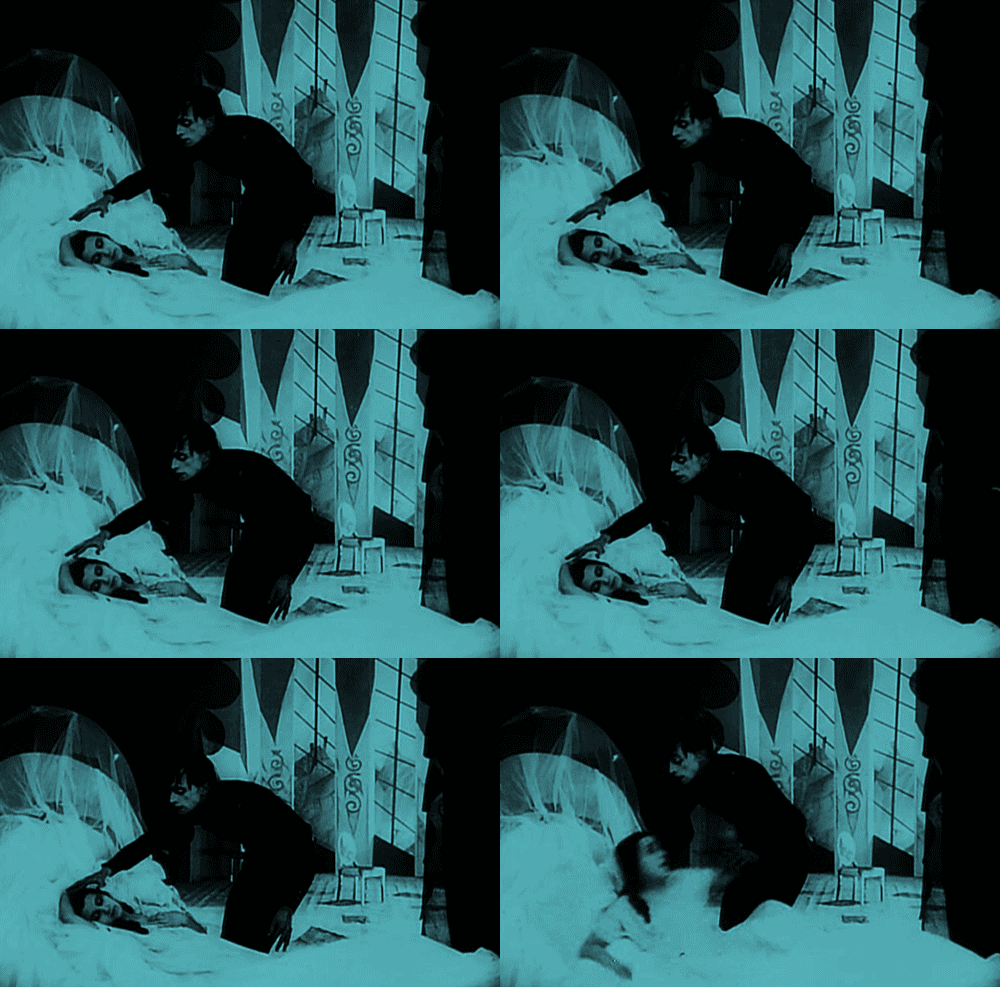
Showing posts with label The Cabinet Of Dr. Caligari (1920). Show all posts

Friday, January 22, 2021

Born Today January 22: Conrad Veidt


1893-1943


The "man with the face," probably one of the most recognizable of silent actors (though in roles only, not necessarily by his "street looks"), Hans Walter Conrad Veidt--known professionally by Conrad--was born on this day in Berlin.  It's hard to tell when Veidt became interested in acting, or even if he got into acting because of an actual interest, as opposed to not having many other career paths.  It is known that an early girlfriend from pre-World War I Germany was an actress.  The relationship ended when he was conscripted into the army in 1915, and sent to the German front.  It was not long before he became violently ill, which necessitated his evacuation to a secure hospital for recuperation. While in the hospital, he recieved a communication from his girlfriend informing him that she had been offered acting work in a theater away from Berlin. Upon his release, Veidt followed her, after applying for work at the same theater that had offered her a contract (that actress, by the way, was Lucie Mannheim, who probably best known to audiences by her appearance in Hitchcock's adaptation of The 39 Steps in 1935--though her career was a long one!).  He definitely worked for a time on the stage in what is now a city in Latvia along side Mannheim in 1916, but not for long. In late 1916, he was sent back into army service and ended his relationship with her for good. In early 1917, however, the army quickly determined that he was not fit enough for service, and quickly discharged him in full (it is entirely possible that this massive infection, which left him weakened by the age of 23, contributed to his premature death). By this time, he had little in the way of a career path to follow other than acting (not to say that he didn't have a passion for it, it just seems that contrary to some of the misleading biographical materials Veidt offered that are now known to have been "embellished" later on--under the circumstances, it seems his life was a bit "a drift" and acting offered a definite path).  What is sure, is that after this point he poured all of his energy into his acting career, which would result in some the most iconic appearances in films during the silent era (and, of course, in Casablanca)!  It would not take long for Veidt to make his first film appearance--he had such a face--and no film director would leave that go for long!! His debut came in a Robert Reinert crime film released in July of 1917: Wenn Tote sprechen (or When the Dead Speak).  Viedt of course has become synonymous with early/silent horror films, with at least two of them becoming two of the most well known silent films today, but his first horror feature was in a little known film that Veidt both directed and produced, as well as starred in. The film, Wahnsinn, which is sadly lost to us today, was produced under his own Veidt Films company (he and his company made one other film--Die Nacht auf Goldenhall (1920)--which is also lost). Of course, his earliest famous film performance was as Cesare in the super famous German expressionist film The Cabinet of Dr. Caligari directed by Robert Wiene and released in late February of 1920.  The film would seem to be the mark of his films career at first glance, but appearances are decieving here.  He actually appeared in over 30 films between his film debut and his role in Cabinet, including about half a dozen horror films (see: Eerie TalesSatanas a Murnau film in which he plays the devil/Lucifer amongst other characters & was written by Wiene, Der Graf von CagliostroNachtgestalten in which he foreshadowingly played a clown and Der nicht vom Weibe Geborene (1917) where is actually played Satan for the first time).  Viedt also appeared in another famous silent horror in 1920--another Murnau production:  The Head of Janus, a film almost as famous for being lost as it is being an "uncredited" version of Stevenson's Jekyll and Hyde story. Veidt, having gained a much deserved reputation as a moody actor, managed to branch out from such roles into crime films and even comedic roles (in playing Manolescu in Manolescus Memoiren, he managed to combine the two, and add historical acting into the mix to boot--since the film was based on the memoirs of George Manoluescu--which were presented with more than a little bit of humor).  Veidt was in another two Murnau films in 1921, the most famous of which is Journey into the Night--both men would later become much more famous in their adopted home town of Hollywood in the later half of the 1920's.  Though, aside from his role in Caligari, his most famous roles came in American films, but he didn't actually make his U.S. film debut until 1927 in the George Melford melodrama A Man's Past (though his appearance in the German production Gesetze der Liebe--co-directed by Richard Oswald probably Veidt's most prolific director during his career--came out after he left for California).  Viedt next film is probably his most famous full stop--especially now that . That of Gwynplaine/Lord Chancharlie in Paul Leni's The Man Who Laughs in 1928. The film was a production out of Universal and some prints were released as "sound films"--what we often call "partial silents" today. It's wider release was fully silent. The film is so much more than a "silent horror"--and it's cultural reach has been far and wide--the most enduring cultural connection that we continue to have even now coming up on 100 years later is that of The Joker from the Batman comics (it is worth pointing out that the most recent iteration of the character was in Todd Philips' Joker, released in October 2019, which garnered the largest number of 2020 Oscar nominations).  Gwynplaine is a "clownish" figure with a "fixed grin"--more like a horrifying "death sneer." This was a powerful enough visage as to completely insipire The Joker character in artistic the mind of Bob Kane & the literary mind of Bill Finger.  The film, along with Murnau's Nosferatu (1922), might be the most culturally continuous images from silent era (I am specifically using the term "images" because film, like no other medium, brought us images that were mass produced like no other--even the works of literature upon which they were based merely had the ability to "invoke" images--film instead projected the image...no need for the imagination [pun intended]--it's powerful stuff). In regards to other influences of The Man Who Laughs, I would be remiss if I didn't also mention William Castle's 1961 cheap thrills Mr. Sardonicus (the film was based on a novella that can only be called a knock off by Ray Russell, who also wrote the screenplay and became an in-house screen writer for Castle). With all of that aside, one of Veidt's best performances of his silent Hollywood career came in The Last Performance--it's a somewhat short feature, with relatively unremarkable performances by the other actors; it's basically a romantic melodrama with horror elements. The film employs a number German expressionist styled visuals, many (if not most) of which feature Veidt. Again, this performance inspired a number of visual images that have been reused much later on (I am not kidding that the late 1960's animated series Scooby Doo, Where Are You? drew famously from this film both in visuals and plots). The film was a partial silent with talking sequences (bit of trivia: Bela Lugosi dubbed Veidt's voice for the Hungarian version f the film).  During his time in Hollywood in the late 1920's, Veidt also worked as an acting tutor. Veidt returned to Germany and it's film industry with coming of the talkies, as he had such a heavy German accent that it did not "translate" well in English speaking roles.  He appeared in the German production The Last Company (Die letzte Kompagnie), a film a in series of films based on Prussian war exploits of the nineteenth century; to my knowledge it was his first speaking role in a German film. In 1930, he also appeared in the German language version of the British film The Love Storm, Menschen im Käfig, in which he appeared with Fritz Kortner and Tala Birell. During this time, Veidt also got the chance to play Rasputin in the Adolf Trotz directed Rasputin, Demon with Women (1932).  He did not stay there long however. Veidt's second marriage had been to a woman who both of aristocratic German and Jewish heritage; they had a daughter that was born in 1925. Though they divorced in 1932, the Nazi regime coming to power in 1933 was more than Veidt could stand; and he also married a Hungarian Jewish woman in 1933, that was more than the Nazi's would stand for. Veidt further inflamed the situation by filling out a questionnaire written up by Goebbels and imposed on the German film industry by listing his "race" as "Jew." He and his third wife fled the country for Britain, and then fled there for California at the start of World War II. He had spent the rest of the 1930's in the British film industry.  In 1940, he took the lead in The Thief of Bagdad, a joint U.K. and U.S. production with filming locations in both countries. He then settled back into life in California in 1941, including a return to the American film industry, where he had a contract stipulation that if he were offered Nazi roles, they must be completely villainous. He made an appearance in the Joan Crawford/Melvyn Douglas film A Woman's Face (1941) directed by George Cukor; and in the Humphrey Bogart comedic crime vehicle All Through the Night (1942).  He took the lead as identical twins in Nazi Agent in 1942, and his appearance in the Loretta Young film The Men in Her Life (1941) eerily matched his death just a few years later. My favorite from this period his career is the rather wacky comedy mystery Whistling in the Dark (1941) starring Ann Rutherford and Red Skelton. Of course, his turn as Major Heinrich Strasser in Michael Curtiz's Casablanca is the role everyone knows him for. Of the film, he remarked that thought it was a sad irony that his performance in the film was praised, when he was portraying the sort of character that had forced him from his homeland. It would also turn out to be his next to last film.  In the 1930's Veidt had discovered that he had inherited his mother's heart condition, combining that with possible damage done by massive illness during the first World War and his constant chain smoking, it was only a matter of time before the condition caught up with him, despite his taking nitroglycerin to lessen the strain in his heart. One afternoon in the spring of 1943, Veidt collapsed on the golf course while playing with, among others, his own personal physician. His doctor pronounced him dead at the scene; it was the 3rd of April and his was only 50 years of age. His last film, Above Suspicion, another Joan Crawford film, was released the same year.  He was cremated at Westwood Memorial and his ashes were originally interred at Ferncliff in New York, later moved (along with the ashes of his third wife) to the Columbarium at Golders Green in England in 1997.


Former niche at Ferncliff.

Current location at Golders Green


Wednesday, June 15, 2016

My Dark Obsession With Cesare (Reel Infatuations Blogathon)


WARNING: SPOILERS

The character of Cesare (Conrad Veidt) , the somnambulist in Das Cabinet des Dr. Caligari (known better here in the U.S. of The Cabinet of Dr. Caligari) might seem like a strange character that a crush like obsession might develop on the part of any cinephile.  But I simply can't seem to help myself.  He is the hapless the victim of the insane hypnotist Dr. Caligari (Werner Krauss).  His character is meant to represent the equally hapless soldier of war, conditioned to kill, by the insanity of government hell bent on waging war.  The film's conception as an allegory came from two German pacifists during the first world war, Hans Janowitz and Carl Mayer--who wrote the film.  Though the allegory can quickly get lost in the pure strangeness of the sets (designed by Herman Warm), and the odd manner of the way the characters move around in them.  It was Cesare's movement that first caught my attention as a child.  Over time, this grew into a pathos that lead to a crush in my teens.  Over the years, that obsession only deepened every time a viewed the film.  He is presented as utterly pathetic; a side-show freak that is the embodiment of the helpless human automaton, doing the bidding of a man that displays demonic motivations.  That's when the pathos started.

Cesare Awakes!

In his side show at the local fair, the "good" Dr. presents Cesare in a coffin like box, propped up on stage. He informs his audience that he is the only person who can rouse Cesare, and that when he does this, Cesare answers questions about the future with truthful predictions.  Cesare, he tells them, has been asleep for 23 years.  The rousing process is frightening, only because Cesare does in no way looks as though he faking a thing.  At Caligari's commandment, Cesare twitches, his mouth opens slightly and finally his eyes open.  After this his hands come up (think Frankenstein's monster) and he is commanded to walk out of his "cabinet."  He is now able to speak.  Amongst the audience are two young men, best friends, both of them sweet on the same young woman .  One of them, against the advice of the other, asks Cesare how long he will live; in an unflinching, but still slightly pathetic expression, he answers "until dawn."  The audience reacts with complete fear and revulsion--the young men flee.  The film presents Cesare as an almost supernatural slave--a man caught not just in nightmare state, unable to wake on his own, and equally unable to stop the predictions that come as answers--only to be returned to his zombie like existence and sealed up in his "pine box."  It's a powerful image that can easily turn into allure on the part of the viewer.  It's the classic, "I need to save him."


Later, during the dead of night, shown in deepest hues of blue, we see the shadow of a figure wielding a knife, who then kills the young man whose death was predicted by Cesare.  The shadow appears to resemble Cesare, but this certainly cannot be the case, as Dr. Caligari has put his hapless somnambulist back in his "cabinet."  Eventually, another member of the village is detained by police for the murder; though it is clear his visage bears no resemblance to the shadow seen murdering the young man.  The viewer then begins to think, "is the evil Dr. using Cesare as murder weapon against Cesare's will?"  If so, what sort of hell must Cesare live in for the brief periods that Caligari allows him consciousness??  The police wonder this as well and have questions.  Again, with me, that only increased my sense of slightly erotic sympathies toward Cesare.  How did this hapless soul come to be in such a state?

Cesare being examined by the police.

When next we see Cesare, Dr. Caligari opens up the casket like cabinet, sits the unconscious Cesare up, and feeds him.  He then lays him back down and closes him back up.  If there were any doubts about the true state that Cesare is in, any suspicions that he is in on any sort of trick or fraud, this scene puts them all to bed, so to speak.  Just after this, the police show up and demand that they be allowed to examine the somnambulist.  Caligari is at first uncooperative, but eventually allows them to into his caravan.  The Dr. opens the cabinet again and the police sit Cesare up; they then proceed to poke and prod him in a very unprofessional manner--demanding that Caligari wake him up--which he successfully refuses to do.  Again, the sympathy for Cesare, the helpless automaton, trapped in what must surely be a nightmare world, from which he cannot wake, wells up.  How much is he aware of his surroundings when in this state?


Throughout various points in the film, scenes depicting the young woman--that object of affection of the two young men--one of them now dead, are woven into the story.  Her domestic life, her learning of the death of the young man and that he died by murder, and finally a her frantic search for her missing father.  This draws her ever closer to the Dr.  She shows up at Caligari's fair tent inquiring if he's seen her father.  Caligari has other plans.... He has Cesare set up for yet another show, he then opens the cabinet to reveal the sleeping man to young Jane.  She looks confused, then scared.  He commands Cesare to wake, which he does.  Cesare takes long and genuinely chilling stare at her, culminating in a face to face stare.  She becomes so livid with fear that she runs.  What Caligari thinks he's up to here, is unclear; but Cesare seems to have shown his first act of thinking for himself.  He notices her on his own terms, not Caligari's.  This further complicates the state that Cesare "lives" in.  Clearly he is a kind of zombie, but not one that couldn't be rescued.  He shows some of his own personality, if even for a fleeting second.


What happens next makes it crystal clear that Caligari is using Cesare as a murder weapon--though what the Doctor's motives are never come to light.  He wakes Cesare and sends him off to murder Jane, just as he obviously had with her young suitor.  Cesare sneaks into her bedroom, knife in hand, having been instructed to kill her.  He raises the knife, but then stops, suddenly having another moment of a kind of lucidity.  He sees that this is the same person that he had come face to face with earlier in the day.  He is clearly struck by her, perhaps even attracted to her.  What he does next looks truly horrifying to the viewer, but it is the first time that poor Cesare acts on his own motivation.  He violently grabs her, waking her in a state of terror, and drags her from her house, through the maze of blue streets, into the dark woods.  It looks every bit the horror film that it is, yet Cesare seems to only be motivated to save her.  In the process, the burden of her weight gets the better of him and he collapses, allowing the young woman to escape back into the safety of the village, to villagers that are searching for her.  Seeing his game is up, Dr. Caligari flees, but not before being chased by the surviving young suitor.


Later films like Tim Burton's Edward Scissorhands, draw some direct inspiration from Cesare's behavior; though, of course, Edward is not bidded to murder anyone and is obviously mostly a re-working of Frankenstein.  Still it's hard not to have a similar progression with Edward, starting with the pathos, and eventually ending in falling for him.  Dr. Caligari, though, unlike "The Inventor" (Vincent Price) in Edward Scissorhands, presents Cesare as a constantly sleeping individual, completely under his power. Only Carligari (who is a repulsive as Cesare is alluring, despite the deep markings around his eyes) claims the ultimate power to wake him and command him to speak.  Still the comparison in look, progression of helplessness and ultimate tragedy the similarlities between Cesare and Edward are stark.


The film takes a turn for the truly bizarre at this point.  We, the viewer, are left not knowing what has become of poor Cesare.  The young man chasing Caligari follows him to what turns out be an insane asylum.  He inquires within if they have a patient named Caligari, never asking about Cesare.  The staff look confused and say "no." He is then told that he should consult the director of the asylum.  On entering the director's office he sees that director and "Dr. Caligari" are the same person.  He flees.  He manages to convince the authorities that they should check the director of the asylum while searching for Caligari.  Sneaking into the director's office at night while he sleeps, they pour over his books, eventually finding an old Italian tome entitled "The Cabinet of Dr. Caligari" about a hypnotist and his somnambulist in a box.  Suspecting that the Cesare from the book was the invention of the director and the Cesare that they saw in his cabinet, might be an inmate of the asylum, they search the woods. At this point in the film my sense of affection for "Cesare," as we must now put his name in quotation marks--since his actual name is unknown--only increases.  What has become of this poor, exploited individual??  The next morning, they confront the director with the lifeless body of "Cesare" and he goes completely mad, screaming that his own personal obsession is now gone.  It turns out I am not alone in my obsession with Cesare.  But now, this poor soul is lost--there will be now saving him; and empathy and allure turn to grief.  


But how can this be?  How is a director of a prominent insane asylum so stricken the mental illness himself?  Is it all in his imagination?  He he driven himself mad with obsession to plumb the dark depths of an ancient form of hypnotism?  Or is something else going on all together?  The answer is, unfortunately, the later.  The film suddenly, very abruptly (!), changes--we see everyone that was in the village are actually inmates of the asylum, even Jane.  That the story teller, the young man that chased Caligari to the institution, is in fact the one that is deeply delusional.  The director, having realized that the young man has taken him for the mythical Italian Dr. Caligari, has just provided him with a means to treat the delusional man; to release from his nightmare world peopled with friends that are not friend, women who don't actually love him, and zombies that predict the future.  As to "Cesare," as the viewer follows the movement of the babbling young man amongst his fellow inmates, there is the poor tortured soul, standing picking flowers against a wall.  He is clearly deeply ill and possibly mute.  We never learn his name, we never know his malady, we only see that he is harmless and helpless.  It's enough to bring a viewer who cares to tears.


All the credit here goes to Conrad Veidt, who plays Cesare/Unnamed Mental Patient.  He hits every facial feature needed to heightened both horror and helplessness, sometimes at the same time.  It is a far cry from The Joker character that he would inhabit some eight years later in Paul Leni's The Man Who Laughed!  Veidt was an actor with considerable talent and range; the sort of thespian who could just fall into character and one has trouble seeing that it the same person from role to role.  In this case, his portrayal, even in a silent film, of a character(s) that basically has no lines is masterful.  Enough to cause viewers to become lovingly obsessed.