Showing posts with label Conrad Viedt. Show all posts

Friday, October 28, 2022

October 28: Unheimliche Geschichten (Uncanny Stories)


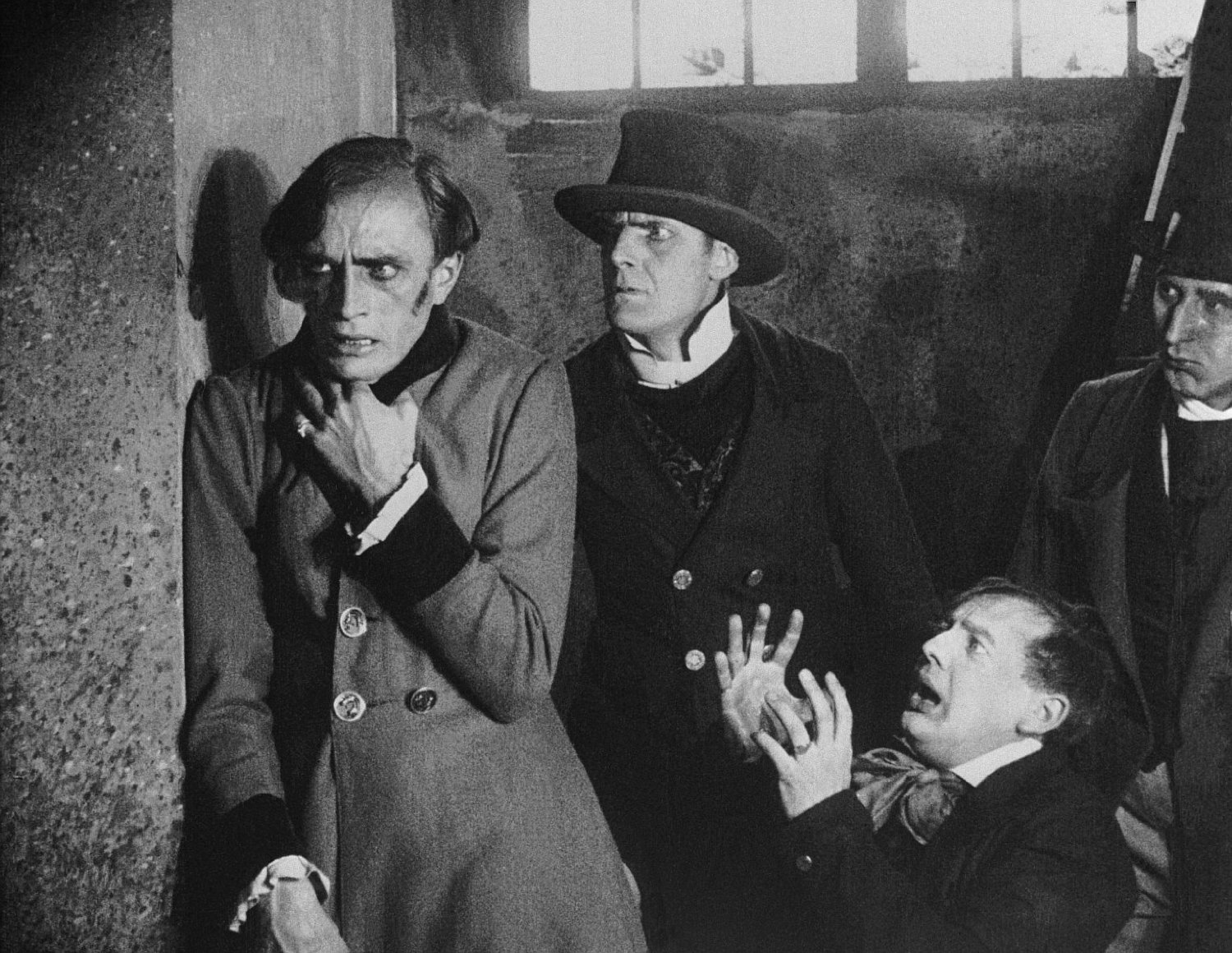
Germany's Unheimliche Geschichte or Grausíge Nächte (Horrible Nights) is the earliest horror anthology; released in 1919 and containing five distinct stories with a sixth frame story. Three of the five stories were written by well known writers of the gothic: Edgar Allan Poe, Robert Louis Stevenson and Germany's own Anselma Heine. Director Richard Oswald provided a fourth story with "Der Spuk" (The Spectre). The fifth writer, Robert Liebmann was on the cusp of establishing himself as an important screenwriter in the country when he provided a story for the film; he would go on to be one of the most successful screenwriters of 1920's German cinema (he would later die at the age of just 52 in 1942 because he was Jewish). The most famous cast member (by far!) is Conrad Veidt, who not only appears as Death in the prologue, but also has roles in the individual stories themselves. The other two principle players appearing in all of the stories are Anita Berber and Reinhold Schünzel.  The director himself makes a cameo in the prologue as well; in what would become a the norm for director cameos, he went uncredited. 


The director in the middle with his two principle male players


The film's original runtime was 112 minutes (or 1 hour 52 minutes), with DVD releases having it cut to 98 minutes. The five principal stories as follows:


The Apparition by Anselm Heine

The Hand by Robert Liebmann

The Black Cat by Edgar Allan Poe

The Suicide Club by Robert Louis Stevenson

The Spectre by Richard Oswald


The film goes by several different translated names in English, including:  Eerie Tales, Five Sinister Stories, Weird Tales, Tales of Horror and Tales of the Uncanny. The film is not just a milestone as the very first horror anthology movie, it is also an oft over-looked early film of German expressionism. Though the direction style is not as outlandish as Murnau or Wiene, it is a very important work in the vein of gothic silent cinema in Germany, a great example of a work that gave ideas to the imagination of later films of Expressionism. Oswald would remake the film in 1932 with full sound as The Living Dead with Paul Wegener as the principle actor. 


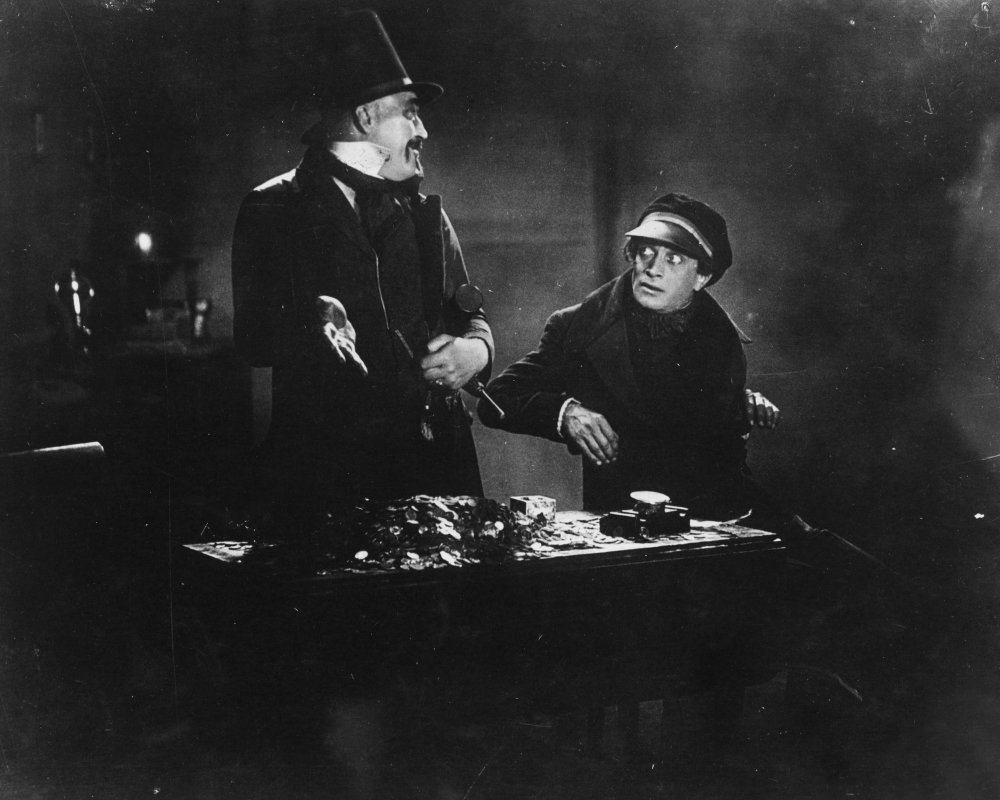
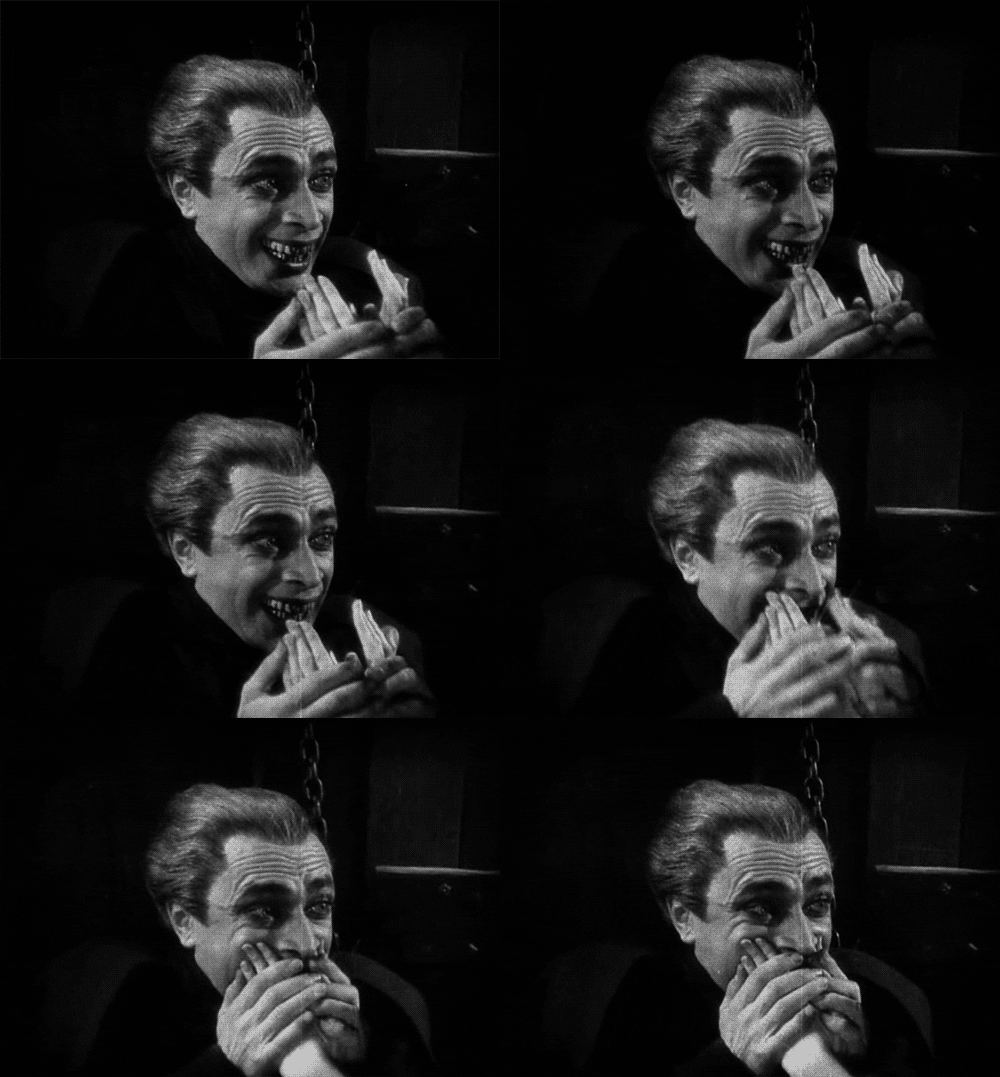
A Few Stills & GIFs


Gr

Tuesday, October 4, 2022

October 4: Brief Notes on The Man Who Laughs (1928)


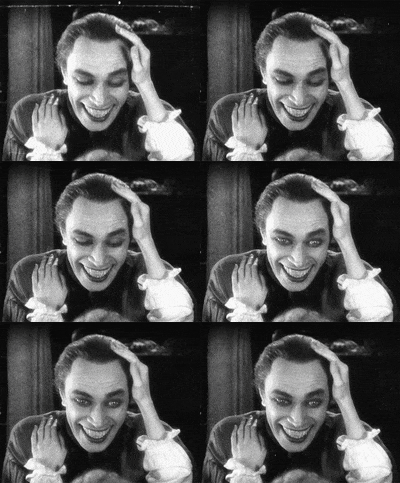
As far as silent horror films go, The Man Who Laughs is one of the most widely known, it's popular recognition falls only behind the likes of Nosferatu (1922) and The Phantom of the Opera (1925).  A myriad of trivia is regularly tossed out in regards to the film, including that is actually a Universal horror film (making Gwynplaine a "Universal monster"), and, most famously of all, that the character/visage of Gwynplaine was the inspiration for the Joker character in the DC Batman comics.  And, it arguably remains the best adaptation of a Victor Hugo novel. I wanted to breifly touch on just a few lesser known aspects of the film (including a few personal notes of favor on my part); elements that make the film a true milestone in the world of cinema.


The first important aspect of the production being a Universal film: Universal was the studio that gave us the 1923 Hugo adaptation The Hunchback of Notre Dame starring the great chameleon Lon Chaney. It was such a success that the studio fully intended to have him star in another Hugo adaptation of L'homme qui rit, this was the first step at Universal to put the film, translated into English as The Man Who Laughs, into production. There was even a contract drawn up with Chaney; but the studio had failed to acquire the rites to the novel for film adaptation from the French studio that owned them. The result was that the project was shelved and Chaney's stared in the now extremely famous production of The Phantom of the Opera instead. The success of that film allowed German ex-pat producer Carl Laemmle to return to The Man That Laughs project with complete control of the production. He wasted no time in hiring a bevy of fellow Germans for the production, including Conrad Veidt, who who effectively lured to Hollywood by the studio; and director Paul Leni. He too had been brought to Hollywood by Laemmle. To round out the cast, Mary Philbin (most definitely an American thespian!), who appeared as the female lead in Phantom, was cast as Dea.


Leni got his start--like so many directors of late 1920's gothic films turned out of American studios--as an expressionist director in Germany. His direction of the expressionist master-class Das Wachsfigurenkabinett (Waxworks) had garnered international attention and prompted Laemmle to hire him for Universal. By the time that he was brought on to this Hugo project, he had already directed two mystery films for Universal (the Charlie Chan vehicle The Chinese Parrot and The Cat and the Canary--now a late 20's horror classic). Leni was as "arthouse" as they came (his Rebus shorts, initially shot as theatrical "extras," are/were partially or fully animated avant-garde films--at least one of which survives), but his first two Hollywood efforts showed the constraints of such a director working in the money machines that were the Hollywood studios. The Man Who Laughs however shows that he was finding his place. The film contains much of his pre-Hollywood direction style and hints at great works to come (even with the coming of sound). Alas, this was not be. Leni died in 1929 at just the age of 44 from sepsis brought on my a tooth infection of all things. It was a huge loss to the art of filmmaking!


Another interesting little point of trivia of the film is that having been made and released right on the cusp of all sound films, a partial soundtrack was later made for the film with the brand new (and quickly monopolistic) Movietone sound system. This simplistic soundtrack, which mostly consisted of tones from bells and knocks, with the occasional brass flourish, was constructed around the song "When Love Comes Stealing." 


In regards to the plot of film, there are those who consider it a dark romance, or work of strange tragedy; even a few who dispute it being any type of horror film at all. This despite it's undeniable gothic foundations.  For me personally, it is a film about the horror of being ostracized by society, of being an outcast, a rejected human being. If you have endured even the mildest of bullying in a school environment or any situation where a bad actor has agency or power over you, then you know first hand this is indeed a horror film. The horror of institutional shame, and the desperate need to flee from it, are the things post traumatic stress are made of. So for me, a person who lives with PTSD, this is high on my list of scariest horror films out there. It is also high of my list of the best of the best horror ever made in these United States. Sad, sickening and devastatingly beautiful!


Wednesday, October 27, 2021

Spooktaober 27: The Head of Janus (1920)


I know... this is two Conrad Veidt films in as many days, but this lost gem is so much more.  It has connections to so many other really famous horror and near horror films (Karl Freund was the chief cinematographer), many of them amongst the most well known silents films out there. The most recognizable connection is that it's a Murnau film from 1920. Murnau needs no introduction; he was famous in his native Germany and later in his adopted United States. Veidt would follow a similar path, via the U.K. But, it is yet another player in this silent German adaptation of Stevenson's Jekyll And Hyde, who became a much bigger fixture the American psyche than Veidt or Murnau combined who is of interest here: Bela Lugosi. Lugosi who was famously Hungarian, born in what is now Romania and a World War I veteran, made his way to Germany after the war (he had already appeared in a Hungarian production directed by future Casablanca director Michael Curtiz), where he appeared in a handful of films, including this one. The film is lost, but stills do survive. We are fortunate that one of them contains Lugosi in his role as Dr. Warren's Diener. 


Tuesday, October 26, 2021

Spooktober 26: Der Student von Prag (1926)


Celebrating 95 years of the 1926 release of Der Student von Prag (The Student of Prague), directed by Henrik Galeen and starring Conrad Veidt.


Saturday, October 23, 2021

Spooktober 23: The Man Who Laughs (1928)


Paul Leni is one of my favorite directors, and Conrad Veidt one of my favorite actors. This 1928 send up of Victor Hugo's 1869 novel is one of the most influential and tragic films from the 1920's of any genre, and pairs the two with perfection. So influential was it, that it gave the world the visage of The Joker in the Batman comic book series from DC; not to mention a whole host of other characters by fans of the film who would go onto the make films themselves (see, for example, William Castle's Mr. Sardonicus). The film was released as fully silent film at first, only to be reworked as a partial sound film with an original score and sound effects a year later. There was never any added dialogue however. Veidt's on screen acting career would go on to hit a rocky road for a time with the coming of sound due to his thick German accent. His performance as Gwynplaine in The Man Who Laughs remains, however, one of the most well known and memorable in cinema history. 


Friday, January 22, 2021

Born Today January 22: Conrad Veidt


1893-1943


The "man with the face," probably one of the most recognizable of silent actors (though in roles only, not necessarily by his "street looks"), Hans Walter Conrad Veidt--known professionally by Conrad--was born on this day in Berlin.  It's hard to tell when Veidt became interested in acting, or even if he got into acting because of an actual interest, as opposed to not having many other career paths.  It is known that an early girlfriend from pre-World War I Germany was an actress.  The relationship ended when he was conscripted into the army in 1915, and sent to the German front.  It was not long before he became violently ill, which necessitated his evacuation to a secure hospital for recuperation. While in the hospital, he recieved a communication from his girlfriend informing him that she had been offered acting work in a theater away from Berlin. Upon his release, Veidt followed her, after applying for work at the same theater that had offered her a contract (that actress, by the way, was Lucie Mannheim, who probably best known to audiences by her appearance in Hitchcock's adaptation of The 39 Steps in 1935--though her career was a long one!).  He definitely worked for a time on the stage in what is now a city in Latvia along side Mannheim in 1916, but not for long. In late 1916, he was sent back into army service and ended his relationship with her for good. In early 1917, however, the army quickly determined that he was not fit enough for service, and quickly discharged him in full (it is entirely possible that this massive infection, which left him weakened by the age of 23, contributed to his premature death). By this time, he had little in the way of a career path to follow other than acting (not to say that he didn't have a passion for it, it just seems that contrary to some of the misleading biographical materials Veidt offered that are now known to have been "embellished" later on--under the circumstances, it seems his life was a bit "a drift" and acting offered a definite path).  What is sure, is that after this point he poured all of his energy into his acting career, which would result in some the most iconic appearances in films during the silent era (and, of course, in Casablanca)!  It would not take long for Veidt to make his first film appearance--he had such a face--and no film director would leave that go for long!! His debut came in a Robert Reinert crime film released in July of 1917: Wenn Tote sprechen (or When the Dead Speak).  Viedt of course has become synonymous with early/silent horror films, with at least two of them becoming two of the most well known silent films today, but his first horror feature was in a little known film that Veidt both directed and produced, as well as starred in. The film, Wahnsinn, which is sadly lost to us today, was produced under his own Veidt Films company (he and his company made one other film--Die Nacht auf Goldenhall (1920)--which is also lost). Of course, his earliest famous film performance was as Cesare in the super famous German expressionist film The Cabinet of Dr. Caligari directed by Robert Wiene and released in late February of 1920.  The film would seem to be the mark of his films career at first glance, but appearances are decieving here.  He actually appeared in over 30 films between his film debut and his role in Cabinet, including about half a dozen horror films (see: Eerie TalesSatanas a Murnau film in which he plays the devil/Lucifer amongst other characters & was written by Wiene, Der Graf von CagliostroNachtgestalten in which he foreshadowingly played a clown and Der nicht vom Weibe Geborene (1917) where is actually played Satan for the first time).  Viedt also appeared in another famous silent horror in 1920--another Murnau production:  The Head of Janus, a film almost as famous for being lost as it is being an "uncredited" version of Stevenson's Jekyll and Hyde story. Veidt, having gained a much deserved reputation as a moody actor, managed to branch out from such roles into crime films and even comedic roles (in playing Manolescu in Manolescus Memoiren, he managed to combine the two, and add historical acting into the mix to boot--since the film was based on the memoirs of George Manoluescu--which were presented with more than a little bit of humor).  Veidt was in another two Murnau films in 1921, the most famous of which is Journey into the Night--both men would later become much more famous in their adopted home town of Hollywood in the later half of the 1920's.  Though, aside from his role in Caligari, his most famous roles came in American films, but he didn't actually make his U.S. film debut until 1927 in the George Melford melodrama A Man's Past (though his appearance in the German production Gesetze der Liebe--co-directed by Richard Oswald probably Veidt's most prolific director during his career--came out after he left for California).  Viedt next film is probably his most famous full stop--especially now that . That of Gwynplaine/Lord Chancharlie in Paul Leni's The Man Who Laughs in 1928. The film was a production out of Universal and some prints were released as "sound films"--what we often call "partial silents" today. It's wider release was fully silent. The film is so much more than a "silent horror"--and it's cultural reach has been far and wide--the most enduring cultural connection that we continue to have even now coming up on 100 years later is that of The Joker from the Batman comics (it is worth pointing out that the most recent iteration of the character was in Todd Philips' Joker, released in October 2019, which garnered the largest number of 2020 Oscar nominations).  Gwynplaine is a "clownish" figure with a "fixed grin"--more like a horrifying "death sneer." This was a powerful enough visage as to completely insipire The Joker character in artistic the mind of Bob Kane & the literary mind of Bill Finger.  The film, along with Murnau's Nosferatu (1922), might be the most culturally continuous images from silent era (I am specifically using the term "images" because film, like no other medium, brought us images that were mass produced like no other--even the works of literature upon which they were based merely had the ability to "invoke" images--film instead projected the image...no need for the imagination [pun intended]--it's powerful stuff). In regards to other influences of The Man Who Laughs, I would be remiss if I didn't also mention William Castle's 1961 cheap thrills Mr. Sardonicus (the film was based on a novella that can only be called a knock off by Ray Russell, who also wrote the screenplay and became an in-house screen writer for Castle). With all of that aside, one of Veidt's best performances of his silent Hollywood career came in The Last Performance--it's a somewhat short feature, with relatively unremarkable performances by the other actors; it's basically a romantic melodrama with horror elements. The film employs a number German expressionist styled visuals, many (if not most) of which feature Veidt. Again, this performance inspired a number of visual images that have been reused much later on (I am not kidding that the late 1960's animated series Scooby Doo, Where Are You? drew famously from this film both in visuals and plots). The film was a partial silent with talking sequences (bit of trivia: Bela Lugosi dubbed Veidt's voice for the Hungarian version f the film).  During his time in Hollywood in the late 1920's, Veidt also worked as an acting tutor. Veidt returned to Germany and it's film industry with coming of the talkies, as he had such a heavy German accent that it did not "translate" well in English speaking roles.  He appeared in the German production The Last Company (Die letzte Kompagnie), a film a in series of films based on Prussian war exploits of the nineteenth century; to my knowledge it was his first speaking role in a German film. In 1930, he also appeared in the German language version of the British film The Love Storm, Menschen im Käfig, in which he appeared with Fritz Kortner and Tala Birell. During this time, Veidt also got the chance to play Rasputin in the Adolf Trotz directed Rasputin, Demon with Women (1932).  He did not stay there long however. Veidt's second marriage had been to a woman who both of aristocratic German and Jewish heritage; they had a daughter that was born in 1925. Though they divorced in 1932, the Nazi regime coming to power in 1933 was more than Veidt could stand; and he also married a Hungarian Jewish woman in 1933, that was more than the Nazi's would stand for. Veidt further inflamed the situation by filling out a questionnaire written up by Goebbels and imposed on the German film industry by listing his "race" as "Jew." He and his third wife fled the country for Britain, and then fled there for California at the start of World War II. He had spent the rest of the 1930's in the British film industry.  In 1940, he took the lead in The Thief of Bagdad, a joint U.K. and U.S. production with filming locations in both countries. He then settled back into life in California in 1941, including a return to the American film industry, where he had a contract stipulation that if he were offered Nazi roles, they must be completely villainous. He made an appearance in the Joan Crawford/Melvyn Douglas film A Woman's Face (1941) directed by George Cukor; and in the Humphrey Bogart comedic crime vehicle All Through the Night (1942).  He took the lead as identical twins in Nazi Agent in 1942, and his appearance in the Loretta Young film The Men in Her Life (1941) eerily matched his death just a few years later. My favorite from this period his career is the rather wacky comedy mystery Whistling in the Dark (1941) starring Ann Rutherford and Red Skelton. Of course, his turn as Major Heinrich Strasser in Michael Curtiz's Casablanca is the role everyone knows him for. Of the film, he remarked that thought it was a sad irony that his performance in the film was praised, when he was portraying the sort of character that had forced him from his homeland. It would also turn out to be his next to last film.  In the 1930's Veidt had discovered that he had inherited his mother's heart condition, combining that with possible damage done by massive illness during the first World War and his constant chain smoking, it was only a matter of time before the condition caught up with him, despite his taking nitroglycerin to lessen the strain in his heart. One afternoon in the spring of 1943, Veidt collapsed on the golf course while playing with, among others, his own personal physician. His doctor pronounced him dead at the scene; it was the 3rd of April and his was only 50 years of age. His last film, Above Suspicion, another Joan Crawford film, was released the same year.  He was cremated at Westwood Memorial and his ashes were originally interred at Ferncliff in New York, later moved (along with the ashes of his third wife) to the Columbarium at Golders Green in England in 1997.


Former niche at Ferncliff.

Current location at Golders Green