Showing posts with label Paul Wegener. Show all posts

Friday, October 29, 2021

Spooktober 29: Alraune [A Daughter of Destiny] (1928)


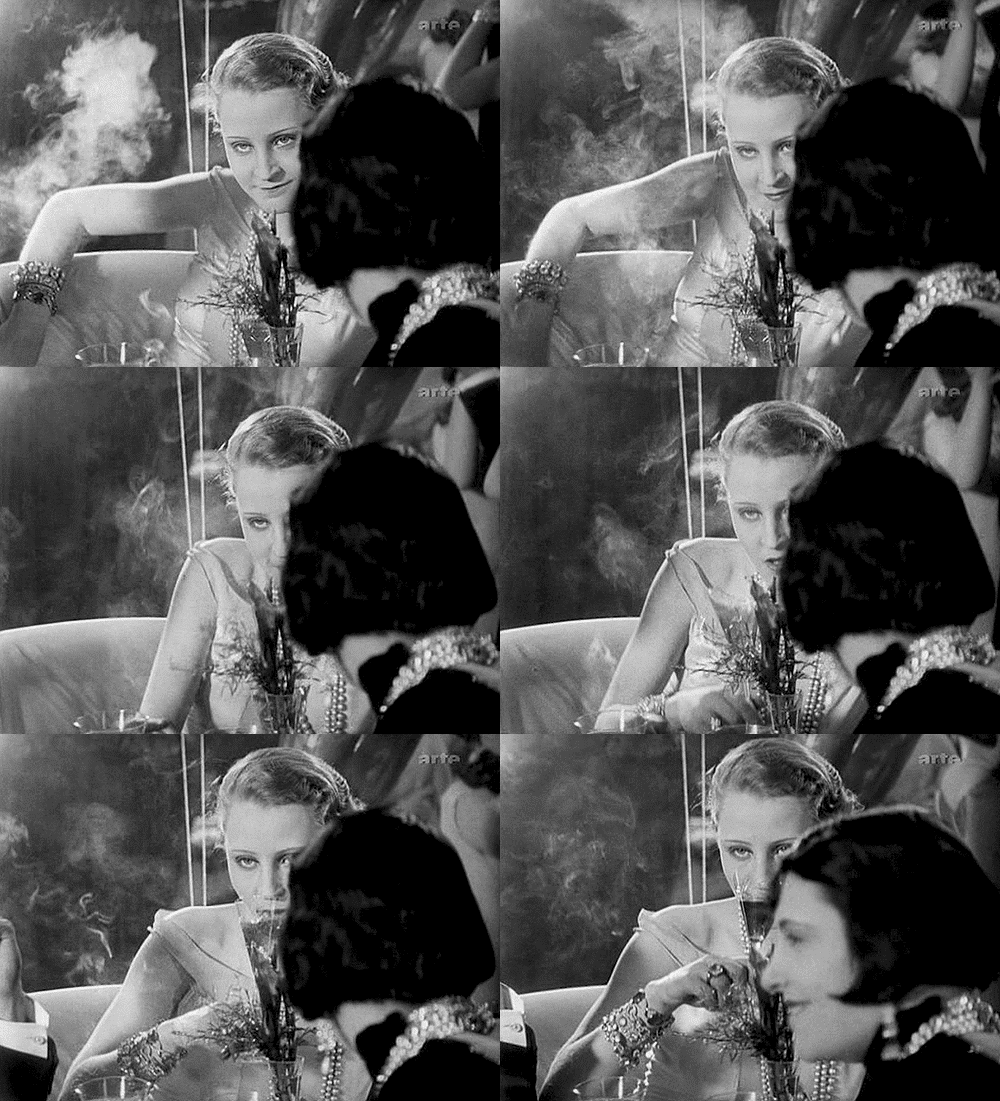
One of the last great silent horror films before the coming of sound Alraune was also one of the last silent films in the Frankenstein story vein, Alraune (also known in English by the title A Daughter of Destiny) was released in Germany at the beginning of 1928 and in the U.S. later that spring.  Despite it's clear influence from and general association with the Mary Shelley novel, the core story, and, indeed, the title itself come from an entirely different novel altogether. The novel Alraune (translation "mandrake" hence the tangled roots prominently featured in several posters) by Hanns Heinz Ewers was published in 1911 as a fully illustrated affair and was based on a German fold tale that dates from the Middle Ages (and I cannot help but mention the anti-Semitic nature of several of the illustrations in that novel despite that it's author claimed not to be an avowed anti-Semite later when he became involved with National Socialism [only to be quickly ostracized and banned], something that is conspicuously absent in the film). Though the novel draws from the folk tale, it updates it into a horrific scientific setting that was clearly a nod at least (if not an out-and-out rip off) of the Frankenstein story published nearly a hundred years before it.  The film further draws from the Shelley invention in the form of a mad scientist like professor played by Paul Wegener. The story then hews much closer to the old belief that mandrakes, which were thought to be the spawn of hanged men, where used by witches to bear soulless children. In the film an experiment is performed by the professor on a prostitute using the same belief, the result is the unnatural offspring Alraune. Brigitte Helm, famous for her starring role in Metropolis, plays the female monster, who grows to adulthood in an unnaturally short period of time and shows all the the signs of being a soulless woman corrupted not just by an unnatural birth, but also by her adoption by the professor, who is playing in God's own arena. To contrast her willingness to engage in shocking behaviors, the story has her sent off to a convent, where things...well let's just say...don't go well for the nuns there. Though the film has very creepy imagery, there is very little straight out horror in it. It is, instead, a kind of morality tale that cautions against the evils of drink, gambling and other vices of "low living." The director was Henrick Galeen, and his is considered the most sexually explicit to date of the handful of adaptations of the Ewers novel (as the first poster above attests), and firmly ensconces Helm into the ranks of the "vamp" (as was made so wildly popular int he 1910's by Fox's Theda Bara). It also thoroughly and successfully turns an old supernatural folk tale into a work of solid science fiction. Helm would replay the role again in 1930 in a sound version directed by Richard Oswald (see the middle poster above). Galeen's Alraune has been compared to some of the best German Expresionist films of the decade, including The Cabinet of Dr. Caligari  and Nosferatu


Monday, October 25, 2021

Spooktober 25: The Magician (1926)


 Celebrating 95 years of Rex Ingram's The Magician, a 1926 MGM release! 

[note: I had planned a much more fleshed out post for this, but I simply cannot get blogger to cooperate. It pains me, it really does, this used to be such a user friendly platform for us blogging non-professional types. 😖]


Monday, October 11, 2021

Spooktober 11: The Golem And The Dancing Girl (1915)


I know it was only a few days ago that I featured another Paul Wegener film, albeit a much more obscure one, but this little lost dainty is worth the mention because it ranks as one of the very first horror comedies intentionally made. Some consider it the very first; but I would argue that Méliès had once again beat everyone to it. In fact, Méliès' The House of the Devil [rough translation] which was released in 1896 and is credited as the first intentional horror film, is at it's core also a comedy; or at least a farce. And so too is Wegener's 1917 The Golem and the Dancing Girl (Der Golem und die Tänzerin). Part of his "Golem trilogy," it along with his first 1915 Golem film, are listed among the lamentably lost films from the silent era. This Golem film is more lost than is Wegener's first (if that is the proper way of stating that); Dancing Girl is so lost that only a few stills exist and just the barest outline of the plot is known. What is known is that Wegener once again braves the Golem makeup, as he would again in 1920, only he is playing the actor who portrayed the monster in the first film...an actor playing an actor who is spoofing a third role. The actor dresses up as the monster for a party to impress a female actress in attendance...only things don't go as planned. Apparently, hilarity ensued. It is such a shame that one of the first fullest horror spoofs is no longer a part of a our cinema choices today; so many films from The Bride of Frankenstein to the Evil Dead movies are in the long line of spoofs and comedies to enrich the world of (horror) cinema decades later; they all have their genesis in films like this one. Of course, Wegener's 1920 Golem prequel does survive, and it considered one of the great German silent horror films along with the likes of Nosferatu and The Cabinet of Dr. Caligari


Sunday, May 3, 2020

Born Today May 3: Niccolò Machiavelli


1469-1527

Famous (or infamous, depending on how you look at him) political philosopher Niccolò Machiavelli was born on this day in the independent Republic of Florence in what is now Italy (birth name: Niccolò di Bernardo del Machiavelli). Machiavelli's father was a very prominent local attorney and town/republic citizen servant of Florence. Despite this, and the prominence of the ancestry of the family, Niccolò was never a full citizen of the republic. He was, however, eventually appointed to an official position of production of official Florentine government documents sometime after the year of 1498; he was then elevated to secretary of the Deci di Libertà e Pace. In the first year of the new century, Machiavelli actually raised and led an army of patriotic Florentine citizens, with their attack and defeat of neighboring Pisa. Of course, the writer is most famous for his work The Princea very famous/infamous political work first published in 1532--five years after his death. What needs to be pointed out, is that Machiavelli, though living during the Italian Renaissance, the years spanning his lifetime were also extraordinarily uncertain, violent, and extremely corrupt. Italy was groaning under the strain of an extant and politically corrosive rule from the Vatican--an extension of attempts at continued rule from Rome, the rise of secular city/states and the violent crumbling of the Holy Roman Empire. It should also be pointed out that The Prince can be read as a vicious satire; though if any reader of Machiavelli's works has read his follow up work to The Prince, Discourses on Livy--which masquerades as a history on Ancient Rome--and turns out to be anything but....it is, in fact, more a pure contemporary theory of political thought and conduct--it is clear that he did actually mean a good deal of the "advice" contained in The Prince. Basically, he regarded naked political ambition--open evil behavior to remain in power--more an exercise in a form of honesty, since he firmly believed that politicians were by nature: sneaky, dishonest and secretly criminally minded. To be a politician or ruler, free of "sneaking deception"--a person willing to openly engage in any behavior to stay in power--was a point of recommendation by the philosopher. He is also regarded as one of the most influential advancers in thought to the modern rule of Republicanism.  In the world of film, there have been less the twenty productions of his work on the large and small screen; and only one of those came in the silent era.  That film, Monna Vanna, was a German production and dates from 1922.  The principle writer on that project was one of Germany's first female writers for the screen Olga Alsen. The film stars Paul Wegener--who is famous for his appearances in The Golem films, and Lee Parry--a German leading lady who made her film debut in 1919. The work is based on one of Machiavelli's many fictional/non-political works (a play) and was directed by Richard Eichberg.  It would be almost 20 years before another film based on his work was produced.  The first ever Italian production of one of his fictional tales, The Mask of Cesare Borgia was released in late September of 1941.  His work first came to television another 20 years after this, with the made-for-tv comedy Mandragola which was produced for East German television and broadcast in late May of 1961.  One of the only times that any of his political writings was used in a filmed production was also the first time that his work was used in an actual television series--in this case a mini-series.  The Age of the Medici (1972-1973) was an Italian production with three episodes (and was, interestingly, the debut of American actor Fred Ward).  While the debut of his work in a full television series came in 1976 in the episode La Mandragore of the long running French series Au théâtre ce soir.  To date, the most recent use of his material came in 2010 in the short Canadian produced film Machiavelli's The Prince, which sports a runtime of 30 minutes. Machiavelli's downfall came in 1512, when after a local political upheaval, he was eventually arrested and tortured. After his release, he was effectively banished from Florence for a time (though, he himself, more than once referred to it as "retirement").  He eventually returned to die in the Republic of Florence (of what is not certain) at the age of 58 on the 21st of June.  He is interred in a unique burial located at the Basilica di Santa Croce in Florence. 


Tuesday, October 8, 2013

Der Golem (1915) Fragments And Stills


Der Golem, or "The Golem," was a German horror film produced and released in 1915, although it is wrongly referred to as the first horror film, obviously with horror films being posted here that go all the way back to the 1890's this cannot be the first horror film; however, it is, or rather was, one of the very first feature length horror films.  It is famously lost, actually, partially lost.  It's director Paul Wegener, remade the film 5 years later, and that film survives intact.  Below are the surviving film fragments from the 1915 version.  Below that are a few surviving production stills.


HAPPY HALLOWEEN SEASON!