Showing posts with label Paul Leni. Show all posts

Tuesday, October 4, 2022

October 4: Brief Notes on The Man Who Laughs (1928)


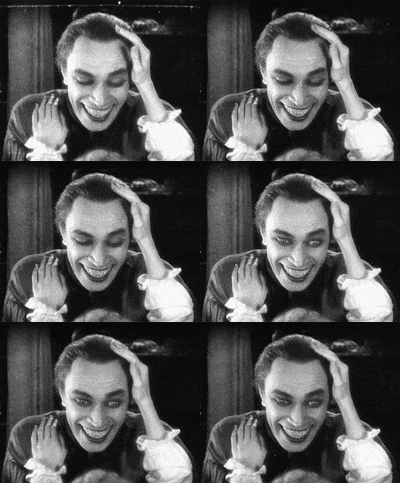
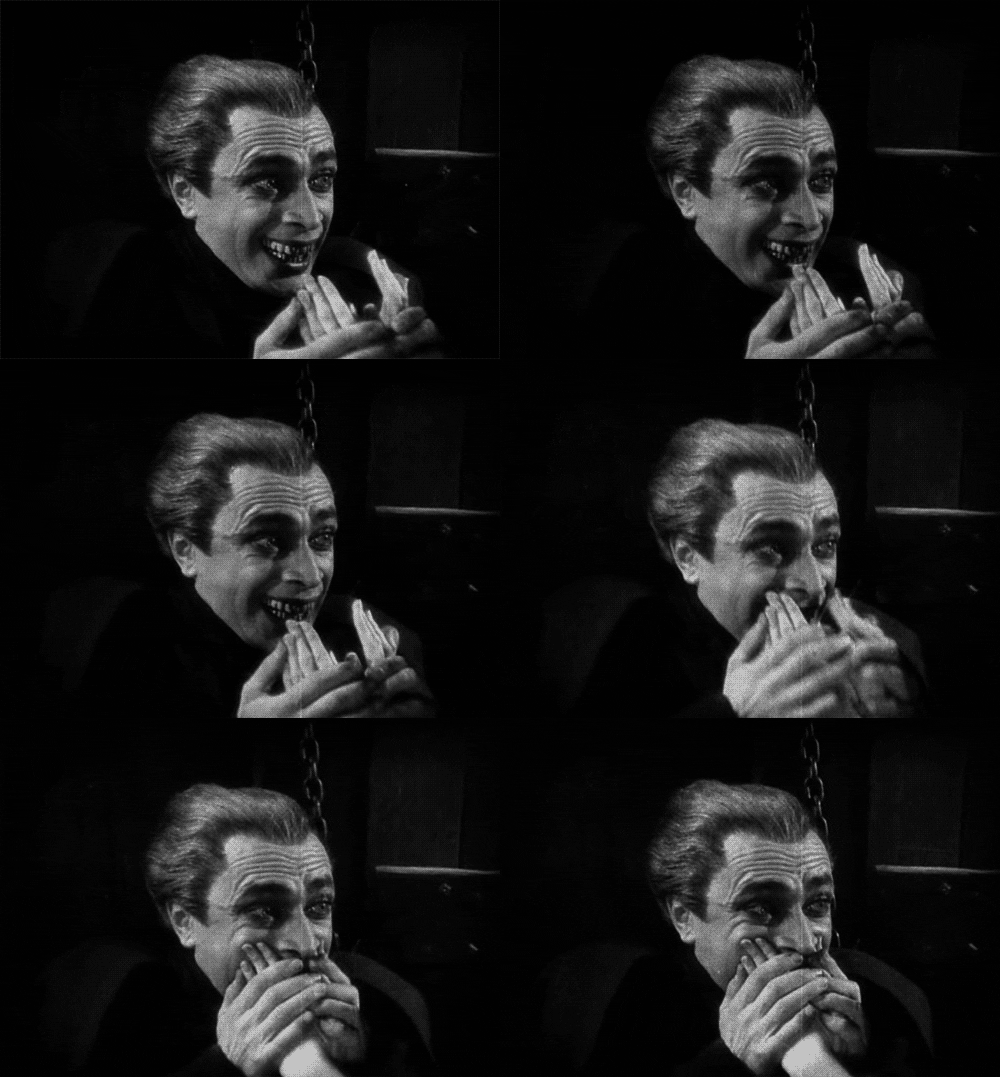
As far as silent horror films go, The Man Who Laughs is one of the most widely known, it's popular recognition falls only behind the likes of Nosferatu (1922) and The Phantom of the Opera (1925).  A myriad of trivia is regularly tossed out in regards to the film, including that is actually a Universal horror film (making Gwynplaine a "Universal monster"), and, most famously of all, that the character/visage of Gwynplaine was the inspiration for the Joker character in the DC Batman comics.  And, it arguably remains the best adaptation of a Victor Hugo novel. I wanted to breifly touch on just a few lesser known aspects of the film (including a few personal notes of favor on my part); elements that make the film a true milestone in the world of cinema.


The first important aspect of the production being a Universal film: Universal was the studio that gave us the 1923 Hugo adaptation The Hunchback of Notre Dame starring the great chameleon Lon Chaney. It was such a success that the studio fully intended to have him star in another Hugo adaptation of L'homme qui rit, this was the first step at Universal to put the film, translated into English as The Man Who Laughs, into production. There was even a contract drawn up with Chaney; but the studio had failed to acquire the rites to the novel for film adaptation from the French studio that owned them. The result was that the project was shelved and Chaney's stared in the now extremely famous production of The Phantom of the Opera instead. The success of that film allowed German ex-pat producer Carl Laemmle to return to The Man That Laughs project with complete control of the production. He wasted no time in hiring a bevy of fellow Germans for the production, including Conrad Veidt, who who effectively lured to Hollywood by the studio; and director Paul Leni. He too had been brought to Hollywood by Laemmle. To round out the cast, Mary Philbin (most definitely an American thespian!), who appeared as the female lead in Phantom, was cast as Dea.


Leni got his start--like so many directors of late 1920's gothic films turned out of American studios--as an expressionist director in Germany. His direction of the expressionist master-class Das Wachsfigurenkabinett (Waxworks) had garnered international attention and prompted Laemmle to hire him for Universal. By the time that he was brought on to this Hugo project, he had already directed two mystery films for Universal (the Charlie Chan vehicle The Chinese Parrot and The Cat and the Canary--now a late 20's horror classic). Leni was as "arthouse" as they came (his Rebus shorts, initially shot as theatrical "extras," are/were partially or fully animated avant-garde films--at least one of which survives), but his first two Hollywood efforts showed the constraints of such a director working in the money machines that were the Hollywood studios. The Man Who Laughs however shows that he was finding his place. The film contains much of his pre-Hollywood direction style and hints at great works to come (even with the coming of sound). Alas, this was not be. Leni died in 1929 at just the age of 44 from sepsis brought on my a tooth infection of all things. It was a huge loss to the art of filmmaking!


Another interesting little point of trivia of the film is that having been made and released right on the cusp of all sound films, a partial soundtrack was later made for the film with the brand new (and quickly monopolistic) Movietone sound system. This simplistic soundtrack, which mostly consisted of tones from bells and knocks, with the occasional brass flourish, was constructed around the song "When Love Comes Stealing." 


In regards to the plot of film, there are those who consider it a dark romance, or work of strange tragedy; even a few who dispute it being any type of horror film at all. This despite it's undeniable gothic foundations.  For me personally, it is a film about the horror of being ostracized by society, of being an outcast, a rejected human being. If you have endured even the mildest of bullying in a school environment or any situation where a bad actor has agency or power over you, then you know first hand this is indeed a horror film. The horror of institutional shame, and the desperate need to flee from it, are the things post traumatic stress are made of. So for me, a person who lives with PTSD, this is high on my list of scariest horror films out there. It is also high of my list of the best of the best horror ever made in these United States. Sad, sickening and devastatingly beautiful!


Saturday, October 23, 2021

Spooktober 23: The Man Who Laughs (1928)


Paul Leni is one of my favorite directors, and Conrad Veidt one of my favorite actors. This 1928 send up of Victor Hugo's 1869 novel is one of the most influential and tragic films from the 1920's of any genre, and pairs the two with perfection. So influential was it, that it gave the world the visage of The Joker in the Batman comic book series from DC; not to mention a whole host of other characters by fans of the film who would go onto the make films themselves (see, for example, William Castle's Mr. Sardonicus). The film was released as fully silent film at first, only to be reworked as a partial sound film with an original score and sound effects a year later. There was never any added dialogue however. Veidt's on screen acting career would go on to hit a rocky road for a time with the coming of sound due to his thick German accent. His performance as Gwynplaine in The Man Who Laughs remains, however, one of the most well known and memorable in cinema history. 


Saturday, October 2, 2021

Spooktober Day 2: The Chinese Parrot (1927)


Charlie Chan movies, from the very beginning, moved in and out of the horror shadows, especially with the coming of "wholesale" sound in 1930's. This lost film from 1927 was the first to introduce the darker elements to Chan films. It was directed by Paul Leni after all! It was also only the second Charlie Chan film ever produced; the first being the Spencer Gordon Bennett directed The House Without a Key in 1926 (which was actually a ten part Pathé serial). Leni, being Leni, introduced significantly darker themes and set pieces to the Biggers story than did Bennett. He also came close to casting his old friend/muse (and now "silent horror icon") Conrad Veidt in the titular Chan role, which eventually went to Japanese born actor Sôjin Kamiyama instead. Leni was not on to anything new by having an Asian actor (albeit a Japanese instead of Chinese person) in the role of Chan, as George Kuwa first played the role in Bennett's film and, in fact, also had a part in the Leni film as well. The horror elements that Leni played on in the story centered around a supposed cursed family heirloom: a pearl necklace. The film was remade with sound in 1934 as The Courage of Charlie Chan (aka Charlie Chan's Courage), with the now familiar Warner Oland in the Chan role; it too is a lost film. It is such a shame that The Chinese Parrot is, for now, considered lost, as Leni only lived two more years, and died tragically young at the age of 44...but hope springs eternal that a copy may turn up in some far flung part of the world, as this was a Universal release and had a wide distribution. Happy Spooktober 🎃


Saturday, July 8, 2017

Born Today July 8: Paul Leni


1885-1929

Famed German expressionist silent film director Paul Leni was born Paul Josef Levi on this day in Stuttgart.  His artistic bent was evident early in his life, and by the age of 15 was an avant-garde painter with obvious talent.  This led his to study at the Berlin Academy of Fine Arts; during his time at art school he started work as a set designer for various stage productions.  His work for the live stage led to his transition to work on set design in the budding film industry.  He then added costume design to his resume (in this capacity, he worked for--amongst others--one Ernst Lubitsch).  In fact, though remembered today as a director, a very large portion of his film credits stem from being in the art department of many productions; the experience in that field led him to be a very artistic, hands on type of director.  The first film that he is credited with "Art Director" was Ein Augestoßener: 1, Teil-Der junge Chef in 1913.  He next served as the Production Designer for The Black Triangle (1914).  He finally made his directorial debut in 1916 with Das Tagebuch des Dr. Hart, or Dr. Hart's Diary, a kind of propaganda film. He would have a long career in the silent era in his native Germany, including a series of animated shorts; but by 1926 the call of Hollywood was too great to ignore.  In 1927 he directed his first film on American soil with the famous Cat And The Canary for Universal Pictures.  He would go on to direct just three more films; one of which is a solid Gothic horror masterpiece:  The Man Who Laughs (1928) starring Conrad Veidt of The Cabinet Of Dr. Caligari fame (I wrote a piece about Veidt's character Cesare for a blogathon, that can be found here).  His last film would be The Last Warning (1929), a horror mystery that was a partial silent; the film featured some scenes tinted with a gold treatment similar to that of the Handshiegl Color Process.  Leni died suddenly at the age of 44 of the 2nd of September 1929, the cause of death was listed a "blood poisoning;" he had a massive septic infection from an untreated tooth infection.  For such a talented and well known silent director, I can find zero information about his burial and/or cremation.  The world truly lost a real talent, right on the cusp of becoming a formidable Hollywood director in the age of talking films.


For More: