Showing posts with label Silent Horror Film. Show all posts

Friday, October 28, 2022

October 28: Unheimliche Geschichten (Uncanny Stories)


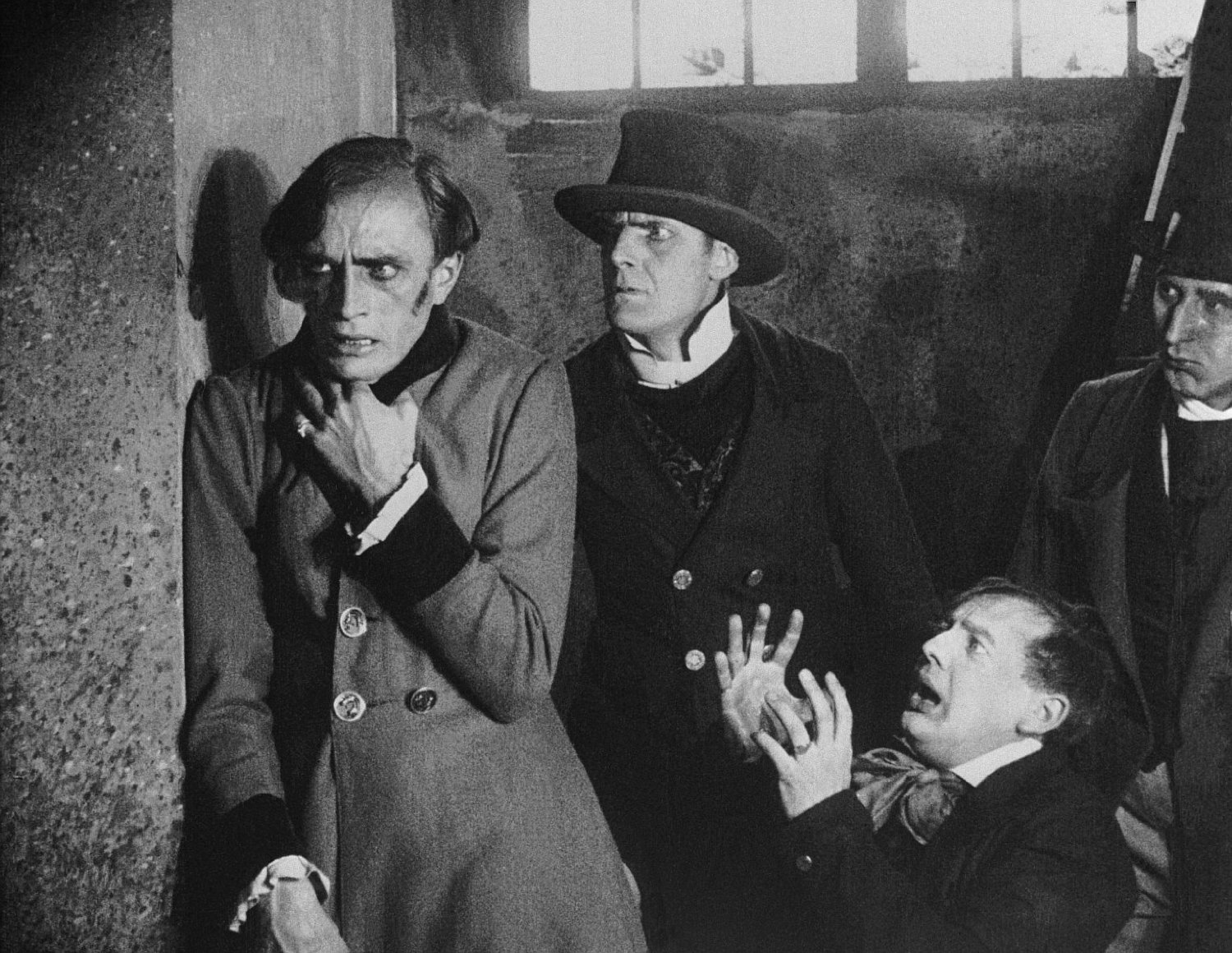
Germany's Unheimliche Geschichte or Grausíge Nächte (Horrible Nights) is the earliest horror anthology; released in 1919 and containing five distinct stories with a sixth frame story. Three of the five stories were written by well known writers of the gothic: Edgar Allan Poe, Robert Louis Stevenson and Germany's own Anselma Heine. Director Richard Oswald provided a fourth story with "Der Spuk" (The Spectre). The fifth writer, Robert Liebmann was on the cusp of establishing himself as an important screenwriter in the country when he provided a story for the film; he would go on to be one of the most successful screenwriters of 1920's German cinema (he would later die at the age of just 52 in 1942 because he was Jewish). The most famous cast member (by far!) is Conrad Veidt, who not only appears as Death in the prologue, but also has roles in the individual stories themselves. The other two principle players appearing in all of the stories are Anita Berber and Reinhold Schünzel.  The director himself makes a cameo in the prologue as well; in what would become a the norm for director cameos, he went uncredited. 


The director in the middle with his two principle male players


The film's original runtime was 112 minutes (or 1 hour 52 minutes), with DVD releases having it cut to 98 minutes. The five principal stories as follows:


The Apparition by Anselm Heine

The Hand by Robert Liebmann

The Black Cat by Edgar Allan Poe

The Suicide Club by Robert Louis Stevenson

The Spectre by Richard Oswald


The film goes by several different translated names in English, including:  Eerie Tales, Five Sinister Stories, Weird Tales, Tales of Horror and Tales of the Uncanny. The film is not just a milestone as the very first horror anthology movie, it is also an oft over-looked early film of German expressionism. Though the direction style is not as outlandish as Murnau or Wiene, it is a very important work in the vein of gothic silent cinema in Germany, a great example of a work that gave ideas to the imagination of later films of Expressionism. Oswald would remake the film in 1932 with full sound as The Living Dead with Paul Wegener as the principle actor. 


A Few Stills & GIFs


Gr

Saturday, October 22, 2022

October 22: The Unholy Three (1925 & 1930)


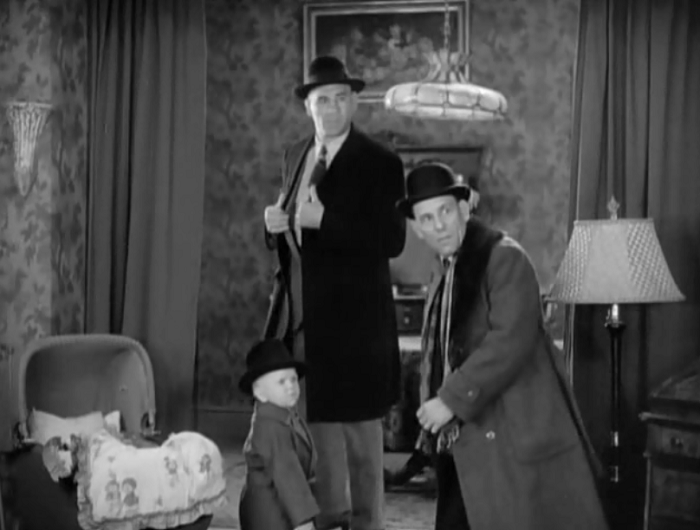
Lon Chaney may not have lived long enough to reprise role from Tod Browning's London After Midnight, but he did reprise another Browning role in a speaking remake of the original. Regarded as one of Browning best films, his 1925 The Unholy Three starred Chaney as a ventriloquist (a feat of very expressive silent acting); Chaney reprised the role in an all sound version in 1930 just prior to his untimely death that year (it would be his only speaking role in a film).  Browning, however, did not direct the film: Jack Conway did. Conway was regarded as a "Jack of all trades" (literally) in terms of genres that he directed. He was not known for an particular specialty; which meant that his pictures, while technically good, were rather bland; it also meant that he was beloved by studio management, particularly Irving Thalberg. The talking remake suffers for it though. It's a competent enough film to be sure, but it is (like so many remakes after it) a poor imitation of the original. The only other principle actor to return from the original cast was German born actor Harry Earles (Kurt Schneider).  Earles was Tweedledee in the original; Conway and crowd merely credited him as "midget" in the remake (Earles was only 3'3"). Below are some production comparisons of the two films. 


Friday, October 21, 2022

October 21: His Brother's Keeper (1921)


His Brother's Keeper was principally a crime film with strong horror elements from 1921. It is yet another lost film with enough extant information and materials to know most of the action of the entire film. The plot was an odd combination of corporate fraud mixed with mesmerizism/hypnoisis.  The following description from on October 1921 print ad taken out in a Poughkeepsie newspaper gives a good description of how this, an early thriller, was marketed:

Can one man compel another, by the force of mental suggestion to murder a third man? It is upon this question that N. Brewster Morse has constructed that greatest drama since the days of "Trilby" and "The Corsican Brothers." [from the Poughkeepsie Eagle-News]

Principally the main plot behind the motivation to commit the murder is a bit beside the point. The point is that somehow a mere mortal man has the power to compel another innocent person to murder a man for him. Hypnotism was a popular "supernatural" trope in films of the time; it had strong connections to spiritualism, but it was also just as connected to the new science of psychology. It was both weird and wonderful; new, but possibly...just possibly, very old. It would also go on to be a popular vehicle in mad scientist films for the 1930's, 40's and 50's; so we find that concept in its infancy in films like this. Even today, we have vampire films and series that use hypnosis as a power that the creatures inherently possess in some form. What was truly frightening about His Brother's Keeper is that the mesmerized murderer is arrested; the audience knew that meant capital punishment. Pretty horrifying stuff. Of course, this is Hollywood, and we can't have the bad guy getting away with it. We have an investigation undertaken by a character named (I kid you not!) John Bonham and the culprit is exposed. As for justice, the film has him then promptly, and conveniently, doing away with himself.  Other than a complete plot description and a poster, there are no other materials on this film for now. 

Tuesday, October 18, 2022

October 18: Go And Get It (1920)


Go And Get It is a relatively unknown feature length horror spoof from 1920. It's plot, like so many involving science fiction plots in the 1910's and 1920's, involves a gorilla or ape man.  It was from Marshall Neilan Productions and Neilan was a co-director, along with Henry Robert Symonds. Agnes Ayers and Pat O'Malley are essentially the leads in the film, one as Helen Allen who has inherited a troubled newspaper from her father, and as Kirk Connelly an investigative reporter. There is a strong mystery element in the plot that involves both a string of unsolved murders and an attempt to ruin the Allen family business by person or persons unknown. The two team up to investigate and find that a mad scientist Dr. Ord (Noah Beery) has transplanted the brain of a criminal into the head of an ape (as one does). The hybrid creature then goes on rampage spree in much the same fashion as the killer in Poe's Rue Morgue. Former wrestler Bull Montana donned the gorilla/ape suit for shoot. The film ran/runs for an hour and ten minutes, and was remade in 1941 as The Monster and the Girl starring Ellen Drew and Robert Paige. For decades Go and Get It was listed as lost, when the Cineteca Italiana in Milan announced that they are a discovered a copy in their archive. 


Print ad from the August 14, 1920 edition of Exhibitors Herald (Public Domain, retrieved from Wikipedia)


(Wikimedia Commons)


Thursday, October 13, 2022

October 12: Genuine: The Tragedy Of A Vampire


One of Robert Wiene's forgotten horrors, Geniune: The Tradegy of the Vampire is worth a mention this October. It is not well known today and only a 45 minute condensed version is available for public screening. While it may not be one of Weine's finest efforts, it is a solid supernatural thriller. It also worth seeking out for the simple reason that it shows that not every German expressionist film is  brilliant by default. As a cinema experience, it is a deeply unsettling film; not in that it's scary, it has something more like a fun house effect. It's sets are highly graphic, in the artistic sense; they were overly garish even by contemporary expressionistic standards of 1920. Many of them don't seem to fit or match in a way that allow the eyes to easily settle into the viewing (set pieces include a skeleton with a clock for head).  Since it was directed by Robert Wiene, it is obviously going to be compared to his masterpiece The Cabinet of Dr. Caligari. Even if we, as movie fans, tried to keep from doing this, it is really inevitable. Of course, when we talk about our experience of the film, it comes with the understanding that no one outside of screenings at the Munich City Film Museum has seen the full print in decades. What we have is the condensed 45 minute version, and if you have the Kino release (as in extra on their Dr. Caligari release) you at least get the original tinting. 


As mentioned above, the film was released in 1920 well after The Cabinet of Caligari, but met with much less success. Screenwriter Carl Mayer (who penned a number a surviving and famous silents, including Cabinet & Murnau's Sunrise) wrote the script solo and the cast is sparse. The story is quite simple, the narrative not being much at all; rather the story is told through a lot of physical acting. As for the monster;  Genuine is in fact not a "traditional" vampire as we have come to categorize them as undead immortal beings, but rather a succubus. In that regard the movie is harkening back to the older "vamp" movies of the 1910's--a very American film trope really. And yet, Geniune is more vampiric than those earlier vamps--and significantly more supernatural. So, I would say that the film falls somewhere in the middle of old and new female monsters: not quite human, but but not quite immortal either. She is described as ancient and her behavior leads one to believe that she is actually a real succubus of some sort, not just a cruel woman out for men's wealth. And yet, she is also deeply manipulative like many of the vamps in films like the famously lost Fox production A Fool There Was, starring the vamp herself: Theda Bara. She bares closest resemblance to what we would call an "energy vampire."


If you haven't already seen it, the is the perfect season to seek it out for a watch. It may not scare you silly, but it is a funky little curiosity from one of Germany's finest early directors.