Showing posts with label The Virginian (1929). Show all posts

Tuesday, February 23, 2021

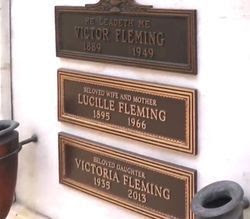
Born Today February 23: Victor Fleming


1889-1949

Most people will instantly think of Gone With The Wind, or even The Wizard of Oz (1939), when the name of director Victor Fleming comes up; he, in fact, though got his start in the film industry in the mid-1910's.  Victor Lonzo Fleming was born on this day what is now Los Angeles County, California (then Rancho La Cañada)--he was born on a working ranch there called Banbury. He is known to have worked on the technical side of films by 1915, with a cinematographer credit on the 1915 romantic comedy short Fifty-Fifty, made for Independent Moving Pictures (IMP) and distributed by Universal.  However, he is listed as an uncredited actor in a minor role in the 1914 melodrama The Envoy Extraordinary which was the work of writer/director Lorimer Johnston. Whatever the case, Fleming was a man of action strictly behind the scenes and was working in camera operations from 1915 through 1919, when he made his directorial debut in the Douglas Fairbanks (Sr.) feature When Clouds Roll By (which both starred and was produced by Fairbanks and his company).  In the meantime, he served mostly as a cinematographer, but did serve as a second unit director on D. W. Griffith's massive project Intolerance (1916).  It was during this period that he became especially close to Fairbanks, serving as the DP on a number of features starring the elder Fairbanks, including The Americano, which was shot on location in Tijuana.  After Fleming graduated to directing, he gave up camera operation on all but one additional film in his lifetime (the all mono documentary Around the World with Douglas Fairbanks in 1931). Despite that he most well known for films in the late 1930's, he actually directed more films during the 1920's than he did in all the rest of his career. He started the decade out with the Fairbanks comedy Mollycoddle (June 1920); his only film of the year, it also featured Wallace Beery and Ruth Renick. He next went to work at Constance Talmadge's production company for two pictures in 1921:  Mama's Affair (January) and Woman's Place (October). He directed three films in 1922, two of which were for Paramount related studios; the other was for the production company of the married writing pair John Emerson and Anita Loos who had penned the adapted script for Mama's Affair.  He upped his directing game in 1923 by directing four features, two of which were Richard Dix westerns. Of the four, To the Last Man (September 1923) is probably the most historically significant, due to it's source material coming from author Zane Grey; and that an [almost] intact copy was found in Russia and has been screened during at least one silent film festival Along with Dix, Lois Weber and Noah Beery round out the cast.  In 1924, he was back to melodrama, though he was also thoroughly ensconced at Paramount, leading to his expanding his directing demands as time went on. He only made two films in 1924, as opposed to his three in 1925, but he was showing signs of becoming the exacting director that he was later known for--which meant that he tended to be a slow worker. The fact that his work product was very good, meant that Paramount did not seem to mind. His abilities to direct well framed scenes on location shoots (from the Arizona desert to Santa Catalina Island) were no doubt informed by his having been an excellent Army war photographer during the first World War; he had, in fact, been a principle presidential photographer of Woodrow Wilson in Versailles.  He was also one of the only directors that could get a really excellent performance out of Wallace Beery, a notoriously difficult actor to deal with (he also directed brother Noah, who was basically the opposite of his hulking brother).  One of his better known silents is the 1926 Clara Bow comedy Mantrap, filmed on location in two areas of the San Bernardino National Forest, it was based on the Sinclair Lewis serialized novel.  Further, if Fleming could manhandle a great performance from Wallace Beery, why not Emil Jannings? Jannings was a difficult actor from Germany who later became gung-ho for the Nazi's, but Fleming directed him in The Way of All Flesh in 1927. It would garner Jannings a Best Actor Oscar for his trouble (it is also a lost film with the except of about 8 minute extant clip). Additionally, in 1927, he directed the war epic The Rough Riders with Charles Farrell, George Bancroft, Mary Astor and Noah Beery as "Hell's Bells;" at nearly 2 1/3 hours long at it's New York premiere and shot in locations in multiple states, it was certainly one of Paramount's most expensive productions (the film was cut to around 110 minutes for wider release).  It was also a film that had hints of what was to come from Fleming in Gone With The Wind.  His next film, Abie's Irish Rose (November 1928) was his first film with sound; a partial silent comedy starring Charles Rogers and Nancy Carroll, containing talking sequences by Western Electric, there was also a fully silent version for wider release.  I don't think there is much doubt that his last film of that decade is historically his most well known of the decade, and  was also considered by many for a long time to be his best film of the decade: The Virginian was also his first full talkie (though a fully silent version was also released).  Released in November of 1929, the film starred Walter Huston, Mary Brien and, most famously, Gary Cooper.  This was to be Fleming's last picture at Paramount. He started the new decade off with two films for Fox, before landing at MGM, where he would direct his most famous works mentioned above: Wizard and Wind (though Gone With the Wind was a co-production with David Selznick's company).  Despite that Fleming is most closely associated with those two films, (remarkably both released in 1939), his most frequent actor in his later films was Spencer Tracy. He first directed Tracy in 1937 in Captains Courageous, a family adventure film was a large famous cast of actors that included Sam McDaniel, the brother of Hattie McDaniel who he would direct in Wind (she would be the very first African American ever nominated for an Oscar, never mind to win--she did both!).  Tracy also starred in Fleming's only horror film, his rendition of Dr. Jekyll and Mr. Hyde released in 1941.  Clark Gable, famous for his turn as Rhett Butler, was likewise a frequent actor in later Fleming films; Fleming directed him no less than five times.  His last film, Joan of Arc, starring Ingrid Bergman in the titular role, he barely finished before  suffering a heart attack in Arizona on the 6th of January in 1949, he died while en route to the hospital. He was 59 years old.  He is interred at The Hollywood Forever Cemetery.  Joan of Arc, made for RKO, and released in November of 1948, was nominated for eight Academy Awards, winning three.  Fleming won his only Oscar for Best Director, of course, for Gone With the Wind.  

[source: AJM (Find A Grave)]

[source:  stateofsunshine19 (Find A Grave)]


Saturday, May 7, 2016

Born Today May 7: Gary Cooper


1901-1961

Born Frank James Cooper in Helena, Montana to English immigrant parents; he had one older sibling, a brother named Arthur.  Their father Charles had become a prominent lawyer in Montana, rising even up to the Montana Supreme Court; this allowed for the family to purchase a large ranch and live comfortably.  Their mother, Alice, wanted her two sons to have an English education, so in 1909 she escorted them back to the UK where they were enrolled in Dunstable Grammar School located in Bedfordshire.  He was educated there from 1910 through 1912.  The boys were then escorted, again by their mother, back to Montana to attend school at the Johnson Grammar School in Helena.  While in high school, he was encouraged by a teacher to join the debate club and get involved in the dramatic arts; this was his first exposure to public oration and acting of any sort.  Also while still in high school, he enrolled in college courses the agricultural college in Bozeman.  After graduating, he headed for Grinnell College in Iowa, the year was 1922.  While there he did well in his course work, but was disappointed not to be accepted at the college's drama club.  During summer's he supported himself as a guide at Yellowstone.  Disgruntled with college life, he quit suddenly in 1924 and headed to Chicago to find work as an artist, but was unsuccessful.  After a month, he headed back to his hometown of Helena, where he got work selling editorial cartoons to the local newspaper.  In the autumn of that same year, Cooper's father Charles left the Montana Supreme Court and moved with his wife Alice out to Los Angeles to work with family members living there.  At his father's request, he joined them there.  He wasn't there long before he ran into two acquaintances from back home who worked as stunt riders in the motion picture industry; they introduced him to rodeo champion "Slim" Talbot who knew people in the industry.  Talbot took Cooper to see a casting director, and he soon found work as an extra for $5.00 a day and a stunt rider for double that amount.  This is were some confusion comes into play.  Many film historians have claimed that Cooper made his film debut in 1923 in an uncredited role in a film titled The Last Hour; this highly doubtful, as Cooper didn't show up in Los Angeles until Thanksgiving of 1924.  It is much more likely that his real debut came as a "crowd extra" in Dick Turbin which came out in 1925.  From there on he got steady work in extra roles in a string of silent films throughout the 1920's.  Realizing that there was more than one actor who went by the credited name of "Frank Cooper," he figured that he needed to change his name.  Nan Collins, a casting director, that had turned agent for Cooper suggested the name "Gary" (after her hometown of Gary, Indiana) and a budding star was born. The first known credit under this name came in 1927 with The Last Outlaw, as "Garry Cooper," in an early starring role for him.  The first partial sound film he starred in came in 1928 in Lilac Time opposite Colleen Moore; though the film had no speaking parts--only sound effects with a musical score.  The first film that he starred in that actually had talking sequences in parts was The Shopworn Angel (1928), with sound provided by Western Electric Sound System.  It was, however, the very last film that he made in the 1920's that was not only his full sound film, but made him a superstar; that would be The Virginian (1929).  Directed by Victor Fleming, it is still a household name amongst connoisseurs of the western film genre.  Cooper would go on to have a very prolific film career, with some very notable roles along the way, including that of real war hero Alvin C. York in the 1941 Sergeant York , for which he won an Oscar.  He also won for High Noon (1952).  His life, though, was cut short, when a late diagnosis of prostate cancer allowed the disease to spread to his colon.  He passed on the 13th of May in 1961, just a week after marking his 60th birthday.  His funeral mass was held on May 18 and was attended by many Hollywood luminaries.  He was then interred at Holy Cross Cemetery in Culver City.  However, in 1974 when his family relocated to New York, he was exhumed and his remains transported to Southampton, NY, where he was reburied at the Sacred Hearts cemetery there; a 3 ton boulder from the Montauk quarry, along with a flat grave stone mark his final resting place.  

His original grave marker in California

His new grave marker, with Montauk boulder, along with the marker for his wife's grave in Southampton, NY.


Wednesday, February 17, 2016

Born Today February 17: Mary Brian


1906-2002

Mary Brain was born Louise Byrdie Dantzler in Corsicana, Texas.  Unfortunately, her father died when she was just a month old and the family moved to Dallas.  In the early 1920's the family relocated to Long Beach, California; where here mother hoped to get her into the motion picture industry.  She was entered into a beauty contest there at the age of 16.  One of the judges was movie star Esther Ralston.  She did not win the $25 dollar first prize, but Ralston, feeling sorry for her, arranged a consolation prize:  an interview with director Herbert Brenon, who was casting for his upcoming production of Peter Pan (1924).  He liked her in the tests for the main part of Wendy Moira Angela Darling; and loved that she was an unknown.  She was put under contract with Paramount Pictures; it was at this time that the studio changed her name to Mary Brian.  She then had very steady work throughout the 1920's.  The studio had put out that she was two years younger than she actually was, and she was eventually dubbed "the sweetest girl in pictures."  By the mid-1920's she had become so popular that Paramount was even willing to loan her out to MGM; which they did for the film Brown Of Harvard (1926).  That same year, along with a host of other young Hollywood luminaries, she was named one of that year's WAMPAS Baby Stars.  During her time with Paramount, she starred in over 40 films.  Her first speaking role came in 1928 with Varsity, a partial silent that had a few talking sequences, with sound by Western Electric (it amongst the long list of lost films, unfortunately). Her first full sound talkie came in 1929 with Black Waters.  Also in 1929, she would have a major role in one the earliest, and most influential, talking westerns, The Virginian, opposite rising star Gary Cooper. The last film that she made in the 1920's was The Marriage Playgrounda return to the partial silent format, with only a few speaking lines.  By the early 1930's, her contract with Paramount was up and she went into freelance mode, unusual for the time. She also got stage experience by performing live vaudeville in New York.  This allowed her to make a successful transition into speaking roles; something that was highly unusual for silent stars that did not start out on the live stage before appearing in films.  She went on to have steady work in film all during the 1930's.  By the early 1940's, she was involved in stage work that took her around the world.  She was also involved in entertaining troops in both the Pacific and Europe live during WWII; she spent Christmas of 1944 with American troops fighting in the Battle of the Bulge.  After this, her acting career began to wane some.  The last full length film that she appeared in was Dragnet in 1947.  In the 1950's she transitioned to television, having a major role as Janet Archer in Meet Corliss Archer (1954-1955), the last acting role that she would have.  After the show was canceled, she quit acting to work with her second husband George Tomasini's work as film editor for Alfred Hitchcock.  Personally, she devoted her time to her lifelong love of portrait painting.  She lived to the age of 96, passing away from natural causes on the 30th of December in 2002 in Del Mar, CA.  She is buried under her married name "Mary Brian Tomasini" Forest Lawn Memorial Park in Hollywood Hills location, next to her husband George, who had passed away in 1964.


Saturday, January 23, 2016

Born Today January 23: Randolph Scott


1898-1987

Born George Randolph Scott in Orange County, Virginia--his original focus was that of a multi-talented athlete; excelling in such sports as American football, swimming, baseball and horse racing. When World War One broke out, he enlisted at the age of 19 soon after the U.S. entered the conflict, serving with distinction in France.  He later claimed that this had honed his horsemanship and given him experience with firearms, which would serve him well in his chosen field of film acting.  After Armistice he stayed in France and entered artillery school, and was eventually offered a commission; which he turned down.  He returned to the United States in 1919 at the age of 21.  Back home, he attended Georgia Tech, for which he played football; and eventually the University of North Carolina, where he majored in textile engineering.  He eventually dropped out of college to go work as an accountant at the textile firm where his father was employed.  Around 1927, Scott decided that he wanted to act in film and made his way out to Hollywood.  Scott's father had before this, made acquaintances with Howard Hughes, and sent a letter of introduction with his son.  This letter garnered him his very first film role in 1928 in Sharp Shooters, a comedy, starring George O'Brien, as a bit part as a cafe customer in Morocco.  It was the only fully silent film that he appeared in; though his next appearance in another bit part in 1929 in Weary River, had a few sequences that were filmed in the silent mode.  He would appear in 7 more films in 1929, all of them early talkies, in bit parts; including the Gary Cooper western (the first of many that Scott would act in!) The Virginian.  Scott, actually being from Virginia, was said to have been hired as Cooper's voice coach for the film as well.  Around this time, the director Cecil B DeMill gave him the advice that he should get some stage work, so as to hone his acting skills and get him some much needed experience.  He was able to this at the Pasadena Playhouse, where he got roles in at least four plays, including a bit part in a production of Shakespeare's Julius Caesar.   Scott didn't get his first actual named credit in film until 1931.  Although he is best known for his work in westerns, he made all types of films:  everything from romantic comedies to a few horror films, adventure & fantasy films to war movies; however, of his more than 100 appearances in film, 60 of them were westerns.  Later on, the with the U.S.'s entrance into the Second World War, Scott attempted to gain an officer's commission in the marines, but was rejected due to back injuries.  So, instead he supported the war effort by touring with a comedy act with Joe DeRita, who would later go on to be in the Three Stooges, for the Victory Committee.  He also raised food for the government on a ranch that he owned.  The last film that he made was Ride The High Country in 1962; after which he retired from acting.  He lived out the rest of his life on a portfolio of very successful investments that he made during his acting career.  He resided, with his wife, actress, Patricia Stillman in Beverly Hills, where they lived a life of leisure.  Scott died at home from heart and lung ailments on the 2nd of March 1987 at the age of 89.  He is buried in Elmwood Cemetery in the Charlotte, North Carolina area.