Showing posts with label Universal Studios. Show all posts

Thursday, October 13, 2022

October 13: The Black Box (serial)


Here is what is left of the 1915 serial The Black Box. The entire serial is lost to us and, for a series that had 15 chapters and a total running time of 195 minutes (or just a little over 3 hours), there are precious few surviving materials. It was released in increments starting in the spring of 1915. 


The series was considered a science fiction mystery and involved mysterious black boxes in which messages from an unknown killer are delivered to authorities. A private investigator decides to look into the matter.  We know that these series contained various elements of horror, including an ape man and an invisibility cloak.  The whole series was directed by Otis Turner for Universal. The detective Sanford Quest was played by Herbert Rawlinson, who would go on to be a prolific character actor in the 1940's and 1950's. 


Tuesday, October 4, 2022

October 4: Brief Notes on The Man Who Laughs (1928)


As far as silent horror films go, The Man Who Laughs is one of the most widely known, it's popular recognition falls only behind the likes of Nosferatu (1922) and The Phantom of the Opera (1925).  A myriad of trivia is regularly tossed out in regards to the film, including that is actually a Universal horror film (making Gwynplaine a "Universal monster"), and, most famously of all, that the character/visage of Gwynplaine was the inspiration for the Joker character in the DC Batman comics.  And, it arguably remains the best adaptation of a Victor Hugo novel. I wanted to breifly touch on just a few lesser known aspects of the film (including a few personal notes of favor on my part); elements that make the film a true milestone in the world of cinema.


The first important aspect of the production being a Universal film: Universal was the studio that gave us the 1923 Hugo adaptation The Hunchback of Notre Dame starring the great chameleon Lon Chaney. It was such a success that the studio fully intended to have him star in another Hugo adaptation of L'homme qui rit, this was the first step at Universal to put the film, translated into English as The Man Who Laughs, into production. There was even a contract drawn up with Chaney; but the studio had failed to acquire the rites to the novel for film adaptation from the French studio that owned them. The result was that the project was shelved and Chaney's stared in the now extremely famous production of The Phantom of the Opera instead. The success of that film allowed German ex-pat producer Carl Laemmle to return to The Man That Laughs project with complete control of the production. He wasted no time in hiring a bevy of fellow Germans for the production, including Conrad Veidt, who who effectively lured to Hollywood by the studio; and director Paul Leni. He too had been brought to Hollywood by Laemmle. To round out the cast, Mary Philbin (most definitely an American thespian!), who appeared as the female lead in Phantom, was cast as Dea.


Leni got his start--like so many directors of late 1920's gothic films turned out of American studios--as an expressionist director in Germany. His direction of the expressionist master-class Das Wachsfigurenkabinett (Waxworks) had garnered international attention and prompted Laemmle to hire him for Universal. By the time that he was brought on to this Hugo project, he had already directed two mystery films for Universal (the Charlie Chan vehicle The Chinese Parrot and The Cat and the Canary--now a late 20's horror classic). Leni was as "arthouse" as they came (his Rebus shorts, initially shot as theatrical "extras," are/were partially or fully animated avant-garde films--at least one of which survives), but his first two Hollywood efforts showed the constraints of such a director working in the money machines that were the Hollywood studios. The Man Who Laughs however shows that he was finding his place. The film contains much of his pre-Hollywood direction style and hints at great works to come (even with the coming of sound). Alas, this was not be. Leni died in 1929 at just the age of 44 from sepsis brought on my a tooth infection of all things. It was a huge loss to the art of filmmaking!


Another interesting little point of trivia of the film is that having been made and released right on the cusp of all sound films, a partial soundtrack was later made for the film with the brand new (and quickly monopolistic) Movietone sound system. This simplistic soundtrack, which mostly consisted of tones from bells and knocks, with the occasional brass flourish, was constructed around the song "When Love Comes Stealing." 
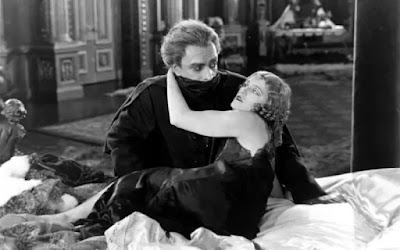


In regards to the plot of film, there are those who consider it a dark romance, or work of strange tragedy; even a few who dispute it being any type of horror film at all. This despite it's undeniable gothic foundations.  For me personally, it is a film about the horror of being ostracized by society, of being an outcast, a rejected human being. If you have endured even the mildest of bullying in a school environment or any situation where a bad actor has agency or power over you, then you know first hand this is indeed a horror film. The horror of institutional shame, and the desperate need to flee from it, are the things post traumatic stress are made of. So for me, a person who lives with PTSD, this is high on my list of scariest horror films out there. It is also high of my list of the best of the best horror ever made in these United States. Sad, sickening and devastatingly beautiful!


Tuesday, May 30, 2017

Born Today May 30: Irving Thalberg


1899-1936

Famed and highly influential early movie producer Irving Grant Thalberg was born on this day in Brooklyn, New York.  At birth he was diagnosed with what was then called "Blue Baby Syndrome" which turns out to be a congenital heart problem.  His doctors told his parents that Irving would be lucky to live to age 20, never mind to 30.  He started experiencing difficulties with the condition while in high school, and to make matters worse, he contracted rheumatic fever when he was 17.  This confined him to bed for a year; insatiably reading everything he could get his hands on became his past time. Lacking the health to enroll in college, he then took a series of part-time jobs; he also taught himself a set of skills that would hopefully help him find better work, they included: typing, short hand and Spanish--he also attended night school.  At the age of 18, he placed an ad in a newspaper touting what experience he had and simply stating "situation wanted"--what he wound up with was a secretarial job at Universal Pictures' New York office!  He quickly worked his way up the ladder to become the personal secretary to the studio's founder Carl Laemmle.  One of his duties was to transcribe Laemmle's notes that he had taken during screenings of films--before long he was making helpful suggestions to Laemmle, offering keen insights, which clearly impressed his boss.  It was not long before Thalberg was issued an invitation to the Los Angeles production studios, where he was given an unofficial management position.  When Laemmle returned to the studio he asked for Thalberg's notes on the goings on in his absence and what sort of action should be taken to correct the problems that Thalberg had carefully described to him.  Amongst Thalberg's recommendations was that a new management position needed to be established at the facility--Laemmle reportedly said "All right, you're it," to which Thalberg supposedly replied "I'm what?!"  So, at the age of 20 he was put in charge of the studio on the west coast, with Laemmle going back to the east coast.  Two years later, he started work as a producer; with Reputation (1921) reportedly being the first film that he had a hand in producing, but went uncredited.  Despite his frail and slight stature and his extreme youthful look (he looked around 15 years of age), Thalberg quickly established himself as a force to reckon with.  His managerial style was to intervene when he saw excesses that directors were taking.  He had a legendary battle with director Erich von Stroheim, whom he would go on to fire out right: a move that utterly shocked the movie industry.  He even got David O. Selznick's attention for the move.  Despite this, he was repeatedly taken for a office boy by those who only knew him by name and not by sight. The first film that he received a production credit for came in 1923 with Merry-Go-Round; though he already had two writing credits to his name from 1922, the first of which was The Dangerous Little Demon.  He was one of the movers and shakers early on in the production of the Lon Chaney Sr. classic vehicle The Hunchback Of Notre Dame (1923).  It was not long before other studios began to take a long hard look at attempting to hire him away from Universal.  The person that succeeded in doing so was Louis B. Mayer, who hired him outright as vice-president in charge of production at his Louis B. Mayer Productions.  The first film that he produced in his short lived position with that company was His Hour (1924).  When Mayer Productions became one of "M's" in MGM, 24 year old Thalberg was made part owner of the newly merged company.  In his time there, he over saw the production of literally hundreds of film.  Funnily enough he would wind up one of the major producers on Stroheim's Greed (1924); which was the second film that he produced at the newly minted MGM, the first of which was He Who Gets Slapped (1924)--a Victor Sjöström vehicle.  Notably, that film starred Norma Shearer, whom Thalberg would go on to marry and have two children with.  It was his idea to have the new studio produce a longish short basic introduction to the new studios in 1925 with 1925 Studio Tour in which he makes a personal appearance.  The first partial silent that Thalberg produced came in 1928 in White Shadows In The South Seas, which has a musical score and sound effects, with a few talking sequences provided by the Western Electric Sound System.   The first full sound film that he produced was The Trial Of Mary Dugan (1929).  He even co-directed one film in 1929: the partially silent Queen Kelly--a film that had considerable production woes--again due to his old nemesis Stroheim.  His accomplishments in production are too numerous to list here, suffice to say that he introduced a great many techniques that quickly became indispensable and are still in use today.  Also under his guidance, MGM was the ONLY film studio to turn a profit during the darkest days of the depression.  He was willing to venture into genres that had been frowned on as well--such as horror.  Additionally, the number of unknowns that he had the foresight to hire, and subsequently made huge stars of is also outside the scope of this post (so, as usual, follow links below).  6 films that he was producing at the time of his death were released posthumously, the last of which came in 1938 with Marie Antoinette, which his by then widow starred in.  After working himself without a real break since he first started working for Universal, he came down with an illness that was subsequently diagnosed as pneumonia. He convalesced at home in a oxygen tent, but never rallied, his birth defect had finally caught up with him.  He died on the morning the 14th of September in 1936 at the age of 37, having lived almost 2 decades longer than his pediatric doctors had predicted.  He interred in the Great Mausoleum, Chapel of the Benediction at Forest Lawn Memorial Park.


For More:


Leave Virtual Remembrances @ Find A Grave

Wednesday, February 1, 2017

Born Today February 1: Germaine Delavigne


1790-1868

French poet and librettist Louis Marie Germaine Delavigne was born on this date in Giveny (Eure) France.  He was the son of a Royal forest surveyor and was the brother of Casimir Delavigne a famed theatrical figure of his time, who was also a poet.  After his studies at the Napoleon High School, he went to the court of Louis-Phillipe I, as keeper of the furniture.  Inspired by his brother's poetry, he began a dramatic career of his own.  He became a frequent collaborator of Eugéne Scribe (page in French, can be translated), who was a class mate of Delavigne's in Paris.  The partnership produced a number of opera libretto's (or libretti) and a quantity of plays.  Only one film has ever been produced from his work; coming in 1916 The Dumb Girl Of Portici is actually a fairly important film by historical standards.  Based on one of Delavigne's libretto's, the film was co-directed by Lois Weber, one of the earliest female film directors, together with her husband of the time Phillips Smalley--the film was made through Universal.  It stars the premiere Russian ballerina of the time: Anna Pavlova. The film survives in two prints: one, a 16 mm print housed at the New York Public Library and the second, a 35 mm print by the BFI.  The later of the two dates from 1920.  Material from both sources were used in a restoration in 2015 that runs 112 minutes.  Delavigne died on 30 November in 1868 at the age of 78 in Montmorency, France.  

Family plot/crypt in Paris' Pére Lachaise

Still from the film showing Palova as "Fenella" (1916)

Wikipedia

Wikipedia France (can be translated)

IMDb


Wednesday, May 18, 2016

Born Today May 18: Frank Capra


1897-1991

One of the giants of American cinema was born Francesco Rosario Capra (who later translated his name into English as Frank Russell Capra) in the Sicilian town of Biscaquino (of course part of Italy) into a family of fruit growers; he was the youngest of 7 children.  In 1903 the entire family immigrated to the United States.  The family was stuffed into the steerage section of the boat, the cheapest way to travel in those times; the journey took 13 days to complete.  For Capra it remained a vivid lifelong memory of a terrible experience.  The family like most Europeans immigrating to the US at the time, came in to the country through New York Harbor (gasping at the size of the Statue Of Liberty on their way in), but promptly made straight for California, settling in the Los Angeles area, in what is today Chinatown.  At that time it was what Capra himself called "an Italian ghetto."  Capra sold newspapers starting at age 10 and continued to do so through high school. His parents convinced him to enroll in college after graduating, instead of going directly to work, which he did.  He also worked through college at Cal Tech and took a slew of odd jobs; AND he worked at night, in clubs playing the banjo--this was his first foray into any sort of entertainment.  In college he studied chemical engineering and graduated in 1918.  Immediately after graduation he was commissioned in the US Army as a second lieutenant (made possible by his ROTC membership in college); he taught math to artillerymen at Fort Scott in San Francisco.  This didn't long; while in the army he caught the "Spanish flu" that was going around (the pandemic would kill millions across the globe); he was discharged and sent home.  With his father having died in an accident in 1916 and he being the only college educated member of the Capra household, it fell to him to provide for the family.  Nonetheless, he was unable to get work, and seeing all of his older siblings gaining steady work, he became depressed and felt a failure; to make matters worse, he discovered that abdominal problems that he had been suffering from was actually from a ruptured appendix.  He then faced another lengthy recovery.  He did managed to become a naturalized US citizen in 1920.  He moved out the house and spent several years living in flophouses in and around San Francisco; also hoping the rails and traveling around the west picking up odd jobs of all sorts.  One of those jobs was acting as an extra in a film; he also supported himself as a poker player.  The one film from the silent era that he is credited as having acted in (there could well be more) The Outcasts of Poker Flats which is listed as having a given year of 1919--it was a Universal production.  It was an early western directed by the great silent western director John Ford--who would go on to direct some Hollywood's golden age Westerns.  Capra's directorial debut came in 1921, when at the age of 24, he directed a short documentary entitled La visita dell'incrociatore italiano Libia a San Francisco...; which documented the arrival of the Italian naval ship the Libia (Libya) in San Francisco bay.  He is also credited with personally working on the intertitles, along with a person credited as "J. J. DeMoro," whose real name was Guilio DeMoro--who was probably a friend.  He then had to take a job as a book seller, which left him nearly broke, and with a fresh sense of defeat--but the venture boldened his moxey.  While selling books, he read an advertisement in a newspaper about a new film studio opening up in San Francisco; he called the number listed and implied a great deal of experience in film and saying that he had recently moved from "Hollywood."  The studio's founder, one Walter Montague, took to Capra and offered him $75 to direct a one-reel silent film.  With the help of the Montague hired cameraman, they managed to make the film in two days, and cast it entirely with amateur actors.  The film was The Ballad of Fisher's Boarding House (1922) (note: this film is sometimes listed as a two-reeler, it's running time is 12 minutes). The film was comedic short, marking the path that his film making career would take off--though Capra could hardly have seen it at the time.  He almost didn't notice that he had actual talent in the field--he saw it more as a way to have gainful employment that didn't involve selling things. After making 3 more pictures at this studio in 1922 (some of which he wrote), he began casting about for other jobs in the industry which lead him to another job working with producer Harry Cohn.  Working for Cohn at first Capra was a jack of all trades, working his way up from property man, to a film cutter, to a title writer and finally to assistant director.  He was then employed as a gag writer by Hal Roach studios; and this is where his narrative film beginnings a comedic writer and director came into it's own.  As a gag writer, he focused particularly on the Our Gang series.  He also wrote scripts for comedian Harry Lagdon as well.  He was in Mack Sennett's world now.  It would, however, be 4 years between full directorial jobs.  When Langdon left Sennett, he took Capra with him to start his own studio/production company, Harry Langdon Corporation.  It was here that returned to directing.  In 1926 directed Langdon in The Strong Man.  It was the first full length film that he had ever worked on in any capacity. He further directed two more films in 1927.  One was with Langdon's company, the other was with First National with Robert Kane Productions, after he was fired by Langdon.  The film was For The Love Of Mike (yet another lost film); it was considered a failure as a film, but it did mark the first time that he directed Claudette Colbert.  His much storied directing career then took off, when he was put under contract with the now transformed Harry Cohn's studio, which became Columbia Pictures.  The first film he made with the historic studio was That Certain Thing.  The first film that he directed that had any type of sound in was Sunshine, which had musical score and sound effects by Western Electric Sound System.  These were only two of the eight films that he directed in 1928.  He would start 1929 off with another partial sound film, that had an alternative silent version:  The Younger Generation.  His next film, The Donovan Affair (1929), was his first full sound film, with the full mono provided by MovieTone.  He would never make a silent film again.  In all 1929 he directed a total of 3 films, all of them in some sort of sound.  For his part, he was glad to see the silent days go; later in life he was quoted as saying "I wasn't at home in silents."  Of course, he would go on to direct some of the most well known and well made early talkies. It Happened One Night (1934), starring Colbert and Clark Gable, won 5 Oscars, including Best Director.  Other films he made during the 1930's include Mr. Deeds Goes To Town (1936) and Mr. Smith Goes To Washington (1938). During the Second World War, he again enlisted in the Army.  While there, he was assigned to work directly under Chief of Staff George C. Marshall; Capra's job was to turn out a series of propaganda films that is collectively known as the Why We Fight series; with his taking time out in 1944 to direct Arsenic And Old Lace with Cary Grant.  After the war, in 1946, the first post war film that he made was It's A Wonderful Life with James Stewart.  As his themes slowly started to get out of lockstep with the ever modernizing Hollywood; he became increasingly disillusioned with the director's chair.  His last film came in 1964, with a short documentary that was ironically enough to serious look to the future.  Entitled Rendezvous in Space, made for the Martin Marietta Corporation (and produced by Capra's own company), it was about futuristic plans in the United States to build space shuttles and space stations.  It was shown at the New York State Fair in 1965.  He then retired from the movie business.  Capra, however, lived until 1991, long enough to see the shuttle program and Skylab, the first American space station. He had started his directorial career with a documentary short and ended it the same way. Capra died at the age of 94 of heart failure on 3rd September 1991, in La Quinta, CA.  For a person that had so many health problems early in adulthood, that were life-shortening any one of them by themselves, that he lived so long is a bit of a miracle in itself.  He is buried at the Coachella Valley Public Cemetery.


Leave Virtual Flowers At Find A Grave

Wednesday, February 10, 2016

Born Today February 10: Lon Chaney Jr.


1906-1973

The man who would become a major fixture in the Universal Horror canon, was actually born Creighton Tull Chaney, the son of his a very famous actor father Lon Chaney, who was a horror icon in silent films.  Creighton's mother was a singer who traveled with road shows with her young son.  His childhood was a difficult one.  His parents divorced in 1913, when he was only 7, after a much publicized suicide attempt by his mother in Hollywood.  He then bounced around from various homes and boarding schools, until his father remarried and was able to provide a home for him.  Chaney openly discouraged his young son from going into show business; even telling him that he was too tall to be an actor.  Nonetheless, he did let his son play a bit part in one of his movies in 1922, when "Chaney Jr." was 16 as "Hands of a Boy;"  the film was The Trap (it can be seen at Internet Archive) and was produced by Universal.  This would be the only silent film that he appeared in; and the only time that he came close to getting any sort of acting approval from his father.  The next film that he would have a role in came in 1931, and only as a extra, in The Galloping Ghost--credited under his birth name.  During this hiatus he worked private industry, had gotten married and started a family In 1930, his father died from a battle of throat and lung cancer.  History records that Creighton had been told his mother had died when he was a boy;  and that it was only after his father's death that he found out otherwise.  After the death of his father, he pursued acting full time; but wound up in only bit parts and uncredited roles for most of the 1930's.  By the late 1930's, he was being billed as Lon Chaney Jr.  In 1939, he got his break through role in Of Mice And Men in the role of Lennie Small.  His very next role, in One Million B.C. (1940), with it's heavy makeup job, got him a much coveted contract with Universal.   While he continued to make other types of movies, principally westerns, the studio started to look at him as a actor following his father's legacy of accepting roles requiring heavy makeup.  Well, we all know where this is going....in 1941 to  The Wolf Man! Chaney was type-cast by the part and appeared in many an horror film from then on.  Lon Chaney Jr. died on the 12th of July from various ailments: he had been suffering from Beriberi (a drinkers vitamin B1 deficiency) and liver failure; he finally succumbed to heart failure in San Clemente, CA.  His body was donated to science for medical research.  For years, it was reported that his liver and lungs were kept in specimen jars, as examples of what extreme smoking and alcohol abuse does to human organs.  He has no grave site and no memorial marking his passing.  


Friday, January 29, 2016

Born Today January 29: W. C. Fields


1880-1946

Born William Claude Dukenfield (hence the "W. C.") in Darby, Pennsylvania; for most of his early life, he was known simply as "Claude."  By at least age 14 or 15, he discovered that he had an unusual talent for juggling after seeing an accomplished juggler in a traveling show at his local theater.  By the age of 17 he was performing juggling acts at his church and theater shows.  The juggler that he was most inspired by was chap who went by the name of James Edward Harrigan, who was billed as "the original Tramp Juggler."  Fields liked his looks and adopted his scruffy beard and shabby tuxedo, and entered traveling vaudeville acts as a gentlemanly "tramp juggler" in 1898.  Oddly, for the time, his family supported his decision to take to the stage, despite that he had a stutter.  To compensate for this, he did not speak while on stage--something juggler's could easily get away with.  In 1900, in order to distinguish himself from other jugglers on the circuit, he changed his look to his original design, and began billing himself as "The Eccentric Juggler."  He began adding stunts to his act that he came up with himself; many of which were simple "magic tricks," such as: manipulating cigar boxes, hats and other objects, much to the delight of the audiences.  He became so successful that, by 1900, he was widely called the "world's greatest juggler."  By this time, his act had gone international, and he toured England, the country that his father had immigrated from.  In fact, he was so successful in this line of work that he was able, in 1904, to purchase a summer home for his father in his native England; this saw Fields encouraging his family members to learn to read and write, so that they could correspond with the father via letters.  In 1905, he made his Broadway debut in a musical comedy entitled The Ham Tree.  At this point he wanted to make the full transition to comedian and found himself stuck in the role that had gained him so much fame and relative wealth--that of the comedy juggler.  However, by 1913, had conquered his speech difficulties and made the transition to speaking comedic roles so successfully that he found himself on stage with Sarah Bernhardt (though the juggling act remained part of the show); first in New York, and then in England, where they performed before the King and Queen.  In 1915, he returned to Broadway in Ziegfeld Follies (bringing one small step away from film acting); and he would remain in these shows through the year 1923 (long after his film debut).  At this point he adopted his characteristic look of the top hat, cut-away coat and collar and the cane.  Much speculation has gone on in regards to the inspiration for this look.  The best guess, is that he lifted it from the cartoon character Ally Sloper.   His first appearance in film came in 1915, with Pool Sharks, a comedic short.  The film was shot in Flushing Meadows, New York, and featured Fields as "The Pool Shark," a role he was almost born to play, as he had been a real-life pool hustler as a child.  Although uncredited, he is said to have come up with the scenario himself.  He would appear in one other film in 1915, His Lordship's Dilemma, now, sadly, a lost film (don't let the "MacIntyre" review of it on IMDb fool you!)--also shot in Flushing Meadows.  He didn't appear in another film until 1924, when his stage commitments had been fulfilled the following year.  Janice Meredith, shot in several locations in the northeast, was his first feature length film (starring Hollywood first Harrison Ford!).  Top billing came for Fields the following year, in D. W. Griffith's Sally of the Sawdust; it was filmed on Long Island (which as of this writing, it currently on Amazon Prime).  He would go on to make 8 more silent films, one of which, Tillie's Punctured Romance (1928), would go on to be one of the most talked about lost silents in history, despite it being a remake (same advice applies here, in regards to "MacIntyre" "review").  In fact, all three silent films that Fields would make with Chester Conklin are now lost (as someone on IMDb is used to saying "please check your attic!").  From then on, Fields would become one of the Hollywood greats of the early taking era--a genuine superstar, a movie star, and king of comedy.  However, he started to have serious health related problems in the mid 1930's due to very, very heavy drinking.  By 1938, he was unable to work in film at all, due in part to delirium tremens.  He managed, instead, to get into some radio work.  By 1939, he was able to return to film work, garnering him a brand new shiny contract with Universal Studios.  This is when he made what is probably his most famous film, The Bank Dick, in 1940.  After this, his health began to decline again; he was mostly relegated to guest appearances in film.  He made his last film appearance a musical Sensations of 1945.  He died on the 25th of December (Christmas Day, a holiday the he reportedly despised) in 1946 of a gastric hemorrhage brought on by heavy drinking in Pasadena, CA. He was 66 years of age. His funeral took place on 2 January 1947, after which it was directed in his will, that his remains be cremated.  However, two of his relatives objected on religious grounds, and took the matter to court.  After lengthy litigation, his remains were finally cremated on the 2nd of June 1949, and his ashes interred at Forest Lawn Memorial Park.  Many people have a fanciful idea about what is on his grave marker.  For some reason, it popularly supposed to read "I'd rather be in Philadelphia."  In truth, it is simply inscribed with his stage name, and the year of his birth and the year of his death.