Showing posts with label Frank Capra. Show all posts

Sunday, July 16, 2017

Born Today July 16: Barbara Stanwyck


1907-1990

One of the most popular movie stars ever to grace the big and small screen, Barbara Stanwyck was born Ruby Catherine Stevens today in Brooklyn, New York.  Her childhood was not ideal, as her mother died under tragic circumstances when she was just four, and her father took a job digging the Panama Canal and disappeared--thought dead--shortly after her mother's death.  Fortunately for Ruby and her brother Byron, their eldest sister Mildred was quite a bit older and she was able to care for the pair for a while.  However, when she was forced to get a job, Ruby and Bryon were placed in a series of foster homes.  Ruby made it a habit to run away from these situations.  Mildred's profession was as a showgirl, and at the age of 9, Ruby was back with her sister, who was by this time touring in the entertainment industry.  For two years Ruby traveled with her, often practicing her sister's routines backstage.  She was also a big fan of silent serial specialist Pearl White, which made her determined to become a performer of some sort.  Ruby dropped out of school at the age of 14 to take a wrapping job at a Brooklyn department store, never attending high school (though some made up biographical material was circulated when she was gaining in popularity as an actress, that she performed while attending a famous Brooklyn high school).  She next took a filing job that paid much better than the department store; this allowed her to live independently.  She saw both jobs as a means to an end, and disliked them both; for her they were necessary to enter the entertainment industry.  She briefly worked for Vogue magazine, but was fired do to her lack of experience in cloth cutting; so she went to work as a typist for a music company, this was reported to be the first job that she actually enjoyed.  Despite that her sister had repeatedly tried to keep from attempting to become a performer, Ruby auditioned in 1923, just before her 16th birthday, for a job in chorus at a night club that operated above New York's famous Strand Theater in Times Square.  A few months later found her dancing for the Ziegfeld Follies.  For the next several years she worked hard evening to dawn as a night club dancer.  In 1926 she was introduced to stage producer Willard Mack, for whom she auditioned and gained a part in a play that he was casting as a chorus girl played by a real chorus girl.  The play opened but was not initially successful, so Mack actually decided to expand Ruby's part as the chorus girl, giving her significantly more lines.  When the play reopened, it became a hit and quickly made it's way to Broadway.  It was at this time that one of her mentors (not known exactly which one) suggested to Ruby that she change her name: thus Barbara Stanwyck was born.  Under this name, she quickly became a huge star on Broadway.  In 1927, she was given a screen test for the upcoming silent Broadway Nights. She did not get the main part (that went to Lois Wilson), but she was given a bit part as a fan dancer, thus Stanwyck made her silver screen debut (see the film's entry at IMDb).  This would be the only silent film that Stanwyck acted in.  In 1928, she married a fellow actor whom she had met on the wildly successful Broadway run of the play Burlesque; the couple promptly relocated to Hollywood.  The first full sound film that she acted in came when she starred in The Locked Door in 1929, with mono sound by MovieTone.  She next starred in and received top billing in Mexicali Rose also in 1929, this time with sound provided by Western Electric.  Though neither film stood out in any way, other than being talkies, a curiosity at the time, they were enough for her to get the attention of directing giant Frank Capra, who gave her the starring role in his 1930 Ladies Of Leisure.  It's a cliche, but it's true to say, the rest is history.  She made her television debut in 1956 on the Ford Television Theatre in the episode Sudden Silence.  In the late 1950's her film career began to wane, she made the decision to specialize in television, at one point having her own show The Barbara Stanwyck Show.  Her role on The Big Valley made her one of the most popular actors in television history.  After making a television movie in 1973, she retired from acting full time and didn't make another appearance in front the camera until making one appearance on Charlie's Angels.  She then had recurring roles in 3 additional television series (one a mini-series), including Dynasty.  Her last role was a large one, she agreed to actually star in the Dynasty spin-off The Colby's.  in 1982, while filming the mini-series The Thorn Birds she contracted a very seriously case of bronchitis, due to special smoke effects on the set, the fact that she had been a serious smoker since before the age of 10 only made this worse.  So, it is not surprising that in the late 1980's she began having trouble with COPD, this in turn brought on congestive heart failure.  Stanwyck died of the ailments on the 20th of January 1990 at the age of 82. She was cremated and her ashes were scattered, via helicopter, over Lone Pine, California--where she had found memories of filming some of the westerns that she starred in.  


Fore More:


Leave Virtual Flowers @ Find A Grave

Wednesday, May 18, 2016

Born Today May 18: Frank Capra


1897-1991

One of the giants of American cinema was born Francesco Rosario Capra (who later translated his name into English as Frank Russell Capra) in the Sicilian town of Biscaquino (of course part of Italy) into a family of fruit growers; he was the youngest of 7 children.  In 1903 the entire family immigrated to the United States.  The family was stuffed into the steerage section of the boat, the cheapest way to travel in those times; the journey took 13 days to complete.  For Capra it remained a vivid lifelong memory of a terrible experience.  The family like most Europeans immigrating to the US at the time, came in to the country through New York Harbor (gasping at the size of the Statue Of Liberty on their way in), but promptly made straight for California, settling in the Los Angeles area, in what is today Chinatown.  At that time it was what Capra himself called "an Italian ghetto."  Capra sold newspapers starting at age 10 and continued to do so through high school. His parents convinced him to enroll in college after graduating, instead of going directly to work, which he did.  He also worked through college at Cal Tech and took a slew of odd jobs; AND he worked at night, in clubs playing the banjo--this was his first foray into any sort of entertainment.  In college he studied chemical engineering and graduated in 1918.  Immediately after graduation he was commissioned in the US Army as a second lieutenant (made possible by his ROTC membership in college); he taught math to artillerymen at Fort Scott in San Francisco.  This didn't long; while in the army he caught the "Spanish flu" that was going around (the pandemic would kill millions across the globe); he was discharged and sent home.  With his father having died in an accident in 1916 and he being the only college educated member of the Capra household, it fell to him to provide for the family.  Nonetheless, he was unable to get work, and seeing all of his older siblings gaining steady work, he became depressed and felt a failure; to make matters worse, he discovered that abdominal problems that he had been suffering from was actually from a ruptured appendix.  He then faced another lengthy recovery.  He did managed to become a naturalized US citizen in 1920.  He moved out the house and spent several years living in flophouses in and around San Francisco; also hoping the rails and traveling around the west picking up odd jobs of all sorts.  One of those jobs was acting as an extra in a film; he also supported himself as a poker player.  The one film from the silent era that he is credited as having acted in (there could well be more) The Outcasts of Poker Flats which is listed as having a given year of 1919--it was a Universal production.  It was an early western directed by the great silent western director John Ford--who would go on to direct some Hollywood's golden age Westerns.  Capra's directorial debut came in 1921, when at the age of 24, he directed a short documentary entitled La visita dell'incrociatore italiano Libia a San Francisco...; which documented the arrival of the Italian naval ship the Libia (Libya) in San Francisco bay.  He is also credited with personally working on the intertitles, along with a person credited as "J. J. DeMoro," whose real name was Guilio DeMoro--who was probably a friend.  He then had to take a job as a book seller, which left him nearly broke, and with a fresh sense of defeat--but the venture boldened his moxey.  While selling books, he read an advertisement in a newspaper about a new film studio opening up in San Francisco; he called the number listed and implied a great deal of experience in film and saying that he had recently moved from "Hollywood."  The studio's founder, one Walter Montague, took to Capra and offered him $75 to direct a one-reel silent film.  With the help of the Montague hired cameraman, they managed to make the film in two days, and cast it entirely with amateur actors.  The film was The Ballad of Fisher's Boarding House (1922) (note: this film is sometimes listed as a two-reeler, it's running time is 12 minutes). The film was comedic short, marking the path that his film making career would take off--though Capra could hardly have seen it at the time.  He almost didn't notice that he had actual talent in the field--he saw it more as a way to have gainful employment that didn't involve selling things. After making 3 more pictures at this studio in 1922 (some of which he wrote), he began casting about for other jobs in the industry which lead him to another job working with producer Harry Cohn.  Working for Cohn at first Capra was a jack of all trades, working his way up from property man, to a film cutter, to a title writer and finally to assistant director.  He was then employed as a gag writer by Hal Roach studios; and this is where his narrative film beginnings a comedic writer and director came into it's own.  As a gag writer, he focused particularly on the Our Gang series.  He also wrote scripts for comedian Harry Lagdon as well.  He was in Mack Sennett's world now.  It would, however, be 4 years between full directorial jobs.  When Langdon left Sennett, he took Capra with him to start his own studio/production company, Harry Langdon Corporation.  It was here that returned to directing.  In 1926 directed Langdon in The Strong Man.  It was the first full length film that he had ever worked on in any capacity. He further directed two more films in 1927.  One was with Langdon's company, the other was with First National with Robert Kane Productions, after he was fired by Langdon.  The film was For The Love Of Mike (yet another lost film); it was considered a failure as a film, but it did mark the first time that he directed Claudette Colbert.  His much storied directing career then took off, when he was put under contract with the now transformed Harry Cohn's studio, which became Columbia Pictures.  The first film he made with the historic studio was That Certain Thing.  The first film that he directed that had any type of sound in was Sunshine, which had musical score and sound effects by Western Electric Sound System.  These were only two of the eight films that he directed in 1928.  He would start 1929 off with another partial sound film, that had an alternative silent version:  The Younger Generation.  His next film, The Donovan Affair (1929), was his first full sound film, with the full mono provided by MovieTone.  He would never make a silent film again.  In all 1929 he directed a total of 3 films, all of them in some sort of sound.  For his part, he was glad to see the silent days go; later in life he was quoted as saying "I wasn't at home in silents."  Of course, he would go on to direct some of the most well known and well made early talkies. It Happened One Night (1934), starring Colbert and Clark Gable, won 5 Oscars, including Best Director.  Other films he made during the 1930's include Mr. Deeds Goes To Town (1936) and Mr. Smith Goes To Washington (1938). During the Second World War, he again enlisted in the Army.  While there, he was assigned to work directly under Chief of Staff George C. Marshall; Capra's job was to turn out a series of propaganda films that is collectively known as the Why We Fight series; with his taking time out in 1944 to direct Arsenic And Old Lace with Cary Grant.  After the war, in 1946, the first post war film that he made was It's A Wonderful Life with James Stewart.  As his themes slowly started to get out of lockstep with the ever modernizing Hollywood; he became increasingly disillusioned with the director's chair.  His last film came in 1964, with a short documentary that was ironically enough to serious look to the future.  Entitled Rendezvous in Space, made for the Martin Marietta Corporation (and produced by Capra's own company), it was about futuristic plans in the United States to build space shuttles and space stations.  It was shown at the New York State Fair in 1965.  He then retired from the movie business.  Capra, however, lived until 1991, long enough to see the shuttle program and Skylab, the first American space station. He had started his directorial career with a documentary short and ended it the same way. Capra died at the age of 94 of heart failure on 3rd September 1991, in La Quinta, CA.  For a person that had so many health problems early in adulthood, that were life-shortening any one of them by themselves, that he lived so long is a bit of a miracle in itself.  He is buried at the Coachella Valley Public Cemetery.


Leave Virtual Flowers At Find A Grave

Saturday, September 19, 2015

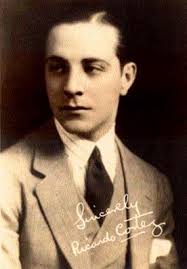
Born Today September 19: Ricardo Cortez


1900-1977

You would think with a name like Ricardo Cortez and the fact that he was born in New York City, he would be  Cuban, Puerto Rican or of some other Caribbean Latin ancestry.  In fact he was born Jacob Krantz to recently immigrated Austrian Jewish parents.  He mother was heavily pregnant with him when the couple made the move to NYC, so many sources incorrectly list his birthplace as Vienna.  The reason for his name change had nothing to do with him personally. With the popularity of the "Latin Lover" type, first made a character type by Rudolph Valentino, who was Italian and other actual Latin actors coming in to fill out roles; due to his genuinely Semitic dark skin color, Hollywood executives actually changed his name (possibly without his knowing it, or at least with some protest) to place him in roles of that sort.  Certainly he was a truly handsome man, and he did bear resemblance to Valentino.  But the incident reminds me a bit of the joke in the Coen Brothers Barton Fink, where Tony Shalhoub's character Ben Geisler mistakes Barton (John Tuturro) for an actor, notices his dark skin and makes a remark about "Indians" (meaning Native Americans), and Barton replies that he's there because he's a writer and Geisler replies "Think about it Fink! Writers come and go, we always need Indians!" (Interesting to me as a side note, because both characters are themselves Jewish).  Before going to Hollywood, and having that abrupt name change, he worked in New York on Wall Street by day and as a amateur boxer by night.  After the move to Hollywood, press kits on him were circulated stating that he had Spanish ancestry, but it wasn't long before rumors arose about his ancestry (now I wonder, did he start them???), so the studios then said he was actually French, finally they admitted his "Viennese" origin, which is why the confusion of his place birth has persisted.  He was married to tragic silent film starlet Alma Rubens until her untimely death in 1931 from pneumonia; but the couple had separated due to her on going drug abuse and instability, she was released from jail just shortly before she caught the cold that eventually led to her death at the age of 33 (she may have been one of the Hollywood Studios first victims of enticed drug addiction--that is a truly dark subject, that was thought to have developed after the silent era).   In all he appeared in 100 films, he was also the second actor to assay the role of Perry Mason, with Warren William being the first.  He went on, to star in films with the likes of Joan Crawford, Bette Davis, Al Jolson and one of the best horror actors of all time Boris Karloff.  Having worked on Wall Street before, when he retired from films he went back to New York and work as a stockbroker at the later infamous (as least for a while) Salomon Brothers.  As a moment of serendipity for me today, checking his credits, I found that archive footage of him was used in two Greta Garbo documentaries (both after his death)--her birthday was just a day before her, and I wrote about her just yesterday. He is interred at Woodlawn Cemetery in The Bronx.

Circa 1935

The Non-Latin Romantic's Early Films

The Fringe Of Society (1927) (scenes deleted, this had to be a real let down for him!  This was to be his first film afterall.  Also has to be one of the earlier cutting room floor incidents in feature films.)


The Next Corner (1924) (Lon Chaney Sr.)

A Society Scandal (1924) (a Gloria Swanson film--love her!!)


Feet Of Clay (1924) (hey the first Jaws film and directed by Cecil D. DeMille to boot.  Take that Spielberg!)

This Woman (1924) (thankfully now a formerly lost film!)  


In The Name Of Love (1925) (also starred Wallace Beery.  Lost film)


Torrent (1925) (this was Greta Garbo's first US film and the last time anyone was ever billed above her...that would by Ricardo Cortez)


The Sorrows Of Satan (1926) (not billed as a horror film, it was directed by D. W. Griffith--but it probably should have been.  Can be viewed as Christian propaganda these days.  At the time it was a over romanticized (surprised surprised) response to Theosophy.  It was adapted from a novel Check out the poster--it's awesome!)


Mockery (1927) (also with Lon Chaney Sr.)


Excess Baggage (1928) (lost film)

The Gun Runner (1928) (lost film)

The Younger Generation  (1929) (Frank Capra directed)

New Orleans (1929) (lost film)

Midstream (1929) (lost film)--was a partial silent with sound effect and musical soundtrack by RCA Photophone System)

The Phantom In The House (1929) (early talkie, sound by RCA Photophone System)

The Lost Zeppelin (1929) (this is a partially lost film that has further footage that has been found--some claim that it complete.  I haven't been able to confirm that.  Would love it if were true.  It is on DVD, but some footage may still be missing due to strange issues with subplots.  Or maybe, it's just a bad script)


Sunday, September 13, 2015

Born Today September 13: Claudette Colbert


1903-1996

Born Emilie Claudette Chauchoin in Saint-Mande', Val-de-Marne, France to French parents who had some Channel Islands ancestry, hence her often being referred to as a French/English actress in Hollywood.  Though she was immediately nicknamed "Lily" because an older relative shared her first name.  Her family moved to the United States when she was just 3 years old, settling in New York City in a 53rd street walk-up.  It was at this time that her parents legally changed her name to Lily Emilie Chauchoin.  She later attended Washington Irving High School in New York, which apparently had a large arts program even for schools of the day, this is where her artistic talents were first discovered.  She made her Broadway debut in 1923 in a play entitled "The Wild Wescotts."  After she began stage work, she herself again legally changed her name to Lily Claudette Chauchoin.  Apparently this is when she adopted her screen name that we all know her by today.  By 1927 she had received critical acclaim on Broadway, and event that was sure to draw the attention of Hollywood (some say she made the move herself because of The Great Depression, this make no sense, because her first film role came in the same year she broke through on Broadway--1927).  Her first appearance on the silver screen was in a film that did not do well at the box office and is now, sadly, amongst a whole host of lost film.  Such a pity, no matter who "bad" the film may have been.  Such a giant of Hollywood's first screen appearance should be around for viewing, if for just historical reasons.  She passed away at the ripe old age of 92 on the 30th of July 1996 in Barbados from complications after a series of strokes.  There is no need to for me to "over biographicalize" her here, since she was such a well known actress of Hollywood's golden age and here work in the 1920's film industry is short. She is interred with her last husband at Godings Bay Church Cemetery in the country of Barbados.


For More:


Serious flapper look here!

Work In 1920's Film:

For The Love Of Mike (1927) (a Frank Capra directed box office flop, and lost film, this was also apparently a terrible experience for her)

The Hole In The Wall (1929) (early talkie, sound by MovieTone)

The Lady Lies (1929) (early talkie, sound by Western Electric)