Showing posts with label American Mutoscope and Biograph Co. Show all posts

Monday, September 24, 2018

Born Today September 24: Marcus (Mark) Hanna


1837-1904

American businessman, turned Republican politician, Mark Hanna was born Marcus Alonzo Hanna on this day in New Lisbon (now just Lisbon) Ohio into a Quaker family of a physician and wife.  As a historical figure, there is little reason to try to go into any sort of detail concerning his life (links are provided below); suffice to say that that the films in which he appeared are strictly historical in nature.  Hanna appeared in 4 documentary news-reels toward the very end of his life.  The first of these was Republican National Committee of 1900, shot by the American Mutoscope & Biograph co. The other three shorts are as follows:

President McKinley Inauguration  (1901) [also Biograph]


Hanna died while still serving in the U.S. Senate in a Washington D.C. hotel, after a bout of typhoid fever weakened his heart on the 15th of February. He was 66. He is interred in a fancy family mausoleum located in Lake View Cemetery in Cleveland, OH. 


Saturday, February 17, 2018

Born Today February 17: Kate Bruce


1860-1946

Prolific silent era matronly actress Kate Bruce was born on this day in Columbus, Indiana. She started acting on the stage and made her film debut in The Fight for Freedom in 1908 in one of the films for American Mutoscope & Biograph that was ghost co-directed by D. W. Griffith to help mitigate the rather disastrous directing efforts by Wallace McCutcheon Jr.!   Bruce is known to have made at least one appearance on Broadway. She would go on to be a favorite actress for Griffith, who used her in older female parts that required a motherly type.  Once she entered pictures, her roles, though very small, were numerous.  She showed up in roles (some of them uncredited) in several of Griffith's most well known Biograph shorts, among them: The Country DoctorA Corner In Wheat, and A Trap For Santa Claus--all of them in 1909.  Of course, as an in-house actress with Biograph, she worked with other directors as well (including, most notably Travers Vale, but also J. Searle Dawley); however it was with Griffith that she is most associated in history.  The number of well known actors in the silent era that she acted along side is long and impressive as well.  That list includes: Jack Drumier, Alan Hale Sr., Lillian Gish, Dorothy Gish, at least one of the Moore brothers (Owen), and Louise Vale--wife of Travers.  One of her appearances with Dorothy Gish came in Gretchen the Greenhorn in 1916, filmed at Fine Arts Film Studio on Sunset Blvd.; it was probably the largest production she had worked on to date. [It appears that Bruce's first feature length appearance in a film came in politically motivated 1915 Civilization, which involved the Ince family is various ways].  She, along with practically everyone who had had worked frequently with Griffith, ended up with bit parts in his massive Intolerance: Love's Struggle Throughout The Ages in 1916.  After that film's production, she resumed work for Griffith in subsequent features--working almost exclusively for him from after 1917 through to mid-1920.  Getting older, she took fewer roles as the 1920's waned on; she took no roles at all in 1926 or in 1928.  The first talkie that she worked on was The Flying Fool in 1929, a William Boyd film made for Pathe Exchange that also had a silent version.  Her last role came, predictably, in a D.W. Griffith film in 1931: she was "Granny" in The Struggle.  She then retired and returned to the east coast, where the Gish sisters helped her live a comfortable, but modest life; she passed away on the 2nd of April, 1946 in New York City at the age of 86.  She was buried at Calvary Cemetery in Queens.  

With Mabel Normand

Leave Virtual Remembrances @ Find A Grave

Wednesday, December 20, 2017

Born Today December 20: Charley Grapewin


1869-1956

Charles Ellsworth Grapewin, who his entire life went by "Charley," famous as the uncle in The Wizard of Oz (1939), was born today in Xenia, Ohio.  Not happy in his young home life, he ran away literally to join the circus--this was the beginning of the young man's road to playing perpetual "old man roles" in character parts in many well known films of the first decades of sound films.  His first specialty was work was in aerial acts and, in the capicity, wound up working for B. T. Barnum.  His circus work eventually led him into acting.  Coming from this background, his drift into vaudeville work was inevitable if he wished to further his acting skills.  Grapewin became a skit writer as a result, penning stage plays for himself.  There is some speculation as to how long Grapewin had been acting on stage before making his film debut in 1900, but at least two decades is a reasonable time period to speculate.  Grapewin is known for his appearance at the dawn of sound in the late 1920's, but he actually first acted on film in Chimmie Hicks and the Rum Omelet (1900). The film was a comedic short that employed slapstick elements borrowed directly from the vaudeville stage--it was an American Mutoscope & Biograph Production, shot at their studio facility in Manhattan.  The film features Anna Chance, Grapewin's actual wife (the two were married in 1896 and remained married until her death). Grapewin also appeared, as the character Chimmie Hicks, in Above The Limit (much more famoulsly known as Chimmie Hicks At The Races).  Both films were shot in 1900, but the later is often dated 1902, and both are drawn directly from his vaudeville act at the time.  Garpewin would not appear in another film until 1929.  Below is an embed of the second of the two film's from the Library of Congress. 


He spent the rest of the time in-between on the stage, making it as far as Broadway (again, conflicting accounts abound as to how many times Grapewin was actually on Broadway--he is credited in some sources as a one time performer, in others as a performer in 1903 Broadway production of Oz). Grapewin returned to film, along with his wife, in Jed's Vacation (1929), a comedic full sound short based on one of Grapewin's scenarios and produced by Christie Film Co.  In all, the couple appeared in four short sound comedies during the year (3 by Christie and one for Universal), before Grapewin moved on to a role in Universal's vaudeville "throw-back" comedy The Shannons of Broadway (1929)--a 65 minute full Western Electric Sound film (the film is lost as of this writing).  He would go on to have supporting roles in some the most well known films of the 1930's and 1940's, including The Wizard of Oz.  These include: The Libeled Lady (1936) with Jean Harlow & an all star cast, The Petrified Forest (1936) with Humphrey Bogart & Bette Davis, The Good Earth  (1937), A Family Affair (1937) with Lionel Barrymore, and  The Grapes Of Wrath (1940).  Grapewin was the star of Tobacco Road featuring Gene Tierney, which was directed by John Ford. He also made several appearances the Ellery Queen films of the early 1940's as Inspector Richard Queen--mostly to Ralph Bellamy's Ellery.  The last film that he appeared was as Grandpa Reed in When I Grow Up, a Bobby Driscoll film, in 1951.  Upon his retirement in the early 50's, he had amassed over 100 film appearances.  Grapewin died on the 2nd of February in 1956 from natural causes at the age of 86 in Corona, California.  He was cremated and interred with the ashes of his beloved first wife in the Columbarium of Inspiration (in the Great Mausoleum) at Forest Lawn Memorial Park in Glendale.


Leave Virtual Remembrances @ Find A Grave

Thursday, May 11, 2017

Born Today May 11: Jean-Léon Gérôme


1824-1904

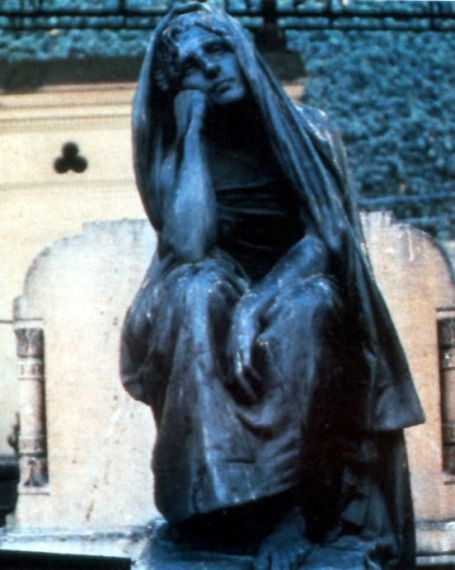
French academic artist Jean-Léon Gérôme was born on this day in Vesoul, France.  In 1840 he went to Paris to study under painter Paul Delaroche; the two made a teaching trip to Italy--visiting major cities and The Vatican, the pair even made a trip to Pompeii.  Gérôme, however, developed a dangerous fever and was forced to return to France in 1844.  He then became a fixture in the studio of resident Swiss artist Charles Gleyre; his stay there, though, was brief.  He then moved on to study at the Prix de Rome, but failed to graduate.  This was a blow to him personally at the time, but would prove short lived due to that fact that he found renown and fame soon after.  His subjects within the movement of Academic Art were quite varied; ranging from portraits, flirting with Oriental subjects, Greek Mythology, historical works and works depicting nature.  Though primarily remembered as a painter, Gérôme was also a sculptor.  His medium was primarily bronze, though he did experiment with the developing art of working with tinted marble.  As far as why he is being written up here, stems from his influence over one motion picture.  Usually, artists have credits in films that actually show case their works.  In Gérôme's case, we have a rare case where one of his works inspired a scenario for a film, where he receives a "writer" credit.  The film is The Slave Market and the scenario for the film is based on his painting The Slave Market In Rome.  It is a later American Mutoscope and Biograph production that dates from 1920.  It is a short film that interestingly is in the 1:36:1 aspect ratio.  Gérôme died in his studio in Paris on the 10th of February in 1904 at the age of 79.  He is buried in Paris' Montmartre Cemetery in front of a bronze statue he called Sorrow that he had cast for his son upon his death in 1891.  Please follow the Wikipedia link below for lots more!


For More:


Leave Virtual Flowers @ Find A Grave


Friday, April 14, 2017

Born Today April 14: Adna R. Chaffee


 1842-1914

Major General of the United States Army Adna Romanza Chaffee  was born on this day in Orwell, Ohio.  Chaffee started his military service by enlisting in the Union Army at the start of the Civil War.  He was soon promoted to Sergeant; and by 1863, just two years after his enlistment, was made First Lieutenant.  He served in several conflicts, both domestically and abroad.  He is mainly remembered for being the Chief of Staff of the United States Army between the years of 1904 and 1906.  He is also the father of Adna R. Chaffee Jr., who also rose to the rank of Major General.  The reason for his inclusion here is his appearance in one documentary short from 1901.  The War In China was produced by American Mutoscope & Biograph, and was actually shot in China.  It is the only documentary film that Chaffee ever appeared in.  After his retirement from the military, he moved to Los Angeles became a civil servant, being appointed president of the Board of Public Works.  Chaffee died on the 1st of November 1914, he was 74 years of age. He is interred in Arlington National Cemetery.


For More:


Tuesday, April 4, 2017

Born Today April 4: Pierre-Paul Prud'hon

A Self Portrait 

1758-1823

French painter Pierre-Paul Prud'hon was born on this date in Cluny, France.  He is most famous for his portraits, though he did paint landscapes and allegorical mythological subjects as well.  As a young man he received formal artistic training in several French provinces; and at the age of 26, he left for Italy to further his education.  Upon his return to Paris, he took numerous jobs painting the mansions of the elite there.  In his framed paintings, his style has been difficult to pin down, being influenced by at least two major styles of the time.  He counted a great number of his fellow artists amongst his admirers.  He is perhaps best known for painting for two of Napoleon's wives; with his portrait of Josephine being famous the world over.  There are not many entries her for artists that lived before the invention of motion pictures, because just not that many silent films used actual art in them; however one short film dating from 1900 does feature his work.  Phrosine and Meledore was an American Mutoscope & Biograph production; it was part of their Living Pictures series that did feature famous works of art. Prud'hon died either on Valentine's Day or two days later on the 16th in 1823 at the age of 64.  He is buried in the huge Pére Lachaise Cemetery in Paris.


For More:


Leave Virtual Flowers @ Find A Grave

Thursday, February 16, 2017

Born Today February 16: Julia Grant


1826-1902

Julia Grant was the 18th First Lady of the United States, being married to Ulysses S. Grant.  She was born Julia Boggs Dent on this date in 1826 in the White Haven section of St. Louis, MO to a slave owning planter and merchant and his wife.  She was the fifth of eight children.  She married the future president in 1848, with Grant's father refusing to attend the wedding on the grounds that he objected to her family owning slaves.  After enduring life as a military wife--being away from her husband for long stretches; and then as the wife of a poor farmer, the Grants found themselves caught up in the Civil War.  Ulysses Grant eventually found himself appointed commander of the Union armies; Lincoln sent for Julia, understanding her positive effect upon her husband.  In 1868 U. S. Grant won the nomination for the Republican party, Julia was much more elated than he was.  He felt he had been compelled to enter the race for highest office in land by the political storm surrounding the impeachment of Andrew Johnson.  She was deeply involved in her husband's political career, and she proved astute in her assessments of situations.  In regards to silent film, she appeared in two news reels the date from the year 1899.  The first was First City Troop Of Philadelphia, appearing with President McKinley.  The second was Mrs. Grant and President McKinley, which also includes Ida McKinley.  Both films were produced by American Mutoscope & Biograph. Her views on slavery and racism have always been a matter of conjecture; what is known is that she thought that the "black race" was inferior to the "white race," though she never supported post-war white supremacists--which included member of her own family--even a brother.  On women's rights, she was much clearer.  She was a complete defender of women's rights and would permit no jokes being told at a woman's expense in her company (especially in Washington D.C.).  After her husband left the office of the presidency, she joined several other former first ladies to become "Queen Mother" figures in the country.  Her husband died of throat cancer in 1885, she continued to live on until she passed away from kidney failure in Washington D.C. in 1902 on 14 December.  She was interred in General Grant's National Monument, affectionately known as "Grant's Tomb," in New York City.   As a curious fact, she always appears in profile in photographs, because she was born with strabismus; a condition that she wanted to correct after becoming first lady.  President Grant was having none of that, proclaiming to her "Did I not see you and fall in love with you with these same eyes? I like them just as they are, and now, remember you are not to interfere with them. They are mine, and let me tell you, Mrs. Grant, you had better no make any experiments, as I might not like you half so well with any other eyes."
 
[source: Found a Grave]

 
[source: Wikipedia]


For More:


Leave Virtual Flowers @ Find A Grave

Thursday, October 4, 2012

The Ghost Train (1903)

This is a "real life trick photo film" that was produced by the American Mutoscope & Biograph Co., the filmmakers working for them who shot this were neither never "credited" or those names were lost to history long before the 1920's.  The was made with a simple reverse negative process to turn an "actualities film" into something spooky.  By some standards it represents an example of American avant-garde in early cinema.