Showing posts with label Frankenstein (1910). Show all posts

Saturday, October 29, 2022

October 29: Mini Post on Some Makeup Men


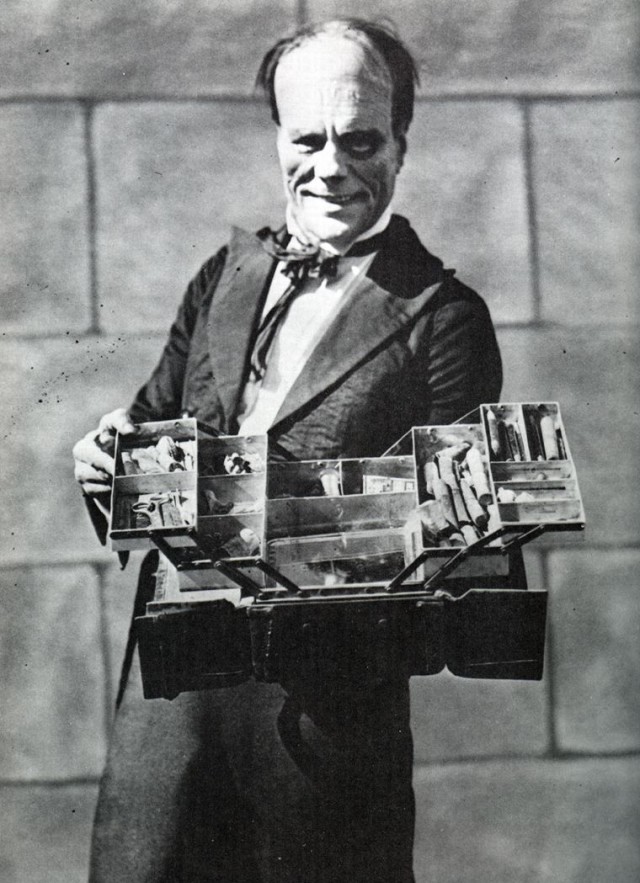
We all know Lon Chaney as "the man of a thousand faces" for his many roles that required either heavy makeup or prosthetics of some sort in the 1920's. Many people also know that Chaney was his own makeup artist, what is not as widely known is that Chaney was just one of a long line of actors that were also very accomplished makeup artists. Two actors to appear in horror before him that stand out are Charles Ogle and King Baggot. They both created their monstrous looks that have in many ways become iconic today.


Charles Ogle was the star of Edison's 1910 adaptation of Frankenstein, the film is only 16 minutes long, but it is memorable for it's creature. Ogle created the complete look himself and makes an unforgettable entrance in the film, emerging from a "creation chamber." His visage is as monstrous as the creature has ever been in film. With wild hair and deformed hands, he appears more a wholly supernatural monster, than a deformed human created wholly by science. Long thought lost until the mid-1970's; the film has been restored multiple times, most recently by our own Library of Congress. 


King Baggot was cast in the dual role of Dr. Jekyll and Mr. Hyde in the 1913  IMP/Universal adaptation of the Stevenson work.  Not the very first adaptation of the work, it was the first for Universal, making Baggot really the first "Universal Monsters." He was responsible for creating the visage of the wild and insane Hyde.  What is interesting about Baggot's Hyde is that it is a look that apparently influenced the 1941 MGM production starring Spencer Tracy.  Originally released in the two parts, the film in total runs close to half and hour. Both are available to stream online and are well worth a view. 

Monday, June 5, 2017

Born Today June 5: Charles Ogle


1865-1940

Giant of the early silver screen Charles Stanton Ogle was born on this day in Steubenville, Ohio, the son of a minister.  Ogle, of course, was a stage actor before acting in film and he made his successful Broadway debut in 1905. Ogle made his film debut in 1908, when he went to work for the Edison Manufacturing Company under contract--one of the first actors to sign such a contract with a studio (the first studio, no less).  The Boston Tea Party, a short historical drama, was released in July of that year and directed by Edwin S. Porter.  Under this contract he would assay a number of well know roles from works of literature.  Probably the most famous is that of Frankenstein's Monster in the very first film of that book.  Frankenstein dates from 1910 and was directed by J.Serle Dawley.  The film featured some truly impressive special effects for the day; Ogle created the makeup for the role himself--and he did a great job (!)--a tradition that was still going strong in the 1920's (see, for example, the many photos of Lon Chaney Sr. [an actor Ogle would later work with] and his portable make-up kit).

Ogle as The Monster

That same year, Ogle would go on to play the meek, hardworking, rather pathetic Bob Cratchit from Charles Dickens immortal Christmas classic A Christmas Carol  ; he played opposite Marc McDermott's Scrooge (McDermott was actually a much younger actor than Ogle).  He had no shortage of work at Edison!  By 1912, he found himself the star of What Happened To Mary, the first serial ever produced.  With the serial turning out to be a great marketing plan to the public (Edison quickly noticed that they were quite addictive), a larger serial thriller was planned and executed in 1914 with The Man Who Disappeared, both Ogle and McDermott [who was the star] appeared in it.  The last film that he made for Edison was also in 1914, he played Ragnarr in The Viking Queen.  After this, he and his frequent co-star Mary Fuller--who he had been working with since the beginning of his film career--absconded to Victor Film. The company had a distribution deal with Universal, and indeed, the first film that they made for the studio--The Witch Girl (1914)--was distributed by Universal.  By 1917, he was with Jesse L Lasky's company.  The first confirmed feature length film that he is known to have acted in was A Romance Of The Redwood (1917), a Mary Pickford film directed by Cecil B. DeMille; the film is 1 hour 10 minutes long.  In 1920, he appeared as Long John Silver in Treasure Island, a film which also featured Chaney Sr.  Throughout the 1920's he fell easily into character acting; with the last film that he appeared in coming in 1926 with The Flaming Forest.  With his retirement in 1926, in all he had appeared in more than 300 films.  Ogle lived a further 14 years in Long Beach, California, where he died from arteriosclerosis on the 11th of October in 1940.  He is buried at the Forest Lawn Memorial Park.


For More:


Leave Virtual Flowers @ Find A Grave

Saturday, May 13, 2017

Born Today May 13: J. Searle Dawley


1877-1949

The man who considered himself the very first real motion picture director, who the world came to know as J. Searle Dawley, was born James Searle Dawley on this date in Del Norte, Colorado.  I would say that it's more accurate to say that he could be considered the very first director of purely narrative films; but the honor of very first director really should go to the man who hired Dawley at the Edison Co., and that would be Edwin S. Porter.  Dawley at first wanted to break into the acting circuit, securing a position in the acting house run by Louis Morrison; however the tour that he was hired to work on was canceled and his was obliged to return home to Colorado.  This was in 1895 and came just after his high school graduation.  He rejoined the group in 1897, and worked both as a actor and a stage manager for 3 years.  He then left for the vaudeville circuit, with ambitions to become a writer.  He worked there both as a writer and actor, before joining the Spooner company, where he plied all of his talent accrued to date: acting, writing and stage managing.  Having gained attention of the Edison Co. and of Porter, he was hired in 1907 specifically to direct.  This was indeed a first.  He was hired to direct a short film that already had a scenario attached to it:  The Nine Lives Of A Cat became his directorial debut in 1907.  Though D. W. Griffith was two years older than Dawley, he wouldn't make his directorial debut until 1908.  In fact, Dawley would direct Griffith in a film that survives to this day; Rescued From An Eagle's Nest was filmed in 1908, before Griffith made his debut later in the year.  It is a remarkable film, because it contains some of the earliest complicated special effects--films had formally moved on from good old fashioned trick photography.  Some of Dawley's early work in Fort Lee for Edison available on disc include:  A Little Girl Who Didn't Believe In Santa Claus  1907, A Suburbanite's Ingenious Alarm 1908, Fireside Remembrances 1908 (all up to this point co-directed with Porter), and  Cupid's Pranks 1908.  Dawley made the move to California in 1910, earlier than most directors--though he still worked for Edison Manufacturing.  He began to focus of films on works of literature.  He brought works by Twain, the Brothers Grimm, Dickens, Dumas,  and Stevenson amongst others, to the moving picture.  But it would be one work of literature by a female author that Dawley would forever be known for.  In 1910 he made the first ever filmed adaptation of Mary Shelley's Frankenstein.  The film, though a short, features extremely sophisticated special effects--cutting edge for it's time.  


It was released on March 18th and starred Augustus Phillips (in his first film appearance) as Frankenstein and Charles Ogle as his monster.  Being the person chosen to set up Edison in a new studio in the Hollywood area, he also brought in new directors that would go on to have a big impact on silent cinema.  The first non-Edison film that he directed was for Solax (Alice Guy's studio).  The film was Between Two Fires (1912), this was quite a long time before he severed work for Edison.   In 1912 and 1913, he began filming outdoor documentaries, most in Yellowstone National Park, but at least one film was produced in Yosemite as well (Dawley had developed a penchant for photographing and filming in the locations as he made his way from the east coast to the west coast--many of these films were actually filmed during the his time of travel and released later).  In 1913, he made his first film for Zukor's Famous Players, a adaptation of Thomas Hardy's Tess Of The D'Urbervilles.  Though known as a famous silent film director, it should not be forgotten that one of his first skills in the theater was writing, and though he was adept and literary adaptation, he also wrote original scenarios for films as well.  The first of these came in 1909 with The Legend Of Sterling Keep.  In all, he has 40 writing credits to his name.  And though he would never make a film in the sound era, his films were not all silent, in fact, the one credit that he has for cinematographer comes in a De Forest Phononfilm demonstration entitled Adolph Zukor Introduces Phonofilm, a film that has Zukor explaining the Phonofilm sound on film system, it dates from 1923.  In fact, his last 3 films used the De Forest Phonofilm system and were full sound movies:  Abraham Lincoln dates from 1924 and Roger Wolfe Kahn Musical Number dates from 1925.  Dawley's last film came out in 1926:  Brooke Johns and Goodee Montgomery, it is a formally lost and now restored film.  After this, Dawley decided to retire from the movie industry; he eventually made his way over to radio, where he worked successfully through the 1930's.  Dawley would also go on to be one of the founders of an organization to would eventually turn into the Screen Director's Guild.  He certainly influenced a whole host of other directors, both contemporary with him and a younger generation coming into their own when he decided to retire.  Walt Disney mentioned several times how influential Dawley had been for him on multiple levels.  Dawley passed away in Hollywood at the age of 71 on the 30th of March 1949.  Strangely there is no information about a funeral service of any sort.  


For More:

IMDb

Wikipedia

Saturday, October 25, 2014

One Of My Favorite Horror Stills!


From the very first filmed production of Frankenstein dating from 1910, produced by the Edison Company and directed by J. Searle Dawley ans starring Charles Ogle as the above pictured Monster.  

Sunday, October 13, 2013

Stills From The Very First Frankenstein (1910)


Black and White Stills


Creation Fire Stills


Sepia Stills


Monster In Reverse
Yellow Toned Sepia Stills


Purple Toned Black and White Stills


And just for the heck of if, I'm reposting the full movie below, even though I posted during last year's Countdown To Halloween.  HAPPY HALLOWEEN SEASON!


Tuesday, April 12, 2011