Showing posts with label Tod Browning. Show all posts

Tuesday, October 25, 2022

October 25: Arachnida the Human Headed Spider


There are a few images from silent films that always show up on various social media platforms around Halloween. One of the most famous is from a Tod Browning's film from the 1920's. Thing is...credit on the image is just as likely to be wrong as right. The image in question is Browning's human spider from his 1927 film The Show. I will leave off any analysis of the film and any connections to Browning's Freaks. Focusing instead on giving credit to French born actress Renée Adorée who is the head of the "human spider" Arachnida costume created for the film.


The concept was not original to Browning; and he was not intending to take credit for it. It was meant to be a quote of sorts. It had long been an actual sideshow attraction that was popular for years before the film's production; it even showed up later as a prop that a person could insert their head in to have a photo taken as a carnival memento. The film which has Adoreé as Salome opposite John Gilbert as Cock Robin, centers around a group of carnival performers in Budapest that perform a variety of dances and illusions in a side-show; the human spider is but just one. The film is based on the 1910 novel The Day of the Souls and is really more of a crime story than a horror. But, this is Tod Browning, and the images are always going to be striking!


Below is a still with John Gilbert in the foreground in character as Cock Robin.  


Saturday, October 22, 2022

October 22: The Unholy Three (1925 & 1930)


Lon Chaney may not have lived long enough to reprise role from Tod Browning's London After Midnight, but he did reprise another Browning role in a speaking remake of the original. Regarded as one of Browning best films, his 1925 The Unholy Three starred Chaney as a ventriloquist (a feat of very expressive silent acting); Chaney reprised the role in an all sound version in 1930 just prior to his untimely death that year (it would be his only speaking role in a film).  Browning, however, did not direct the film: Jack Conway did. Conway was regarded as a "Jack of all trades" (literally) in terms of genres that he directed. He was not known for an particular specialty; which meant that his pictures, while technically good, were rather bland; it also meant that he was beloved by studio management, particularly Irving Thalberg. The talking remake suffers for it though. It's a competent enough film to be sure, but it is (like so many remakes after it) a poor imitation of the original. The only other principle actor to return from the original cast was German born actor Harry Earles (Kurt Schneider).  Earles was Tweedledee in the original; Conway and crowd merely credited him as "midget" in the remake (Earles was only 3'3"). Below are some production comparisons of the two films. 


Saturday, October 15, 2022

October 15: Juxtaposing London After Midnight with The Mark Of The Vampire


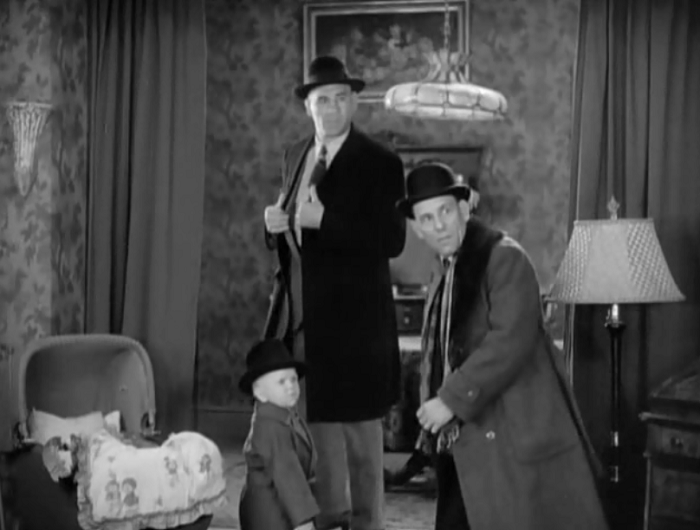
Director Tod Browning remade his London After Midnight (1927) as The Mark of the Vampire in 1935. His original intent was to have Lon Chaney reprise his role of the professor, but Chaney died at the age of 47 in 1930. The next logical choice was Bela Lugosi whom Browning had directed in Dracula in 1931. Today a full print of the London is one of the most sought after films in the world.  Mark of the Vampire however, is very much intact and available for viewing. Just a few still comparisons follow. 


Sunday, October 2, 2022

October 2: The Mystic (1925)


I can't help but get some Tod Browning entries here early in Spooktober. Browning arguably became one of the earliest (at least in America) directors associated with the horror genre. Today we have everyone from John Carpenter to Ari Aster, David Cronenberg to James Wan, Tobi Hooper to Robert Eggers, and the list goes on. And while the world of cinema had Méliès from France, Murnau from Germany, George Albert Smith and even the up and coming Alfred Hitchcock (not known for his dark side until the 1930's) from Britain; the U.S. had no directors that were closely associated with the genre. Sure, there are American horror films from the 1910's and very early 1920's, but Brownings turn toward the dark side in the 1920's cemented in his own mind a desire to present truly gothic cinema and films with darker elements. This may have been in no small way to do with his close association with Lon Chaney. Known for good reason as "the man of a thousand faces," due to his talented proficiency in self applying the heavy make-up for roles that called for complete physical transformation. But, it should also be pointed out that Browning often let Chaney inhabit roles that did not require heavy make-up at all, thus both allowing him to bring more psychological sophistication to sinister parts and prove that he was an absolute acting talent, with our without the make-up bag. By the time The Mystic was made however, Browning was just beginning to make this turn and had only The Unholy Three as his only well known  Chaney film under his belt to date. He did not work with Chaney here, presumably because Chaney, was off making The Monster with Roland West. Instead we have Conway Tearle (as Michael Nash aka "the bad guy") in a supporting male role behind star Aileen Pringle as Zara (the mystic). She shines in the role and completely elevates the entire film from crime concept and conceit, to a real believable drama with real humanity and pathos. This is good, because without some added sophistication, the plot is overly simple and was nothing new.  It's the old "Gypsy medium" vehicle, with a the slight plot twist of having a group of Hungarian "gypsies" imported by an American criminal "mastermind" (Tearle) to swindle an heiress out of her valuable jewels to (for Zara, of course), and sign over her other holdings him.
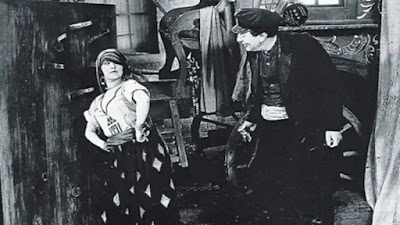


The plot is certainly racist by today's standards (and it was back then too, that was part of the point; adding the supposed element of criminality, that the Roma (e.g. "gypsies") were equated with criminal behavior far and wide--it was just considered acceptable racism). It was a plot that hung on longer than it should have, having even shown up in my lifetime in a Scooby-Doo episode "A Gaggle of Galloping Ghosts" (to be sure, by this time the racism is put off onto the character who is using the Gypsy disguise to ward off the Scooby Gang).  But....,yes, BUT, this is a Tod Browning film and he rarely disappoints. The screenplay was an adaptation of his own story (adapted for the screen by Waldemar Young), and it had a number of strange twists and darker elemental flares and, of course, the filming is excellent. The sets, costume design and atmospherics are all beautiful to look at, but are in no way distracting from the story (which the viewer is in on from the beginning). Working the cinematographer Ira Morgan, who was by 1925, a seasoned DP veteran, Browning was able to produce a film full of (melo)drama that was not cliched. And it stands the test of time. It is not a silent horror film, but it's dark and moody enough to warrant a place in any Spooktober silent lineup.


Browning plot point of trivia: there is performative knife throwing at the beginning of the film--foreshadowing Browning's The Unknown two years later--with Chaney back in the lead, opposite a very young Joan Crawford. 

Friday, October 15, 2021

Spooktober 15: The Unknown (1927)


Tod Browning's film Freaks (which is currently streaming on HBO) was not his first foray into the world of "circus freaks." In 1927 he directed The Man of a Thousand Faces (and apparently feet as well) Lon Chaney in The Unknown. Also starring Joan Crawford, it is the a story of "Alonzo the Armless" a fugitive and "freak imposter" played by Chaney. On the run from the law, he joins the circus as an armless knife thrower (!) and works with Nanon (Joan Crawford) the circus player at whom he tosses knives (and even fires a gun) at with his feet. Nanon, it turns out has a fear of being "pawed" by men (we have every good reason to believe that she is living the horror of being a sex assault survivor). Alonzo falls for her, but of course he actually has arms, which he is secretly terrified she will discover. Meanwhile the circus strongman has also fallen for Nanon, whom she likes but fears being close to. The lengths to which Alonzo is willing to go to make sure that he and Nanon can live happily together is the true horror of the film.... I am sure one has a notion of where this is headed, even if you have not seen the film. The Unknown is more of a psychological fear drama, than a straight forward horror film. It certainly has no supernatural horrors. But, and it is an important "but," it counts as one of the very first body horror films.  Many, if not most, more modern body horrors--everything from Eyes Without A Face, Cronenberg's The Fly to The Skin I Live In--contain strong stories of obsession that lead to various mutilations and horrific physical outcomes. The Unknown was one of the very first.