




I felt it was time to feature some more Méliès, and it is also a good idea to occasionally take the time to turn a little attention to some of his films that are, at present, lost to us. Many only have titles, and are known only by catalog entries; but some, like this one have extant materials. In this case, all that remains of Méliès Le petit chaperon rouge [Little Red Riding Hood] is one of his drawings. What currently survives of this 1901 short, which was probably released in the spring of 1901 in France, is the color illustration made by Georges Méliès himself of his intents for the final scene of the film. We do know that the film was quite popular as it was released in both the U.K. and the U.S.; though only in the U.K. was it properly promoted. We also know that the film had hand tinting, due to the distribution in England by the Warwick Trading Company, as they had the choice to distribute the film in either color or in black and white. One small hope that we have that a copy may be found, say perhaps in the Library of Congress, in a mislabeled storing is that Edison's company, in all definitions of the word "stole" the film from Star Pictures and promoted it in the United States as an Edison production. Shockingly, laws in the U.S. at the time (written largely due to lobbying by Edison and like companies) permitted this. For this reason, it, ironically, gives film historians and film lovers some hope that copy may turn up under this bogus title.


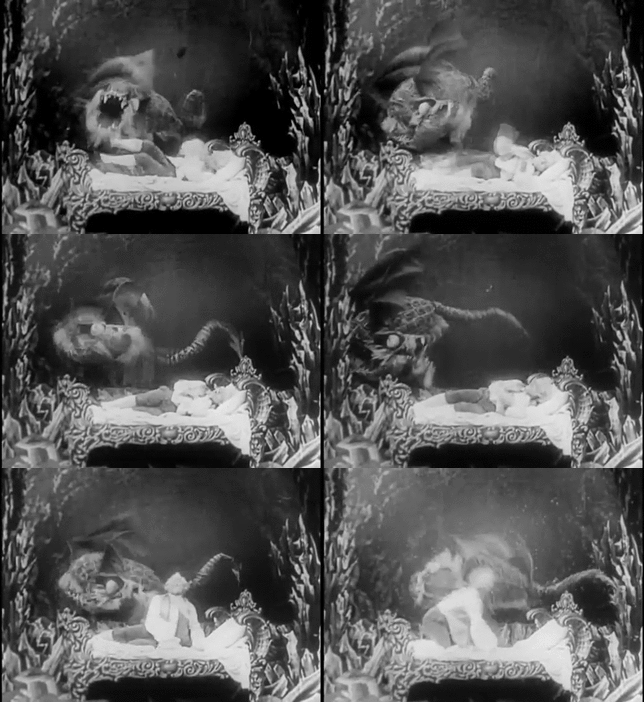
I feel like I would be remiss if I didn't feature a Méliès film in the first week of Spooktober, so I am going with one of his lesser known "trick films." One of literally hundreds that he made between the last five years of the nineteenth century and the first decade of the twetith (many lost, as one can well imagine), Le Portrait Spirituel (or The Spiritualist Photographer) isn't so much a horror film, or even a fantasy picture, as it is a light hearted fancy that pokes fun of the spirit photography tradition that was an absolute craze in the late 1900's, but had waned by 1903. There is nothing derogatory in this little 2+ minute affair; rather it focuses more on Méliès' well honed editing talents. It's really more like a "magic" film (say, in like the David Copperfield tradition). But, it is fun and very atmospheric for this time of year. Besides, Méliés is credited with making the very first actual horror film, back in 1896. Happy Halloween Season 🎃


1747-1794
German poet and ballad writer Gottfried August Bürger was born on this day in the Prussian village of Molmerswende (now incorporated into Mansfeld in Saxony-Anhalt) to a prominent Lutheran pastor. A fanciful and somewhat morose child who preferred to keep to himself in nature, he also began to write verses at a very early age, almost as early as he learned to write. He was also a sensitive child who was sent off to boarding school to be groomed for a career in theology, at an unreasonably early age, causing trouble with his studies, particularly classical languages, but not for lack of intelligence. What he possessed in intelligence he lacked in discipline; as soon as he was at University in 1764 to study theology, he quickly switched his focus to literature, only to switch (after family urging) again to the study of law in 1868. He did make progress in this field, but added the study of classics to his menu in the 1870's. He had never given up his study of literature however, and though it was well read in the literature of the continent, he was particularly found of Shakespeare and of English and Scottish balladry--both the ballads themselves and their makers (when known). In 1773 he published his own ballad Lenore; it was to become his most famous work--widely translated and read. Gothic in nature and full of the fanciful dark places that he used to frequent as a child, it basically a ghost story--but it has also been interpreted as a vampire tale, especially in the 20th century after the 1897 publication of Bram Stoker's epistolary Dracula (and I have personally wondered more than once if the name might not be, if not the answer, at least an answer to where Edgar Allan Poe came to use the name in his own poetry). The work certainly shows up in the writings of others, including Shelley and Dickens, but also Stoker himself. On this point, there is no doubt that aspects of the poem have been used in screenplays, for which Bürger has never once been credited (two screenplays explicitly come to mind: Dan Curtis' Dracula from 1974 written by Richard Matheson & Coppola's Bram Stoker's Dracula from 1992 written by James V. Hart). Rather is is his translation and "interpretation" and "elaborations" on Raspe's novel Baron Munchausen's Narrative of his Marvellous Travels and Campaigns in Russia for which he gets film credit (up to a point). Bürger translated the book into other languages, including English; which were so popular that there were successive editions. To this end, Bürger admitted embellishing the tale tales and adding to some of the more excessive boasts of the Baron, but he was also improperly supposed to have written the work in the first place in England for a long time. And it is his name that appears in the credits of the very first film made from the tales. Ironically, the film is not English, it is French and made by the master of the original trick film himself: Mèliés. His The Hallucination of Baron Munchausen (a rough translation--for English marketing purposes--from his original French title that literally translates as The Adventures of Baron von Munchausen); a later film for him made in 1911, it gives sole credit to Bürger for the book with no mention of Raspe (probably because he was unknown to the filmmaker entirely); French novelist Théophile Gautier is also credited as the translator. The one other silent film made from the Baron Munchausen material was also produced in France the following year by Gaumont. The Wonderful Adventures of Herr Munchausen was directed by Ëmile Cohl and credits both Bürger and Raspe for "inspiration" no other writers are credited. Given that Cohl was a pioneer in animation, I have to wonder if the film didn't contain some animations, despite it being a short. The very next version of the film, probably the second most famous behind Terry Gilliam's version; and, disturbingly, it is also a brilliant piece of German propaganda. Münchausen (or The Adventures of Baron Munchausen), doesn't credit either of them (neither does Gilliam's version, for that matter). They both get writing credit in the 1962 Czech language version, while Rasp gets sole credit for a 1967 and a 1979 version. Bürger again gets solo credit in a Hungarian version of the book released in 1978; and again in an animated French film released the following year. Gilliam's film was released in 1988 and that is where the credit for Munchausen ends for Bürger. He has one more writing credit for the historical television mini-series Absender from West Germany from 1982, where he is also the subject on of one of the episodes that aired on the 24th of October. Bürger himself continued to write and teach throughout his life with the same, if reduced, hectic approach that characterized his early life. At one point he was given a teaching accolade with position attached to it, but without even so much as a stipend to go with it; so while he had a "major award" he was also obliged to teach for free. Naturally these kinds of turns in his life lead to poverty later in life. By the time of his death on the 8th of June at the age of just 46, he was on government assistance. He is buried at Bartholomäusfriedhof in Gottingen in Lower Saxony. It is a pity that none of his actual writing has been adapted for film, as he wrote several very influential poems and his ballads (of which there are many) are considered among the best ever written in the German language.

[source: Wikimedia Commons] 
[source: Wikimedia Commons]


