Showing posts with label The Unholy Three (1925). Show all posts

Saturday, October 22, 2022

October 22: The Unholy Three (1925 & 1930)


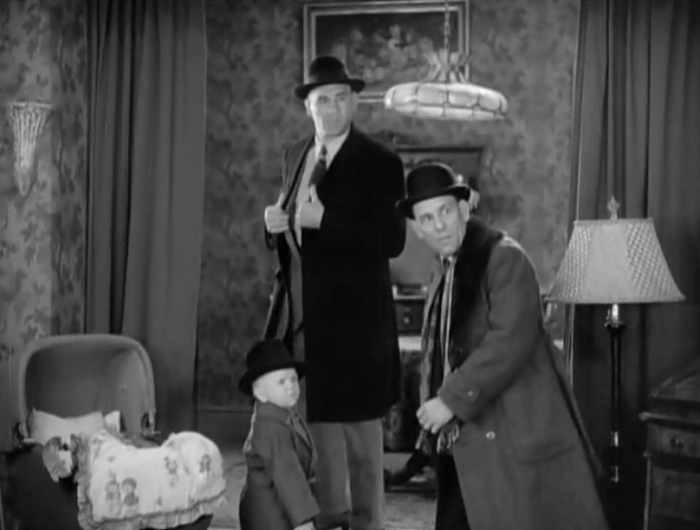
Lon Chaney may not have lived long enough to reprise role from Tod Browning's London After Midnight, but he did reprise another Browning role in a speaking remake of the original. Regarded as one of Browning best films, his 1925 The Unholy Three starred Chaney as a ventriloquist (a feat of very expressive silent acting); Chaney reprised the role in an all sound version in 1930 just prior to his untimely death that year (it would be his only speaking role in a film).  Browning, however, did not direct the film: Jack Conway did. Conway was regarded as a "Jack of all trades" (literally) in terms of genres that he directed. He was not known for an particular specialty; which meant that his pictures, while technically good, were rather bland; it also meant that he was beloved by studio management, particularly Irving Thalberg. The talking remake suffers for it though. It's a competent enough film to be sure, but it is (like so many remakes after it) a poor imitation of the original. The only other principle actor to return from the original cast was German born actor Harry Earles (Kurt Schneider).  Earles was Tweedledee in the original; Conway and crowd merely credited him as "midget" in the remake (Earles was only 3'3"). Below are some production comparisons of the two films. 


Monday, January 8, 2018

Born Today January 8: Matt Moore

[Photo: Freulich/Universal Pictures]

1888-1960

Youngest of the Moore Brothers from County Meath, Ireland, Matt Moore was born today two years after his brother Owen and 5 years after the eldest Tom.  The brothers immigrated to the U.S. in 1896 on the cheapest passage on a passenger liner, passing thorough the Ellis island gateway in May of that year.  Matt's career was longer than that of his older brothers, but only just in the case of Tom.  His career during the silent era was very successful.  Moore made his debut in the film Tangled Relations in 1912; a production made by Victor Film (the company set up by Florence Lawrence and her husband Harry Solter with backing by Carl Laemmle) where his brother Owen was already working.  From here, he went to work at Laemmle's IMP, next showing up in the George Loane Tucker film Just A Fire Fighter  in 1913 (Moore also appeared in Tucker's 1913 Traffic in Souls the rather infamous [due to it's subject matter] 6-reel "white slavery" film).  His appearances in films at the company over the next year  were mostly opposite Jane Gail, who starred in a number "Jane" films for the studio.  In fact, it was on a "Jane" picture later in 1917 that he first sat behind the camera for the first time on Plain Jane, a film that he also appeared in.  Moore would go on to have 18 credits for directing between 1913 and 1917.  The vast majority of the films were shorts featuring himself and Gail--the last of these was The Brass Girl (1917).  In the meantime, he was on the set of The Pawn of Destiny in 1914, when the infamous set fire broke out that essentially ended her career. He was the actor that the studio claimed that the diminutive actress was supposed to have saved single-handedly.  Of course, it was just a press fabrication and one that must of have mortified Moore.  Two years later  he would go on to his most important role of the teens in the underwater extravaganza 20,000 Leagues Under The Sea, which was directed by Laemmle himself and was a cinema first in terms of undersea camera work.  By 1920 Moore was still appearing in films being produced in the New York area; late for the time period when the majority of studios had made the major move west.  In the early 1920's he found himself working for the Selznick Pictures Corp. By 1922 Moore had moved over to films produced at Universal (Lewis Selznick's  company would not survive much longer).  Universal's The Storm (1922) may not have been the first film that he acted in California (it likely is), but, certainly by this time, he had made the westward move at last.  By the mid-1920's he had also made films for both MGM and the new studio in town: Warner Brothers.  In 1925 he had a major role in the one silent film that he is remembered for; he assayed the role of the straight man Hector McDonald in Tod Brownings famous crime film The Unholy Three, starring amongst others, Lon Chaney Sr.  And, by the late 1920's, he had become a kind of comedy specialist, taking top billing in a number of feature length domestic follies.  He was also at the top of the bill for a couple of mystery films that did quite well at the box office.  These titles include Tillie the Toiler (1927) starring Marion Davies, Diplomacy (1926) with Blanche Sweet and Three Weeks in Paris (1925) which was penned by Darryl J. Zanuck.  The first film that he worked on that had sound was the partial silent Dry Martini in 1928; the film starred Mary Astor and featured a MovieTone musical score.  His very next film, Coquette (1929), was a full talkie of his career, and featured his sister-in-law at the time Mary Pickford (who was married to his brother Owen).  Moore weathered the transition to sound just fine (as did his brothers), his turn in the Joan Crawford film of 1932 Rain, shows his bankability in the new talking era.  He worked continuously throughout the 1930's and 1940's, though by the late 1940's his roles had dwindled to small to uncredited.  He lived long enough to debut on the small screen as well.  In 1955 he played a judge in an episode of Screen Directors Playhouse; and he went on to make a couple of more television appearances in his lifetime.  The last film that he appeared in was the B-horror mystery I Bury The Living in 1958.  Matt Moore passed away in Hollywood on the 20th of January in 1960, just a couple of weeks after his 72nd birthday.  He is buried (along with his brother Tom) in Calvary Cemetery in East Los Angeles.  


IMDb

Wikipedia

Leave Virtual Remembrances @ Find A Grave

Thursday, December 10, 2015

Born Today December 10: Victor McLaglen


1886-1959

Born Victor Andrew de Bier Everleigh McLaglen; the place of his birth is bit of a mix-up.  On the one hand, he claimed to have been born in Tunbridge Wells, in County Kent; on the other, his birth certificate states that he was actually born in the East End of London.  On thing is for sure, he was born somewhere in England in the United Kingdom.  People popularly believe that he was completely of Irish ancestry; when in fact, he was Scottish by ethnicity.  His father, who would become a Bishop in the Free Protestant Episcopal Church, moved the family to South Africa when Victor was a child.   He actually joined the British Army when he was 14, lying about his age, but soon after was forced to leave when his true age was discovered.  Four years after this, he moved to Canada and became a successful boxer and wrestler.  He was also famous for being a westerner that practiced and mastered the martial art of Jujutsu and even wrote a book on the subject. When World War I broke out and rejoined the army, serving as acting Captain for the 10th Battalion, Middlesex Regiment.  He also did some service in Baghdad later in war.  While in the army he was Heavyweight Champion in 1918.


After the war, he began taking roles in British silent films.  From the start, they were not small roles--no uncredited roles in his filmography.  The first film he appeared in was The Call Of The Road in 1920, the plot of which revolved around boxing.  At some point he moved to Hollywood and quickly became a character actor in silents.  He often played Irishmen, which lead movie goers to assume that he was actually from Ireland, rather than from England.  One aspect of his "character" was that he was particularly good at playing drunks.  One of my personal favorite silent films that he had a role in was The Unholy Three (1925), which was remade as a talkie in 1930.  He starred alongside "The Man Of A Thousand Faces" himself, Lon Chaney, Sr. It is crime caper that just captivates; and, of course, he plays the strongman figure in the film. Rounding out the "three" is Harry Earles, who stood only 3'3" as Tweedledee. This is why I got the joke in Rob Zombie's The Devil's Rejects (2005), about the "The Unholy Two" featuring one of my favorite Native American actors:  Danny Trejo.  To my mind, the 1925 silent is better than the talking remake, which also featured Chaney, Sr.  

The Unholy Three

For a man that went into acting with no formal training, and went directly into leading roles in silent film, McLaglen made the transition to sound film with a great of ease.  The first full sound film that he was in is The Black Watch (1929), which starred Myrna Loy and was directed by John Ford.  Sometime toward the end of his life and during his third and final marriage, he became a naturalized citizen of the United States.  He died of a heart attack on 7 November 1959 in Newport Beach, CA.  He is interred in Forest Lawn Memorial Park in Glendale.


Below is the clip from The Devil's Rejects that includes the "the unholy two."