Showing posts with label MGM. Show all posts

Saturday, October 22, 2022

October 22: The Unholy Three (1925 & 1930)


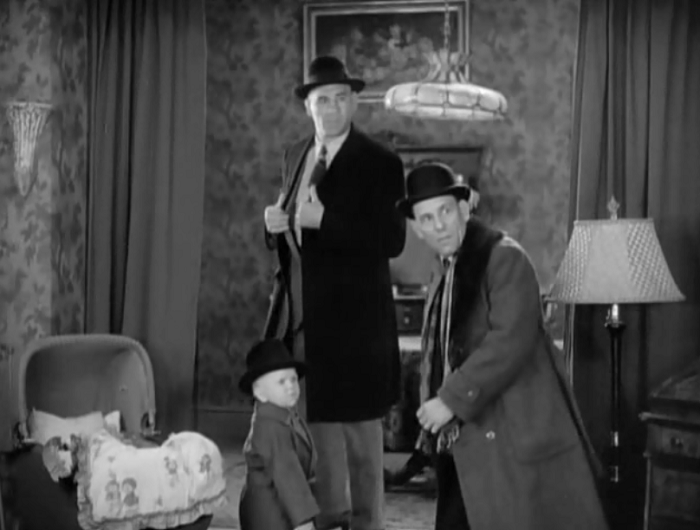
Lon Chaney may not have lived long enough to reprise role from Tod Browning's London After Midnight, but he did reprise another Browning role in a speaking remake of the original. Regarded as one of Browning best films, his 1925 The Unholy Three starred Chaney as a ventriloquist (a feat of very expressive silent acting); Chaney reprised the role in an all sound version in 1930 just prior to his untimely death that year (it would be his only speaking role in a film).  Browning, however, did not direct the film: Jack Conway did. Conway was regarded as a "Jack of all trades" (literally) in terms of genres that he directed. He was not known for an particular specialty; which meant that his pictures, while technically good, were rather bland; it also meant that he was beloved by studio management, particularly Irving Thalberg. The talking remake suffers for it though. It's a competent enough film to be sure, but it is (like so many remakes after it) a poor imitation of the original. The only other principle actor to return from the original cast was German born actor Harry Earles (Kurt Schneider).  Earles was Tweedledee in the original; Conway and crowd merely credited him as "midget" in the remake (Earles was only 3'3"). Below are some production comparisons of the two films. 


Monday, October 16, 2017

Born Today October 16: Harry Rapf


1882-1949

Producer, studio executive and promoter Harry Rapf was born on this day in New York City.  He started out in vaudeville, working to put together traveling acts and promoting them.  He first got his start in the film industry in 1917 as an early example of what became known as a "presenter." His first presentation was (as far as anyone knows) The Argyle Case.  The film was also partially produced by his own company, Harry Rapf Productions, and was directed by Ralph Ince. The first film for which he receives a direct producer credit for (though he should had one all along with any film his production company was involved in getting made) was To-Day in 1917.  He quickly became one of the most important inside movers and shakers in the budding Hollywood studio system, but quietly and practically. He was one of the first top executives in the newly formed Metro-Goldwyn-Mayer from 1924 on.  He was a personal favorite of Louis B. Mayer; and was a much lower profile executive than a Irving Thalberg.   He created the comic duo (one that most have never heard of) of Dane & Arthur in the late 1920's and he was one of the founders of the Academy of Motion Picture Arts and Sciences (AMPAS).  He also managed to help steer productions through very, very hard times in the 1930's during the depression.  He would continue to produce films right up until his death, in fact.  In 1929, he was a heavy producer and promoter of films featuring full sound and early technicolor two color process.  The last silent film that he produced with the Norma Shearer After Midnight in 1927. All of the films he produced in 1929 had either the color process and full or partial sound--most has both, including the once missing and recovered short Manhattan Serenade.  His The Broadway Melody was nominated for 3 Oscar awards (the brand new award given by the Academy he helped found) and won Best Picture. In the 1930's, he produced in nearly all genres.  For example, he was a producer on Tod Browning controversial 1932 film Freaks, albeit as a "stealth producer." By the 1940's, his production work slowed considerably; by the mid 1940's he wasn't producing at all.  He had suffered a near fatal heart attack in 1939 which was responsible for the slow down.  He produced just one film in 1946. His final film production was the Van Johnson film Scene Of The Crime 1949, the film was released after his death.  Rapf passed away from another heart attack on the 6th of February in Los Angeles.  He is interred Home of Peace Memorial Park in East Los Angeles.  Rapf was the father of producer Matthew Rapf and writer Maurice Rapf.


Tuesday, May 30, 2017

Born Today May 30: Irving Thalberg


1899-1936

Famed and highly influential early movie producer Irving Grant Thalberg was born on this day in Brooklyn, New York.  At birth he was diagnosed with what was then called "Blue Baby Syndrome" which turns out to be a congenital heart problem.  His doctors told his parents that Irving would be lucky to live to age 20, never mind to 30.  He started experiencing difficulties with the condition while in high school, and to make matters worse, he contracted rheumatic fever when he was 17.  This confined him to bed for a year; insatiably reading everything he could get his hands on became his past time. Lacking the health to enroll in college, he then took a series of part-time jobs; he also taught himself a set of skills that would hopefully help him find better work, they included: typing, short hand and Spanish--he also attended night school.  At the age of 18, he placed an ad in a newspaper touting what experience he had and simply stating "situation wanted"--what he wound up with was a secretarial job at Universal Pictures' New York office!  He quickly worked his way up the ladder to become the personal secretary to the studio's founder Carl Laemmle.  One of his duties was to transcribe Laemmle's notes that he had taken during screenings of films--before long he was making helpful suggestions to Laemmle, offering keen insights, which clearly impressed his boss.  It was not long before Thalberg was issued an invitation to the Los Angeles production studios, where he was given an unofficial management position.  When Laemmle returned to the studio he asked for Thalberg's notes on the goings on in his absence and what sort of action should be taken to correct the problems that Thalberg had carefully described to him.  Amongst Thalberg's recommendations was that a new management position needed to be established at the facility--Laemmle reportedly said "All right, you're it," to which Thalberg supposedly replied "I'm what?!"  So, at the age of 20 he was put in charge of the studio on the west coast, with Laemmle going back to the east coast.  Two years later, he started work as a producer; with Reputation (1921) reportedly being the first film that he had a hand in producing, but went uncredited.  Despite his frail and slight stature and his extreme youthful look (he looked around 15 years of age), Thalberg quickly established himself as a force to reckon with.  His managerial style was to intervene when he saw excesses that directors were taking.  He had a legendary battle with director Erich von Stroheim, whom he would go on to fire out right: a move that utterly shocked the movie industry.  He even got David O. Selznick's attention for the move.  Despite this, he was repeatedly taken for a office boy by those who only knew him by name and not by sight. The first film that he received a production credit for came in 1923 with Merry-Go-Round; though he already had two writing credits to his name from 1922, the first of which was The Dangerous Little Demon.  He was one of the movers and shakers early on in the production of the Lon Chaney Sr. classic vehicle The Hunchback Of Notre Dame (1923).  It was not long before other studios began to take a long hard look at attempting to hire him away from Universal.  The person that succeeded in doing so was Louis B. Mayer, who hired him outright as vice-president in charge of production at his Louis B. Mayer Productions.  The first film that he produced in his short lived position with that company was His Hour (1924).  When Mayer Productions became one of "M's" in MGM, 24 year old Thalberg was made part owner of the newly merged company.  In his time there, he over saw the production of literally hundreds of film.  Funnily enough he would wind up one of the major producers on Stroheim's Greed (1924); which was the second film that he produced at the newly minted MGM, the first of which was He Who Gets Slapped (1924)--a Victor Sjöström vehicle.  Notably, that film starred Norma Shearer, whom Thalberg would go on to marry and have two children with.  It was his idea to have the new studio produce a longish short basic introduction to the new studios in 1925 with 1925 Studio Tour in which he makes a personal appearance.  The first partial silent that Thalberg produced came in 1928 in White Shadows In The South Seas, which has a musical score and sound effects, with a few talking sequences provided by the Western Electric Sound System.   The first full sound film that he produced was The Trial Of Mary Dugan (1929).  He even co-directed one film in 1929: the partially silent Queen Kelly--a film that had considerable production woes--again due to his old nemesis Stroheim.  His accomplishments in production are too numerous to list here, suffice to say that he introduced a great many techniques that quickly became indispensable and are still in use today.  Also under his guidance, MGM was the ONLY film studio to turn a profit during the darkest days of the depression.  He was willing to venture into genres that had been frowned on as well--such as horror.  Additionally, the number of unknowns that he had the foresight to hire, and subsequently made huge stars of is also outside the scope of this post (so, as usual, follow links below).  6 films that he was producing at the time of his death were released posthumously, the last of which came in 1938 with Marie Antoinette, which his by then widow starred in.  After working himself without a real break since he first started working for Universal, he came down with an illness that was subsequently diagnosed as pneumonia. He convalesced at home in a oxygen tent, but never rallied, his birth defect had finally caught up with him.  He died on the morning the 14th of September in 1936 at the age of 37, having lived almost 2 decades longer than his pediatric doctors had predicted.  He interred in the Great Mausoleum, Chapel of the Benediction at Forest Lawn Memorial Park.


For More:


Leave Virtual Remembrances @ Find A Grave

Friday, January 22, 2016

Born Today January 22: Ann Sothern


1909-2001

Born Henriette Arlene Lake in Valley City, North Dakota; her mother was a professional singer who regularly toured with musicals.  Her maternal grandfather was famed Danish violinist Hans Nielsen.  The family resided in Minneapolis, where she attended McPhail School of Music.  Her mother also home schooled her in piano.  Her parents separated when she was four.  She then began to tour with her mother when time permitted.  By 11 she was both a well schooled pianist and soloist in singing and spent time singing in her church choir.  By 14 she resumed voice lessons.  In high school, she not only appeared in several school plays, she even directed a few of them!  Also while in high school, she entered state sponsored music composition competitions, and won three years in a row.  After she graduated from high school her mother moved to Los Angeles because she had gotten a job a Warner Bros. studios as vocal coach.  Sothern chose to move to Seattle where her estranged father had moved, there she enrolled in the University of Washington; but dropped out one year later.  At some point after she dropped out of University, she appeared in one silent film (her motion picture debut) as a Fan Dancer extra in 1927; Broadway Nights [this must be around the time that she chose to use a stage name].  The film was shot in New York City and produced by the short lived Robert Kane Productions.  She then visited her mother in Los Angeles; while there she auditioned for and got a role in a very early full sound musical revue produced by her mother's employer Warner Bros in 1929:  The Show of Shows.  The film featured full mono sound by Vitaphone with the Western Electric Apparatus, and had parts that were in very early technicolor.   This lead to her signing a 6 month contract with MGM.   These titles were the only two films she appeared in during the late silent era.  She quickly became disillusioned with Hollywood, and left for Broadway in the 1930's with the help of Florenz Ziegfeld.  She returned 3 years later; and had a very long and prolific career in film, radio and television.  During the 1950's, she decided to become a business woman and owned a slew of different type of business ventures, from production companies, a sewing store, to a cattle ranch in Idaho.  She even managed to record an album in 1958.  Some of the notable television appearances came on shows such as:  The Loretta Young Show, The Alfred Hitchcock Hour, and The Lucy Show.  From 1958-1961 she had her very own television series The Ann Sothern Show.  She is also the mother of actress Tisha Sterling (her father is was actor Robert Sterling).  The last film she made was in 1987, The Whales of August, with the likes of Lillian Gish, Bette Davis and Vincent Price.  This garnered her the only Oscar nomination of her career--that for a supporting role.  After this she retired to her ranch in Idaho.  She passed away there at the age 92 on the 15th of March 2001.  She buried there in the Ketchum Cemetery.


Thursday, August 13, 2015

The MGM Logo Evolution Starting In 1917


I'm posting this for my son, who is a little logo freak!  So, this one is for "Peanut" AKA Mr. P.