Sunday, October 24, 2021

Spooktober 24: Little Red Riding Hood (1901)


 I felt it was time to feature some more Méliès, and it is also a good idea to occasionally take the time to turn a little attention to some of his films that are, at present, lost to us. Many only have titles, and are known only by catalog entries; but some, like this one have extant materialsIn this case, all that remains of Méliès Le petit chaperon rouge [Little Red Riding Hood] is one of his drawings. What currently survives of this 1901 short, which was probably released in the spring of 1901 in France, is the color illustration made by Georges Méliès himself of his intents for the final scene of the film. We do know that the film was quite popular as it was released in both the U.K. and the U.S.; though only in the U.K. was it properly promoted. We also know that the film had hand tinting, due to the distribution in England by the Warwick Trading Company, as they had the choice to distribute the film in either color or in black and white. One small hope that we have that a copy may be found, say perhaps in the Library of Congress, in a mislabeled storing is that Edison's company, in all definitions of the word "stole" the film from Star Pictures and promoted it in the United States as an Edison production. Shockingly, laws in the U.S. at the time (written largely due to lobbying by Edison and like companies) permitted this. For this reason, it, ironically, gives film historians and film lovers some hope that copy may turn up under this bogus title.


Saturday, October 23, 2021

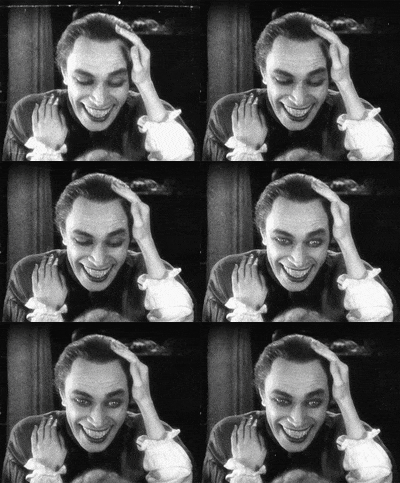
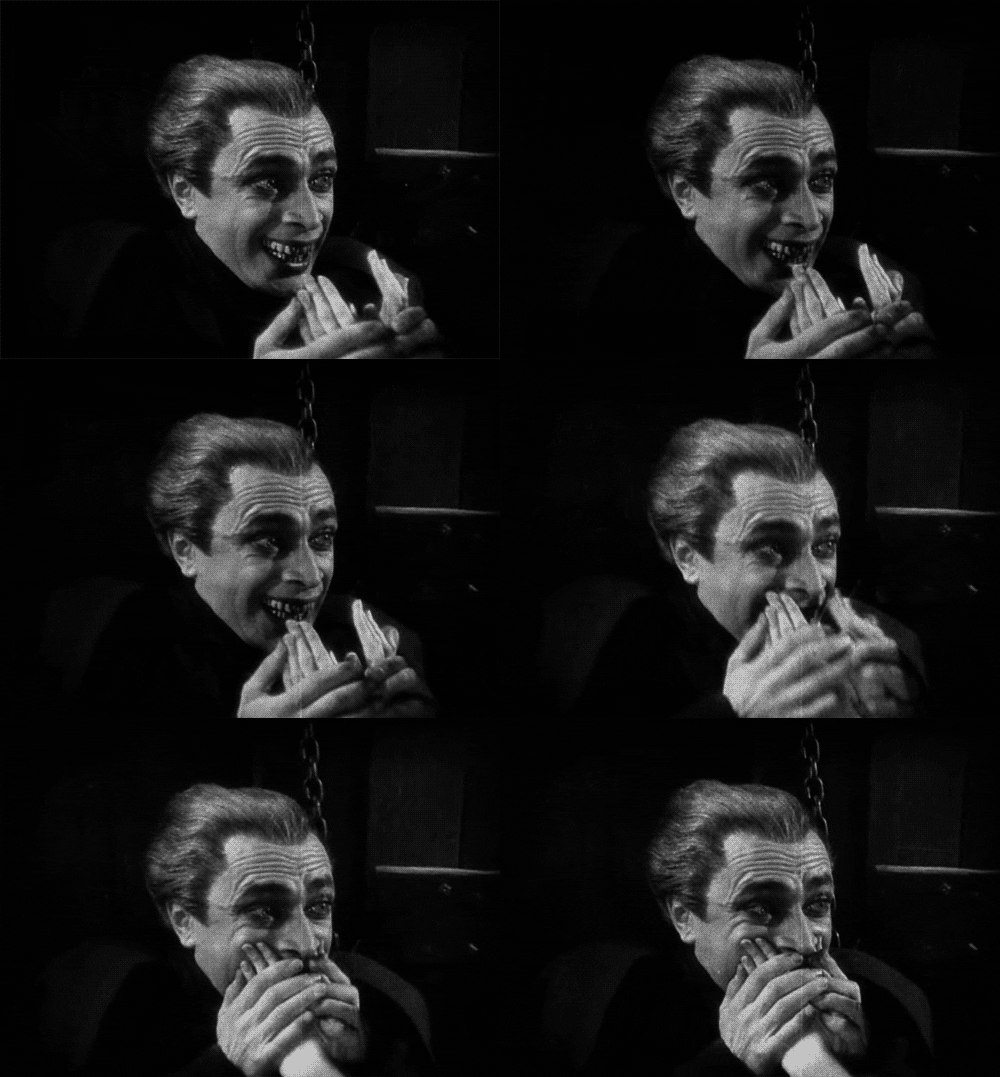
Spooktober 23: The Man Who Laughs (1928)


Paul Leni is one of my favorite directors, and Conrad Veidt one of my favorite actors. This 1928 send up of Victor Hugo's 1869 novel is one of the most influential and tragic films from the 1920's of any genre, and pairs the two with perfection. So influential was it, that it gave the world the visage of The Joker in the Batman comic book series from DC; not to mention a whole host of other characters by fans of the film who would go onto the make films themselves (see, for example, William Castle's Mr. Sardonicus). The film was released as fully silent film at first, only to be reworked as a partial sound film with an original score and sound effects a year later. There was never any added dialogue however. Veidt's on screen acting career would go on to hit a rocky road for a time with the coming of sound due to his thick German accent. His performance as Gwynplaine in The Man Who Laughs remains, however, one of the most well known and memorable in cinema history. 


Friday, October 22, 2021

Spooktober 22: Die Pest in Florenz (1919)


Another day, another Poe adaptation.  Die Pest in Florenz (The Plague of Florence) is a 1919 German film based on Poe's The Masque of the Red Death, and although it was directed by Otto Rippert, it is most famous for being associated with another German (later turned American) director: Fritz Lang.  Lang however was the script adapter and writer in this case, not the director; it is his only credit on the film, so it is unclear if he also had other involved (highly likely) in the making of the picture. The timing of the film had been noted as especially important; and given the world's recent pandemic plague of Covid 19; it is more relatable than ever. The film was made and released during the "Spanish flu" pandemic griping the world at the time. 


Thursday, October 21, 2021

Spooktober 21: The Pit and The Pendulum (1913)


A surviving fragment from Alice Guy's 1913 The Pit and the Pendulum made at her Solax studio. This film was thought completely lost until a copy was found at the Library of Congress. It is an excellent example of why movie lovers should always have hope for the recovery of lost reels! Happy Spooktober 🎃🎃🎃


Wednesday, October 20, 2021

Spooktober 20: The Witch's Ballad (1910)


Only known (for now) still from Luigi Maggi's La ballat della strega (The Witch's Ballad or The Ballad of the Witch). Produced for Società Anonima Ambrosio in Italy and ultimately distributed in the both the United States and the U.K. in 1910. 

Monday, October 18, 2021

Spooktober 18: Haunted Spooks (1920)


I am having to resort to a rather lazy approach to posting, as my shoulder issues have resurfaced, so typing is right out for now. Still....Happy Spooktober! 🎃🎃🎃


Saturday, October 16, 2021

Spooktober 16: Dr. Jekyll And Mr. Hyde (1920)


Just like the vampire form in Nosferatu remains one of the scariest in the history of vampire films, John Barrymore's Mr. Hyde remains one of the scariest, if not the most frightening, Hyde in film history.  It is also not reliant solely on special effects/makeup or superior acting prowess, as other famous Hydes have. Barrymore's Hyde instead employs a winning combination of the two.  For this alone, the film remains one the most effectively frightening horror films of all time. A quick look at Barrymore's Hyde.


Friday, October 15, 2021

Spooktober 15: The Unknown (1927)


Tod Browning's film Freaks (which is currently streaming on HBO) was not his first foray into the world of "circus freaks." In 1927 he directed The Man of a Thousand Faces (and apparently feet as well) Lon Chaney in The Unknown. Also starring Joan Crawford, it is the a story of "Alonzo the Armless" a fugitive and "freak imposter" played by Chaney. On the run from the law, he joins the circus as an armless knife thrower (!) and works with Nanon (Joan Crawford) the circus player at whom he tosses knives (and even fires a gun) at with his feet. Nanon, it turns out has a fear of being "pawed" by men (we have every good reason to believe that she is living the horror of being a sex assault survivor). Alonzo falls for her, but of course he actually has arms, which he is secretly terrified she will discover. Meanwhile the circus strongman has also fallen for Nanon, whom she likes but fears being close to. The lengths to which Alonzo is willing to go to make sure that he and Nanon can live happily together is the true horror of the film.... I am sure one has a notion of where this is headed, even if you have not seen the film. The Unknown is more of a psychological fear drama, than a straight forward horror film. It certainly has no supernatural horrors. But, and it is an important "but," it counts as one of the very first body horror films.  Many, if not most, more modern body horrors--everything from Eyes Without A Face, Cronenberg's The Fly to The Skin I Live In--contain strong stories of obsession that lead to various mutilations and horrific physical outcomes. The Unknown was one of the very first.