Wednesday, December 23, 2020

Born Today December 23: Aleksandr Levitsky


1885-1965


Silent era Russian/Soviet cinematographer Aleksandry Levitsky was born on this day in some location in Imperial Russia.  Though he has one acting credit and one editing credit (he most certainly had more these that are not currently available via research!), all of the rest of his credits come as a cinematographer.  He worked in film before, during, and after the Russian Revolution of 1917.  His first turn at cimematography came on the film 1812, made in 1912. At 48 minutes long, it is one of the earliest feature length films in the history of cinema, not just early Russian motion pictures; and it had three different directors: Vasili Goncharov, Kai Hansen and Aleksandr Uralsky.  As the title indicates, the film is set in 1812 and a historical drama about Napoleon's invasion of Russian that year. He next photographed the rather famous Russian short Departure of the Grand Old Man [Ukhod velikovo startza] (1912), which not only was co-directed by a woman--Elizaveta Thiman (her only film credit that we know of)--it also features film footage of Leo Tolstoy from documentary footage shot of him by an entirely different filmmaker (Alexander Drankov as "A. Drankov"). The film is actually "about" Tolstoy in a fictionalized account of the end of his life.  It would have been relegated to complete obscurity if Tolstoy's widow had not threatened several times to bring legal action for libel against the filmmakers for their portrayal of her as a "let them eat cake" sort. This occasioned it's being banned in Russia upon it's release, which apparently satisfied her and no suit was ever brought.  Tolstoy was played by Vladimir Shaternikov (who it seems made a minor career out of playing Tolstoy), Thiman had a role--but Tolstoy's widow was played by a name many will know:  Olga Petrova.  He then became the priciple cinematographer for director Yakov Protazanov (co-director of Grand Old Man) after the the film was finished. He was also the main cinematographer for director/actor Vladimir Gardin.  He was the director of photography on Gardin's Tolstoy adaptation War and Peace in 1915, which Gardin both adapted and starred in himself.  His first film outside the realm of this group of people came with his work with directors Vsevolod Meyerhold (a theater man who was later executed by Stalin's regime) and Mikhail Doronin on their short adaptation of Wilde's The Picture of Dorian Grey (Portret Doryana Greya) in 1915--it is one of major Russian works that is greatly lamented as lost today because of Meyerhold's involvement. He next worked with director Nikolai Larin on the experimental and philosophical short Likho odnoglazoe in early 1916.  By this time, there was renewed political intensity in the country; a reuptake of political action that had first become a movement in 1905. The result was that Levitsky would not shoot another film until the following May, when it was clear which way the winds were blowing, with political change already under way. That film was Great Days of the Russian Revolution, a film taking a highly nostalgic tone of the 1905 revolution; it would be one of only two films that he shot that year.  He managed to work on three films in the unrestful year of 1918--though not until very late in the year, including the aptly named Uprising (November 1918 [Julian calendar]) featuring Boris Afonin as a courageous Bolshevik soldier. In 1919, he was back again working for Gardin on The Iron Heel, based on the Jack London novel and Levitsky's only film of that year. In the new decade of the 1920's he worked on ten films between 1920 and 1928. Most of these were highly idealogical in nature and bore a stark, almost schizoid, difference from his earlier films--many of which were based on works of literature and included art movements imported from France and Germany.  Of these films, one thankfully survives and is widely available for viewing. The Extraordinary Adventures of Mr. West in the Land of Bolsheviks is an early Soviet film and a silent comedy, released in April of 1924.  It is the only film on which he has a formal editing credit; it was directed by Lev Kuleshov, who was young enough to be considered one of the very first truly Soviet directors. Levitsky's last film was the little heard of Yad, directed by Evgeniy Ivanov-Barkov and released in 1927. Levitsky appeared in one film in 1915--Ekaterina Ivanovna--a film that he also shot for Uralsky.  He has a cinematography credit from 1958 that included some of his original photography of Lenin; Zhinvoy Lenin was documentary short of still and moving footage of Lenin, though completed in 1958--it was not released in the Soviet Union until 1969.  Levitsky himself died on July 4 in 1965 in Moscow at the age of 79.  I can find no information as where he is buried, but it must be somewhere in the greater Moscow area. 


IMDb 

Tuesday, December 22, 2020

Born Today December 22: Frankie Darro


1917-1976


Child actor (and sometime stuntman) Frankie Darro was born Frank Darro Jr. on this day in Chicago. His parents were both circus performers who had their own flying circus act.  So, Frank Jr. was born into dare-devilry. Despite that Frankie would go onto be an adventurous child actor, he was born with a fear of heights that meant that it was not easy for him to follow in his parents exact footsteps.  Right around the time he was getting the hang of it, his parents divorced and his short-lived circus career came to an end. His talent for this type of performance did not go to waste however. At just the age of 6, he started his acting career, and along with it came stunt work as well. His film debut came fittingly in the adventure drama Judgement of the Storm starring Lloyd Hughes and fellow child actor Lucille Ricksen--the film was released in January of 1924.  He would go on to appear in five additional films in 1924 alone, with just his second role taking the title role of Half-a-Dollar Bill--also released in January of 1924.  The other notable title of that year is one in which he plays a "kid sidekick" for the first time in the action drama Roaring Rails (21 September 1924) starring Harry Carey.  His work in 1925 was even more prolific when he acted in fully twelve films, many of them physically demanding roles. A few of these were major productions; for example he had a role as a prince in Victor Sjöström's Confessions of a Queen, starring Alice Terry. "Three-upping" his number in 1926, he appeared in 15 films; and by the end of the year, he was still only 9 years old!   One notable film from that year was his appearance in the Clarence Brown directed Kiki, starring Norma Talmadge--it was one of studio big-wig and producer Joseph Schenck's "presentations" (married to Talmadge at the time, he was the funds behind her company Norma Talmadge Film Corporation).  Another was Flesh and the Devil, yet another Clarence Brown film starring heart-throb John Gilbert and Greta Garbo.  Of his ten films roles in 1927, a few notable titles among them are :  Moulders of Men directed by Ralph Ince and starring Conway Tearle, Little Mickey Grogan his first top billed role, and an uncredited appearance in the Harry Langdon comedy Long Pants directed by Frank Capra. Another top billed role came in the 1928 melodrama The Circus Kid, fittingly a story about a young boy who flees an abusive orphanage to join the circus; the film was directed by George B. Seitz. His first talkie was the 1929 musical The Rainbow Man, starring Eddie Dowling and Marion Nixon.  His last film of the decade was yet another Dowling musical: Blaze o' Glory, which was released on the 30th of December, eight days after his 12th brithday.  The bulk of his career during the 1920's, though, came as a child side-kick of western star Tom Tyler, who was only 14 years Darro's senior. All the films that they made together between the years 1925 and 1929 were fully silent films.  His first film of the 1930's came in a Cagney crime film--The Public Enemy released in May of 1931--in an uncredited role (famously a William Wellman film--he would go on to star in Wellman's Wild Boys of the Road in 1933). It was the beginning of a long career in both supporting "tough guy" roles in both film and on television. Though Darro was certainly handsome and had real acting abilities that allowed him to make the transition to speaking roles, he stopped growing at 5'3" and thus was not regarded as leading man material.  The 1930's also brought his first formal credit as a stuntman, though he had been doing stunt work all through the 1920's, especially in the Tyler films.  Darro made his television debut in the western series "Adventures of Wild Bill Hickok," in the episode The Slocum Family (airing again, eight days after his birthday--this time his 34th).  He had guest roles on a number of series after this, including: Bat Masterson, The Addams Family, Mister Ed, Alfred Hitchcock Presents, Perry Mason, Batman, even the pilot episode of The Johnny Carson Show in 1955. Later in life he opened a tavern, in part because he had become a heavy drinker as the result of a heath problem with a pain management issue. This is one of the reasons for his not making many films past the mid-1950's; it kind of sad, then, that his last acting job was "Lester the Drunk" in the mystery film Fugitive Lovers in 1975. Darro's most famous film appearance actually came in a role that he is not known for at all: he was the main actor/operator inside the Robbie The Robot suit in Forbidden Planet in 1956.  While visiting family for the holidays and his birthday in 1976, Darro died in Huntingdon Beach, California of a massive heart attack on Christmas Day, just three days after his 59th birthday. He was cremated and his ashes scattered in the Pacific Ocean.


IMDb 

Wikipedia 


Monday, December 21, 2020

Born Today December 21: Robin Irvine


1901-1933


British stage and screen actor Robin Irvine was born Leslie Robins Irvine on this day in London--in the Stoke Newington area of Hackney.  He made his acting debut on the stage in 1918 while still at school, subsequently making his professional stage debut in London in 1923.  Just two years later, he made his film debut in a supporting role in the fantasy drama The Secret Kingdom starring Canadian born actor Matheson Lang, whom resembled Irvine to the point of being a bit scary, a brilliant bit of casting, since Irvine was playing the son in the film. He did not make another film for two years; when, in 1927, he shows up in the lesser known Alfred Hitchcock film Downhill (also known as When Boys Leave Home) in another supporting role, this time to Ivor Novello's lead. Also appearing in this film is actress Isabel Jeans, who would become an early Hitchcock muse; her sister Ursula would marry Irvine in 1931.  He appered again in another Hitchcock film with Isabel Jeans that same year. Easy Virtue, released in August of 1927, is a more well known Hitchcock silent film (widely available!) based on the Coward play of the same name, Jeans takes the lead, opposite Franklin Dyall, with Irvine again supporting in the role of John Whittaker. By the end of 1928 he had been in five more films when he appeared in an early British sound film The Intruder, a nine minute comedy produced by British Sound Film Productions.  In 1929 (having gone to Germany to work), he appeared in Maurice Tourneur's 2 hour long German production The Ship of Lost Men (Das Schiff der verlorenen Menschen) featuring Fritz Kortner and Marlene Dietrich in the lead roles, it was his last film of the decade, but not his last silent film. Sound films were later coming to the continent than they were to the British Isles; and in 1930, he had a role in the Erich Schönfelder film Fräulein Lausbub, which was released very early into the brand new decade--it was a fully silent film release.  Back in Britain, he had the lead role in the 40 minute full sound comedy Leave It to Me; filmed at Twickenham studios; it was the production of George King Productions, founded by the film's director George King. He would appear in just two more films in his life time, the last of which was the comedy Above Rubies, released in July of 1932.  He accompanied his wife to New York in 1933, where she made her stage debut. The were in the process of returning to England via Bermuda when Irvine developed a fever from some sort of infection that developed into pleurisy that killed him rather quickly. He died in Bermuda on the 28th of April, 1933 at just the age of 31.  Specific details of his burial are currently unknown, but it is known that his remains were returned to England and he is buried somewhere in the greater London area.  His wife Ursula would remarry; she married Welsh actor Roger Livesey and together the two of them share a memorial plaque at The Actor's Church: Saint Paul's Covent Garden.


Still from Downhill


IMDb 


Find A Grave entry 

Sunday, December 20, 2020

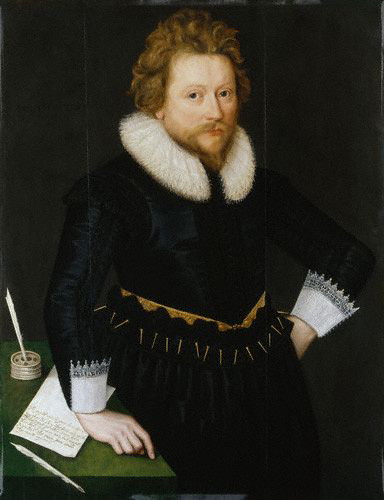
Born Today December 20: John Fletcher


1579-1625


Jacobean playwright and frequent writing partner of  Frances Beaumont was baptized on this day in Rye, England (Sussex), where he was born some time earlier in the month. His father was a prominent cleric who was, among other things, chaplain to Queen Elizabeth I until he fell out of favor with her. His father died not long after this, so it fell to an uncle to take in Fletcher and his seven siblings.  It would prove to be an important catalyst in his life, as his uncle, Giles Fletcher, was a poet. This was apparently the only benefit that he gained from this particular family connection, as his uncle too would become persona non grata through an ill fated patronage.  It is thought that young John entered college at the University of Cambridge at just the age of 11.  From what records remain, he was studying to follow in his father's footsteps and take up a career in the church. Somehow, and it is unclear how it came about, he instead made his way into London theatrical circles. Though he wrote many plays on his own, he is by far more well known as a writing collaborator of Beaumont. It is again unclear how he came to know Beaumont, but Fletcher was, at the beginning of his work in London, in the company of several theatrical company's. The first of which was as a writer for the Children of the Chapel, a choir that clearly had connections with the church and may provide some clue as to how he ended up in this line of work in the first place. This is likely the meeting place for Beaumont and Fletcher's, as their earliest collaborations were penned for the Children. Early in his career, it can also be confirmed that Fletcher was, for a time, in the employ of well known writer Ben Jonson.  Aside from his collaboration with Beaumont, Fletcher is most famous for his being a later associate of Shakespeare, who eventually would be the famous writer's successor at the King's Men as house playwright. Of course, as with all important writers, artists and historical figures, please follow links below for more information. As far as films are concerned Fletcher's work has only been used in six productions, the most recent of which was in 1999 (see:  Shakespeare's Women & Claire Bloom). None of these productions have been based on his work with Beaumont or even his solo work, but have been based solely on one of his collaborations with Shakespear: the play Henry VIII.  The first two films based on this work came in the 1910's; the first being the rare early near-feature length (by today's standards) British production Henry VIII in 1911. It was a heavily promoted film, is listed as Britain's first feature film and is now sadly lost. The second film by contrast, really was a short and only featured a section of the original play. Cardinal Wolsey was a Vitagraph production released the following year (thus was a product of the U.S.A.) and was co-directed by J. Stuart Blackton and Laurence Trimble. The film featured Hal Reid and Julia Swayne Gordon in the lead roles, supported strongly by Tefft Johnson as Henry VIII and Clara Kimball Young as Anne Boleyn.  The next production of the play, was for television a whopping 57 years later, as an episode of the short lived BBC West series "Whatever Next?" airing the 14th of June in 1969.  Just like we are not completely certain of Fletcher's actual birth date, we are also not totally certain of his death date. He died at the age of 45 from plague on, or about, the 28th of August in 1625. He is entombed at London's Southwark Cathedral.  


Source: Connie Nisinger [Find a Grave[)


Wikipedia 


Encyclopedia Britannica 


Project Gutenberg 


LibriVox (publicly available audio books)


Find A Grave entry 

Saturday, December 19, 2020

Born Today December 19: George L. Aiken


 1830-1876


American playwright and actor George L. Aiken was born on this day in Boston. Although Aiken is best known for his plays, his writing career started as novelist. He was adept at writing intriguing stories quickly, supporting himself by getting his work published as inexpensive paper backs, even as he turned to the theater and became an actor.  He was introduced to the work by a cousin who was an owner of a theatrical troupe.  Though he wrote completely original plays, it was his adaptation for the stage of Harriet Beecher Stowe's novel Uncle Tom's Cabin in 1852 for which he is remembered today.  His would not be the only adaptation of the novel for the stage, but it was the first (as the book was itsel also published in 1852), and Aiken's adaptation is far and away the most popular stage adaptation.  His specific reworking of the book was itself adapted for the motion picture screen by Edward McWade in 1914.  That film, was directed by William Robert Daly  for Selznick's World Film.  The lead was played by Sam Lucas, famed for his minstrelsy. It was the only time, that is credited at least, that his adaptation was made into a film, though his version of the play continued to be performed live on the stage well into the 1930's.  Aiken himself retired from the stage in 1867 at just the age of 37.  He also died young, at just the age of 45, some nine years later on the 27th of April in Jersey City, New Jersey.  He was buried back in his home state, the Commonwealth of Massachusetts, at Cambridge's famed Mount Auburn Cemetery (note: Find A Grave obviously has him mixed up with someone else with the same name--they erroneously have him buried in Bay Minette, Alabama).


A handwritten page from his adaptation of Uncle Tom's Cabin


Wikipedia


The George C. Howard & Family Collection: Harry Ransom Center

     (Howard was Aiken's theatrical cousin who gave him his start on the stage)


Thursday, December 17, 2020

Born Today December 17: Alexander Hammid


1907-2004


 Czech photographer and filmmaker Alexander Hammid was born Alexander Siegfried George Hackenschmied on this day in Linz, now located in Austria on the border with the Czech Republic (some sources list his birth name as Alexander Siegfried Georg Smahel). Although an absolutely influential early avant garde film crafter, he barely makes the cut here. Only because he worked on one film in that was released in early 1929. Importantly that film was silent.  Erotikon (or Seduction) was a melodrama that contained  camera work and images that would be at home in a Bergman film. It's director, Prague born Gustav Machaty had been working in the Czech film industry since the late teens. Seduction was his fifth outing as director and his last silent; he hired Hammid, along with two others, for art direction on the film. Credited as "Alexandr Hackenschmied," he was the principle on the team. After this, he found work in various aspects of film making the Czechoslovakia in the early 1930's. In fact, his very next project, the avant-garde documentary short Bezucelná procházka marked his first outing as director.  He directed just one more documentary in the early 1930's--The Prague Castle (1931)--not making another film until 1937.  In the meantime, he worked as a cinematographer and editor.  He also worked in filmed advertising in the town Zlin.  In the late 1930's, he began working with American filmmakers, which occasioned his and his first wife's immigration to the United States .  He became a U.S. citizen in 1942, which is when he legally changed his name to Hammid. He would make 20 important films, both big and small, in his career--most were documentaries, though one--The Medium [which he reportedly co-directed, though he went without a credit--he does get an editor & associate director credit] is a filmed opera (if you are a cat/animal lover, you will want to check out his The Private Life of a Cat). His 1945 short documentary Library of Congress was nominated for an Oscar.  Though his film To Be Alive! (1964) is often cited as his last turn at directing, he actually co-directed the short drama We Are Young in 1967 with fellow documentarian Francis Thompson. Hammid has one additional cinematographer credit from 1972 on the feature length documentary Moonwalk One. His last film credit dates from 1976, and it's an important one. He and Thompson were partners in production for years and in celebration of this nation's 200 year "birthday," they were deeply involved in the production of the film To Fly!.   The film was made for the brand new Smithsonian National Air and Space Museum, which opened in July of that year. The film was the first made for the museum's theater and was the very first film to be IMAX formatted; the nearly 30 minute long film continues to play there to this day. In regards to his and Thompson's important contributions to the IMAX foramt, many of the pair's films dating from the 1960's were in formats nearly the same as what we recognize today as IMAX.  Hammid lived an extremely long life, dying in New York City at the age of 96 on the 26th of July in 2004.  Details of his burial are currently unknown.  


IMDb


Wikipedia 


Find A Grave entry


Tuesday, December 15, 2020

Born Today December 15: Melva Cornell (Not So Silent edition)


1904-1960


 Almost completely unheard of actress and later long time employee at 20th Century Fox Melva Frances Cornell was born on this day in Santa Barbara. Both of her parents worked for the Santa Barbara based studio The American Film Company, so it is little surprise that growing up around the burgeoning film industry, Cornell would get bitten by the acting bug. She did appear on the stage on both coasts in a few plays, but she is formally listed as acting in only one film: Fox Movietone Follies of 1929, the musical celebrating Fox the studio and it's new all sound films (the film is also thought lost).  Her role is not named, though she does get a full credit (Google for some reason returns a search result that she was in the also lost full talkie from Fox The Girl from Havana in 1929, I combed through every source I could find online and found nothing--without time to check other sources this will just have to remain a question mark for the time being).  After she lost her husband and her son within a few years of each other in the early 1940's, she reportedly went to work at 20th Century Fox; so she stayed in the film industry--just behind the scenes. It affords the rare opportunity to praise the hundreds of people who work in jobs like these that make our viewing pleasures possible! She died at just the age of 55 in Los Angeles on the 19th of January in 1960. She is buried under her married name of Lachmann, next to her young son at Forest Lawn Memorial Park in Glendale. 


[Source: Romper90069 (Find A Grave)]


Find A Grave entry 

Monday, December 14, 2020

Born Today December 14: Jane Cowl


1884-1950


Stage and film actress Jane Cowl was born Jane Bailey on this day in Boston.  Though born in Boston, she spent a good deal of her childhood in New York City, attending high school in Brooklyn and later attending Columbia in Manhattan.  She, of course, started on the stage and made her official Broadway debut in 1903.  She stayed primarily a stage actress for all of career, which lasted through the 1940's.  She made her film debut in the lead role in the drama Garden of Lies in 1915; shot primarily in several locations in Florida.  She appeared in just one other silent film in her career in 1917; The Spreading Dawn was another drama in which she took top billing--it was made for Goldwyn.  As far as silents go, she actually had a bigger presence in the writing department than she did as an actress. Under the name Alan Langdon Martin, she wrote plays with Jane Murfin (they used the pen name jointly).  Between the two of them, they share five silent or partially silent writing credits for films made between the years 1918 and 1928.  The first of these was Daybreak (1918) an Albert Capellani film.  The last of these was the partial silent Lilac Time (1928) starring Colleen Moore and Gary Cooper.  Two more films were made from thier plays before Cowl again appeared in a film again herself (see: Smilin' Through--1932 and Smilin' Through--1941). In 1943, she made her first film appearance in 26 years, though the role was tiny and uncredited, in the Frank Borzage film Stage Door Canteen.  It would be a further six years before she had another credited film role in Once More, My Darling (1949).  She made three more films, the last of which--Payment on Demand (a Bette Davis film)--was released posthumously in February of 1951.  Also posthumously, were two productions for television of her play Smithin Through--both in 1953. They represent the most recent use of her writing for a film and/or television.  Cowl died in Santa Monica on the 22 of June in 1950 at the age of 65.  Her ashes were buried at Valhalla Memorial Park in North Hollywood.   Cowl was married to actor Adolph Klauber; but they had been separated for three years before his death in 1933; she never remarried. On Broadway, she was one of the first influential female directors as well. 


[Source: AJM (Find a Grave)]


Wikipedia


IMDb 


Finda A Grave entry 

Saturday, December 12, 2020

Born Today December 12: Laura Hope Crews


1879-1942


Long an actress of the stage who later in her career became a character actor of films, Laura Hope Crews was born on this day in San Francisco. Her parents were theater people--her father a sets builder and her mother an actress--so it is hardly surprising that she started acting at an early age.  She was, in fact, just four years old when she made her professional acting debut.  She grew up in San Francisco and San Jose and stopped acting to attend school, but returned to the stage as a young adult.  In 1900, she moved with her mother, to New York City and began to act there on the stage. It was there that she made her film debut in 1915 in the lead role of the Jesse L. Lasky produced melodrama The Fighting Hope.  She was in one other 1915 Lasky production, Blackbirds; but like so many serious actors of the stage, she found silent film acting not at all to her taste.  She did not appear in another film until 1929 with the coming of sound. She had supporting role in the Paramount domestic melodrama Charming Sinners, a full sound film released August. She then went back to the stage for a couple of years before turning up the Charles Brabin directed film New Morals for Old in 1932 with Robert Young, Myrna Loy and Lewis Stone. After this point she worked steadily in films. When she appeared in the film version of The Silver Cord, in 1933, she was reprising her role from the a Broadway production of the Sidney Howard play; the only other member of the production that was a part of the stage production was director John Cromwell.  Without a doubt, her most famous role came as Aunt "Pittypat" in Gone With the Wind. George Cukor apparently recommended her for the role, but she already knew Clark Gable from the 1920's and had been instrumnetal in helping him get a start on the stage. It was her last film of the decade.  She appeared in seven films in the early 1940's, the last of which was New York Town, where her appearance went uncredited. She passed away at 62 in New York City on the 13th of November following a sort illness. She was returned to the west coast and laid to rest at Cypress Lawn Memorial Park in Colma, California.  Her lasting legacy was her contribution to stage performance; she had worked in some of the biggest venues on both coasts and had over 200 hundred appearances on Broadway.  She also worked as a vocal coach from time to time and was hired by Gloria Swanson to help her make the transition from silent to talking cinema. This came about on the set of Swanson's 1929 self produced talkie The Trespasser, for which Crews has an editorial associate credit.  


[Source: Scott G (Find A Grave)]


IMDb


Internet Broadway Database 


Wikipedia 


Find A Grave entry 

Thursday, December 10, 2020

Born Today December 10: Philippe Gille


1831-1901 


French dramatist and operatic librettist Philippe Gille was born Philippe Emile François Gille on this day in Paris.  Although Gille wrote plays, he was first and foremost a librettist; and a prolific one at that, having penned over twenty of them in a 35 year period. Although his most well known works are with other composers, his largest body of operatic work was with Offenbach.  Gille is yet another example of a writer/musician of his time who started out studying law, and even working as a law clerk for a time, before finding his way into the arts. Gille got into writing by way of theatrical criticism and as a hired theatrical secretary (this is one case where in his law career, such as it was, actually advanced a career in the arts).  In regards to film, a little more than half of his credits unsurprisingly fall under the "soundtrack" category; but his one credit from the silent era comes as a writer. Les trente millions de Gladiator was a short film production of Pathé Frères directed by French comedian Charles Prince; it was based on writings from both Eugène Labiche and Gille. As far as his soundtrack credits go, it bears mentioning that his work has shown up in everything as diverse as a Tarantino/Tony Scott film (True Romance), the 1998 film of The Phantom of the Opera, an episode of "Castle Rock" Hulu's original horror series based on the works of Stephen King, and,  it's most recent use, an episode of the reboot of Magnum P.I.  Gille died in Paris on the 1st of March in 1901 at the age of 69. There is no information on his burial, despite that he is was a citizen of prominence in France. 


IMDb