
1901-1992
Consumers, no matter how casual, are familiar with Marlene Dietrich whether they know it or not. Her voice is often used to denote the sultry German voice of a by-gone age, but she got her start in film in the era before sound when she was barely in her twenties. Born Marie Magdalene Dietrich on this day in Berlin, "Marlene" was a nickname. Her first wish was to become a musician and she actually studied the violin as a teenager, but due either to lack of obtainable skill or an actual wrist injury this was not to be. She did have a job for a about a month or so playing in a pit orchestra for a silent film house. She had been interested in theater since at least her early teens, so she made her way onto the stage as a chorus girl in the early 1920's. She eventually found her way into small dramatic stage roles from there. Her accepted film debut came in 1923 in the biographical drama The Little Napoleon, directed by Georg Jacoby and starring Egon von Hagen as the diminutive Bonaparte (it was one of only two known film roles for Hagen; his other appearance in 1927 was also in the role of Napoleon). [Note: Dietrich is unconfirmed in the 1919 Im Schatten des Glücks] She would appear in three more films in 1923. It would not be until 1927 that she moved from bit and small parts to minor supporting roles and not until she appeared in the melodrama Cafe Electric (released in November of 1927 in Austria) that she garnered a leading role, starring opposite Willi Forst. Along the way, she appeared in two Alexander Korda films--A Modern Du Barry & Madame Doesn't Want Children both in 1926--when he was working his way from Hungary toward England, where he would settle into work in the British film industry. By her next film, Art of Love (1928), she was back in a smallish supporting role. Her first turn in a film with sound was the partial silent I Kiss Your Hand Madame released in Germany in January of 1929. I don't think it's to much to state that her lead in this film made her a star. She starred opposite the Prussian born star Harry Liedtke; it was a romantic melodrama filmed on location in Paris. Her first absolute top billing came in her next film, the fully silent Three Loves directed by Curtis (Kurt) Bernhardt, who would go on--like Dietrich--to have a career in Hollywood, the film can best be described as a "love intrigue." Her last film of the decade is a bit of a surprise--and not just because it was directed by Maurice Tourneur, but because it was also fully silent. The Ship of Lost Men puts Dietrich together with Fritz Kortner (who was her male lead in Three Loves) and British actor Robin Irvine--then working in Germany for a time--as a young American doctor. Though the 1920's had made a continental star of her, she was not yet the exotic foreign Hollywood icon that she was destined to become. In fact, her first film of the decade that normalized talking films was also fully silent. Nights of Love was a comedy that made late fun at the old "vamp genre" by way of putting it together with plot that is similar in some respects to Hitchcock's The 39 Steps or even Capra's It Happened One Night, films made years later. It should also not be forgotten that Dietrich continued to work on the stage all through out the 1920's and importantly (and rather predictably) wound up in musical revues. Among fans of these revues, she was far more of a draw in both Vienna and Berlin than she was in her film roles. It is then a point of importance to mention that she has, at this point, more credits in soundtracks than she had in life as an actress. Also important, the first of these actually came in 1929, with the song on "Wer wird weinen wenn man auseinander geht" (No Use Crying) on the soundtrack for Richard Eichberg's Why Cry At Parting? released in August if 1929. She sung the song in duet with German Baritone Gerhard Pechner; this little film features among it's cast another who would make his mark on Hollywood, albeit as a character actor S. Z. Sakall (you may have seen him recently in Christmas in Connecticut) . Of course, once you get to 1930, classic film fans know her career pretty well. Famously her international break out role came in Josef von Sternberg's norish nightclub melodrama The Blue Angel. The production of this film began in 1929 in Berlin and it marks so many milestones it's a bit exhausting contemplating them. First of all, top billed Emil Jannings was on his way back from a Hollywood career when he appeared as Professor Immanuel Rath; it was his first film back in his home country and his first all sound film--and the first performance in a long slide into both obscurity and infamy for the actor. The opposite was true of Sternberg and Dietrich--who had a very famous/semi-public love affair during the production--for Dietrich this was her last domestic film before being gobbled up by the Hollywood machine (Sternberg was already a Hollywood veteran). Secondly, the film features one her most famous singing performances of the song "Falling in Love Again (Can't Help It)" written by German composer Friedrich Hollaender, who reportedly had to tailor the song to Dietrich's vocal range. The song was recorded for release separate from the film and became so popular that several record labels in 1930's licensed the performance for release. This was also one of those early sound films that actually made two versions of the same screenplay in two languages: German and English (running two production simultaneously). It was the early sound answer to the old multinational casts that comprised the backbone of the German film industry in the 1920's. Obviously, this was before dubbing. Having said that, for many years, the English version of the film was presumed lost until a copy turned up in a German film archive; by 2009 it had been completely restored. [taking deep breath....and moving on!] Her very next film was also her first Hollywood production; she starred opposite Gary Cooper in the cabaret romance Morocco (1930). The Blue Angel had landed her a contract with Paramount (they badly wanted her as a rival to MGM's Swedish Greta Garbo) and Morocco was a deep collaboration between her and Sternberg. Helpful to both of their career's, was that the English language version of Blue Angel was actually released after the big premiere of Morocco; so American audiences had two films to flock to during the darker days of winter to bask in the sultry gaze of the exotic Marlene. She would make three more films with von Sternberg--one of which was the legendary Blonde Venus opposite Cary Grant (though Shanghai Express was more financially successful)--before finally being directed by another Paramount man. She appeared in the romantic drama The Song of Songs (1933), directed by Rouben Mamoulian and set in Berlin, though shot at Paramount Studio lot in Hollywood. She would appear in two more of Sternberg's Paramount pictures: The Scarlet Empress ( a film that featured a small part for her 10 year old daughter Maria*) and The Devil is a Woman; but, Sternberg was dismissed from Paramount and the two never worked together again. Her first "post Sternberg" film was the crime comedy Desire directed by Frank Borzage, released in February of 1936, where she again appeared opposite Cooper. She would go to have roles in a number of films we today regard as classic of the golden age of Hollywood, but gradually her film career slowed. She made just one film in the 1960s after appearing in Orson Welles' 1959 noir Touch of Evil; Judgement at Nuremberg (1961) a Stanley Kramer film with Burt Lancaster, Richard Widmark and Spencer Tracy (she did have a cameo in the 1964 Audrey Hepburn comedy Paris When It Sizzles). She instead spent some twenty years touring the world performing live shows. She was persuaded to come out of retirement for an role in Just a Gigolo in 1978, a drama set in post World War I Berlin starring David Bowie. Dietrich lived another 14 years, dying of kidney failure on the 6th of May in her apartment in Paris, France. She was 90 years old. Her funeral mass was held in Paris, but she was buried back in Berlin at the Friedhof Schöneberg III, located in the Friedenau district. Despite that she wished to be buried in her place of birth, her coffin was draped with an American flag, as she had become an citizen of the U.S. in 1937. Dietrich's acting credits may have ended in the 1970's, but her voice lives on in film to this day. The most recent use of one of her performances came in the Melissa McCarthy comedy Can You Ever Forgive Me? (performer of "Illusions") in 2018. Dietrich was only nominated for a one Oscar, Best Actress in a Leading Role for Morocco, the little gold man went instead to veteran actress Marie Dressler. I can't imagine she minded much.
 |
| [Source: TripAdvisor] |
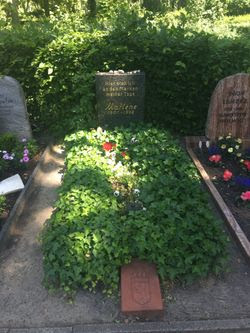 |
| [Source: Mina Schmidt (Find A Grave)] |
*Maria went on to her own acting career under her married name of Riva; she is best known today as Mrs. Rhinelander in the holiday classic Scrooged, playing the wife of Robert Mitchum's cat crazy Preston Rhinelander character.


