Showing posts with label Formerly Lost Film. Show all posts

Wednesday, June 21, 2017

Born Today June 21: Aubrey M. Kennedy


1887-1953

Silent film writer, director, independent studio founder, and major studio executive Aubrey M. Kennedy was born on this day in Winnipeg, Manitoba, Canada. Kennedy, along with his partner Elmer Bosoeke, founded the Santa Barbara Motion Picture Co.; Kennedy would go on to found his own production company The Aubrey Kennedy Pictures Corp. which only produced one film in 1932.  The first film that he made was wholly his project alone, he both wrote and directed The Yellow Menace in 1916--it was a serial.  Though a life long studio executive, Kennedy was only active in direct film making from the years 1916 to 1933.  He definitely wrote or adapted three of the four films or serials that he directed; it is probable that he also wrote Liquid Gold (1919).  In all, he wrote or adapted works for six films or serials.  One of them, The Masked Rider, was a very violent 15 part serial that represents the earliest known surviving appearance on film by Boris Karloff, playing a Mexican.  The film was presumed lost until an almost complete print was found in the home of a former projectionist in Pennsylvania in 2003; one part was beyond repair and due to editing from the projectionist himself, other parts were simply missing.  Still quite the find!  The last film that he directed came in 1920 with Sky-Eye.  The last film that he wrote for was his first production credit and the first sound film that he had worked on; The Face On The Barroom Floor was released by Kennedy's own company in 1932.  The film that he worked on directly was Playthings Of Desire in 1933, which he produced.  He was then hired by Goldwyn to be their studio manager.  Kennedy died on the 20th of October 1953 in Alameda County, California at the age of 66.  There is no information as to his burial or cremation.


For More:


Friday, May 19, 2017

Born Today May 20: Estelle Taylor


1894-1958

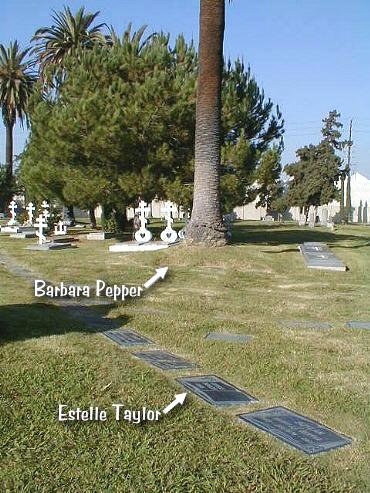
Born Ida Estelle Taylor on this date in 1894 in Wilmington, Delaware, into a Jewish family.  Her mother, for whom she was named, had worked as a freelance make up artist.  In 1903, her parents divorced, and her mother remarried Harry J. Boylan, a vaudevillian.  Little Estelle, as she was known because of her mother, was raised by her maternal grandparents.  Her childhood dream was to become and actress, and at the age of ten, she sang on stage for the first time in an amateur performance of H.M.S. Penifore in the part of "Buttercup" in Wilmington.  While in high school she got a job as a typist; at 17 she married a bank cashier (some sources cite her age as 14, was is wrong and ridiculous).  The marriage didn't last long; and she soon set out for New York with acting aspirations.  She made her official stage debut in the musical Come On, Charlie.  She then relocated to Hollywood, and was able to start film work playing extras.  The first film that she is credited in comes in 1919 with the comedy The Broadway Saint; at 50 minutes, this was considered a very early feature length film.  She found some early success in an early crime melodrama anthologies While New York Sleeps; playing the female leads in each of it's segments (one including a Vamp role).  What is remarkable about this film is that I am happy to write that it is a formerly lost film.  A nitrate copy was discovered and was restored enough to screen at an L.A. film festival (the original nitrate copy is in the vaults of the film school at UCLA).  Her fame only strengthened when she appeared in the critically acclaimed Monte Cristo, across John Gilbert in 1922.  Around this time, she started having trouble with an arthritic condition.  Despite this, she kept working and appeared in the role of Miriam in Cecile D. DeMille's first version of The Ten Commandments in 1923.  In ever increasing pain, she fought for and got the supporting role of Mary, Queen of Scots in Dorothy Vernon of Haddon Hall in 1924 starring Mary Pickford. She was the consummate silent actor and her fame and popularity with players only increased as time went by.  In 1926 she was cast in one of the earliest sound films that was a major production; Don Juan, as Lucrezia Borgia. This was a major breakthrough in sound effects in movies, and was touted as so by Warner Brothers, that unbeknownst to theater organists who played music live in film theaters to projected silents, their days were numbered.  This was so early in this phase, in fact, that the sound was provided by Vitaphone, a company that had been pioneering sound tracking--they were quickly rewarded for their efforts be being copied and improved on, because, in large part they had not been able to patent much of their earliest sound technology because of the Edison corporate giant.  It would be over two years later that she would appear in a film of the same sort; in Show People (1928).  In between this time, she had been cast to star opposite Rudolph Valentino, but he died before production ever started and the film was never made.  The first full sound film that she made was in 1929, Pusher-in-the-Face, a short drama penned by F. Scott Fitzgerald.  Ironically enough, she ended the 1920's going back to starring in a partial silent, with the soundtrack and sound effects being the only tracked recordings in the film and the dialog completely silent, quite unusual for the day for someone who had achieved such success in the height of the 1920's feature length cinematic spectacle.  The film was Where East Is East, a title not without merit; it was directed by Tod Browning and starred Lon Chaney Sr. During the twenties, she had appeared in several films featuring New York, a kind of type casting--one of the earliest that can be easily recognized--despite that she from Delaware (her nickname was "The Delaware Delilah").  Taylor did make a transition to sound film, but it was not to last.  In 1925 she had married famous boxer Jack Dempsey, this in part added to her celebrity; the marriage was over by 1931 and her star began to wane.  Though she is touted as having been a serious star of the silent era who made the transition the talking era, that was not completely the case.  After 1932, she only made more 4 more films in her life; and unfortunately she was 40 years of age in 1934 and the studios still give women of that age a hard time even today; back then one can only imagine the pressure!  Combine that with her health issues from the mid 1920's, one can hardly blame her for retiring from film.  Between Call Her Savage in 1932 and her last film The Southerner in 1945 she only appeared in roles that could barely be considered "bit parts" by actors starting out in the film business.  One notable, and sad, event happened to her in 1944, when she was reportedly the last person to see Lupe Valez before she committed suicide.  In her retirement, she became the founder and president of the California Pet Owner's Protective League and in 1953 served on the Los Angeles City Animal Regulation Commission.  Taylor died in her home on the 15th of April in 1958 at the age of 63 after battling cancer.  She is interred in Hollywood Forever Cemetery.  


For More:


Leave Virtual Remembrances @ Find A Grave

Friday, June 3, 2016

The Twice Lost and Found King: Richard III (1912)


The 1912 silent feature length* rendition of Richard III, based on the famous Shakespeare play, was once a lost film; so famously lost that one cannot read a book on early film predating its rediscovery without reading lament after lament of it's "permanently lost" status.  What was more famously lost?  The body of the actual man himself.  Finding a copy of a feature length nitrate (see film base) dating from 1912 was considered impossible; the most anyone could hope for were extra nitrate prints that could be spliced onto surviving ones to produce some motion from the film.  Finding the body of the actual man King Richard III was considered an even more remote possibility; something along the lines of finding evidence of a historical Camelot.  Since 1996 both have found.  


Original title card for the 1912 film

The car park in Leicester under which the actual remains of Richard III were found (Leicester Mercury)

The story of the rediscovery of the film is a bit ironic, since a full copy of the film emerged not all that far away from the modern movie mecca of the world, Hollywood CA; the film was just north in Portland, OR. all along.  A complete and well preserved copy was simply handed over to the American Film Institute in 1996.  It had been stored in the basement of a retired film projectionist for more than 30 years.  Only one feature length film was produced earlier in the U.S.--Oliver Twist--and it only survives in partial form.  Richard III was produced as a vehicle for well known Shakespearean actor Frederick Warde, whose presence as an actor in plain-clothes frames the film.  At a time when live stage plays of Shakespeare tended to be not so true to the source material; had been "Victorianized" (to use a royal description); this film does just the opposite.  It shows Shakespeare's Richard III, the last king in the Plantagenet line, unflinchingly.  He is, in the capable hands of Warde, both charming and utterly evil.  One point of interest, is that there is no playing up of the hunchback look of Richard, which actually, as it turns out, pretty much is what was discovered in the body of the king himself, of what he actually looked like in life.  The film does not use any Shakespearean dialog; rather the film follows the action within the plays acts faithfully.  Being literal to the source directions, meant that the film came out in a very stripped down fashion, despite it's lavish production features.  It presents the story starkly and with no concern about offending "delicacies" of the time.  


Warde as Richard in Richard III  (1912)
  
Historical portrait of the actual Richard III

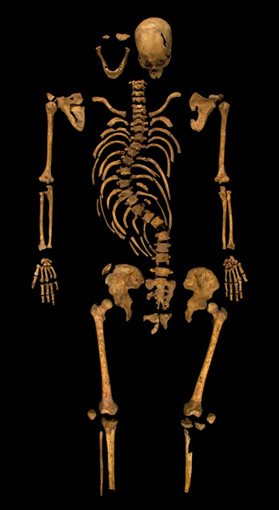
While the film was rediscovered in 1996, one full year after Sir Ian McKellan's film version of the play hit the theaters; it would be a further 16 years before the body of the actual man himself would be discovered.  This came in 2012, in the city of Leicester, where he was found buried beneath a car park (parking lot). By 2014, DNA proved that the skeletal remains of the man with a curved spine and fatal battle injuries, were in fact, those of the last monarch in English history to die on the battle field. Richard did suffer from scoliosis, a form of curved spine, and he had a pretty severe case of it.  But, this DOES NOT produce a "hunchback" look in people who have it.  As it turns out, this is the only direction from the actual Shakespeare play that the film does not take up.  The rest of the 55 minute film, is completely and unapologetically faithful to the play.  It shows the murders of royal family members front and center--there is no off camera inference of murder or covering the violence with a curtain, which was the norm o of the day.  In fact, the film actually shows murder for murder's sake, even of the two young princes, completely.  The later, taking place in the infamous Tower of London, is shown in blue tints to emphasize it's extreme violence. For a brief second, the shear evil of the acts makes one forget that this is indeed a silent film dating from over 100 years ago.  

Associated Press photo of Richard III's remains before being removed from his original grave.

Another still of Warde as Richard III from the film.

Of course, history is written by the victors, and Shakespeare was the patron of the House of Tudor, so his "historical" plays had to reflect that newly founded royal house is every positive light and with a history that gave legitimacy to it's very existence.  However, a few facts about Richard III can not be denied, and it goes to what Shakespeare is likely to have gotten right.  At least three things found in the play, and shown so starkly in this film, have solid basis in history. One is that Richard did actively seek out the throne for himself after the death of his older brother King Edward IV. He had actually been placed in the official royal role of "Lord Protector of the Realm," since Edward's heir Edward V was only 12 years of age upon succeeding his father to the throne.  Many of the moves that he is known to have made after Edward the Fourth's death do point to extreme plotting,  and even complaisance in deaths.  However what we know of the hard  facts, they do not match the plotted death's from the play--and hence the film-- save possibly the last two. In light of how Henry VII came to the throne in the wake of the demise of the Houses of Lancaster and York, it is easy to see how Shakespeare would twist the facts to make Richard III appear to be a truly illegitimate ruler and monster to boot.  In fact, many of his actions, were monstrous, but not against his brothers.  

Warde as Richard III wooing Anne in the film

Actual bust of the historical Richard III based on a reconstruction of his recovered skull

A second fact that Shakespeare got right, was the disappearance of the two young princes at the Tower of London.  This was a fact that was too glaring and horrible to embellish on.  In the 1912 version of the film, the prince's are shown being strangled to death after their nightly prayers on Richard's direct orders.  If this 104 year old scene is shocking today; one can only imagine how it was received by audiences in 1912!  In reality, all that anyone knows is that the two princes were kept in the Tower of London awaiting the official coronation of 12 year old Edward V, and that they simply disappeared.  What is certain: there were persistent rumors of the location of their burial, suggesting that someone knew something solid about the deaths not being down to natural causes; and that allegations and fears of murder spread like wildfire after the disappearances.  Spreading even to France, who also had a very young king at the time.  That being said, not all sources cited Richard as being directly, or even indirectly, involved.  There were rumors that the murders occurred independent of Richard, by a person who wished to see him on throne.  What is known, is that two small skeletons were uncovered in 1674 in the area that they had long been rumored to have been buried all along by a stonemason remodeling the Tower at the time.  King Charles II had them placed in Westminster Abbey four years later, assuming they were the bodies of Edward and his younger brother who was also named Richard.  The bones were disinterred in 1933, examined and measured, then reburied.  No further disturbance has been made since, so, of course, no DNA samples have been obtained.  The problem with these types of "historical facts" verses the "propaganda facts" put out during the early years of Tudor rule, is that they look good on the surface, but blur easily upon further scrutiny.  These two bodies were not the first children's skeletons discovered in the Tower.  Another set of skeletons had been uncovered earlier in a walled up chamber.  To make matters worse, a couple of unaccounted for coffins were found in the burial chamber of Edward IV and his Queen in St George's Cathedral.  At first it was thought that the caskets, though unnamed, were for two of their children who had died in childhood before the demise of Edward and historically accounted for:  George 1st Duke of Bedford--died aged 2, and Mary of York--died aged 14.  But a later excavation in the early 19th century to provide room for the house of King George III turned up two additional (and traditional) lead lined coffins marked with the names of George and Mary; leaving a huge mystery as to who the children were in the coffins originally thought to be these two children.  Given the tomb was for Edward and his wife Elizabeth, speculation sparked that the two princes had been disinterred from the tower and properly laid to rest with their parents.  But who would do this??  Richard III???  What is known, is that these coffins do not match any burial records for children of the royal couple that died within their lifetimes, and again, the caskets bear no names.  This leaves a huge mystery that would require a royal decree from Her Royal Highness, Queen Elizabeth II to investigate, which has not been granted; but then again, no formal request has been made.

Warde as Richard III utilizing a fully working set in Richard III (1912)

Richard III body reconstructed in lab, showing spine curvature. Photo: BBC

The third thing that is absolutely undisputed as a fact in Richard III's life that Shakespeare gets right, is actually the manner of his death.  Richard III the 1912 film was very sophisticated in it's use of outdoor filming, complete with actual processions, boats and even battle scenes--staged fully with actual horses.  In the film, we see Richard's death at Bosworth, in full riotous gear.  Henry Tudor AKA the Earl of Richmond in the film is his killer; Richmond, who looks more the grinning villain than Richard III does, has an expression as if he just got away with one big crime from which he knows he will benefit. The role is played by the person most directly responsible for the film's existence, writer/director James Keane.  He is the one who adapted the play to the script, and he was the shadow director.  It is unclear what he means to convey by having the future King Henry VII appear in the film with such vicious features and wild over-acting.  At first, the viewer is tempted to just assume he's simply bad at acting; but upon repeat viewings I do not believe this to be the case.  I do think that he is deliberately leaving wiggle room for a lurking menace below the surface of the grandfather of Elizabeth I.  This having been said, the real death of King Richard III at Henry Tudor's "hand" at Bosworth turned out to be right on par with what is in the play, and hence the film, save that Henry probably didn't strike any of the blows that lead to the king's death.  When found, the body bore more than a dozen life-threatening wounds.  A clear and very large laceration is visible in his left temporal lobe, this wound alone could have sent him to his grave.  Additionally, he had a large hole in the back of his skull, clearly a wound by some type of mace.  It was a fact:  Richard III was the last English king to die in battle; he was killed on 22 August 1485, he was 32 years of age.  He was buried in the floors of the little church that served the small community near by.  Over time the location of the original church was lost, and it was assumed by most to be lost for all time.  After research revealed that history had gotten the location of the actual battle wrong, a small group of dedicated individuals from several walks of life, gathered themselves in effort to uncover the proper locations of the other historical buildings and landmarks from the 15th century.  This quest, of course, paid off beyond most people's expectations.


Active battle scene from the film

The reburial of the actual body of Richard III in Leicester Cathedral

Finding a complete copy of a nearly hour long film on nitrate in good condition 84 years after it's release is close to unheard of, as nitrate has many ways of deteriorating.  Finding the body of a king that had almost passed into myth 527 years after his death and hasty burial, is a near miracle. The film was restored and given a full premiere cycle in both New York and Los Angeles.  Later, the completely restored print was released on DVD by Kino, with a new score by famed movie composer Ennio Morricone. The king was sealed into the traditional lead lined casket and reburied in Leicester Cathedral after a 3 days of allowing the public to pay their respects.  He was given a full reburial ceremony, with at least one member of the current royal family in attendance--Sophie the Countess of Wessex.  His casket was borne by a guard of honour drawn from successor Army regiments that fought at Bosworth (both sides).  Actor Benedict Cumberbatch, a distant relative of of the king, read a poem written for the occasion by the current British poet Laureate.  His tomb was then sealed and revealed to the public the following day.

*feature length is usually described in terms of time length and being longer than 40 minutes


Leicester Cathedral re-burial market, noting the location of Richard III's original grave.

Frederick Warde, in plain clothes, taking a bow at the end of the film.
For More See:

Wikipedia  page for Richard III

Wikipedia page for the Princes in the Tower

Wikipedia page of Henry VI

Wikipedia  for the film

University of Leicester Full interactive history of discovery of the king's grave.

BBC Article detailing the reburial of the king

1996 New York Times Article on the discovery of the film.

Viewing:  the PBS episode "Resurrecting Richard" for the series Secrets Of The Dead.


Sunday, September 20, 2015

Born Today September 20: Victor Sjöström


1879-1960

Born Victor David Sjöström in Silbodal Sweden, he is primarily known as a very prolific director of films, but, in fact, he was also a prolific actor as well, often directing himself in his own films.  He is well known as "The Father Swedish Film" and is regarded as one of the very best film directors ever.  He directed some very famous and influential silent films, especially in the 1920's that includes one of my favorite silent horror films of all time The Phantom Carriage (which he also wrote) in 1921.  Though born in Sweden he was only one year old when his father Olof moved the family the New York; when 6 years later his mother died, at just the age of 7 he returned alone to Sweden to live with relatives in Stockholm.  He started down the path toward making films, when at the age of 17 he started acting with a touring theater company. He left the stage to make his first film in 1912 and continued to direct films through the year 1937. In all he made 41 films in Sweden, many are probably and  sadly lost.  Though he started directing in Sweden, he made the move to Hollywood in the 1920's at the invitation Louis B. Mayer, where he went on to direct the likes fellow Swede Greta Garbo, Lillian Gish, Lon Chaney Sr. and John Gilbert, just to name a few. When in Hollywood he was credited as "Victor Seastrom." He made only two talkies in the US, with only one A Lady To Love (1930) actually made for US consumption.  Though his next film Die Sehnsucht jeder Frau (1930) was produced by MGM, it was in the German language and debuted in Finland; on this one he insisted that his real name be credited as director.  This marked his end in Hollywood, when he returned to Sweden to direct a further two films.  His last film Under The Red Robe (1937) was made in England, where he was once again credited as Seastrom (it is currently on Amazon Prime).  He then stopped directing films and returned to the theater in Stockholm.  He did, however, continue acting in movie, with his last role coming in the year 1957 in no less than the Ingmar Bergman directed Wild Strawberries.  In addition to being an incredibly talented actor and director, he was also very good writer of screenplays.  He passed away in Stockholm on the 3 of January in 1960 at the age of 80 and it interred at Norra begravningsplatsen (Northern Cemetery), where a number of other famous Swedes are buried including actress Ingrid Bergman is also buried.

In Hollywood with Lillian Gish and Lars Hanson, amongst other on an outdoor shoot.

His Very Prolific Silent Era Work:

Trädgårdsmästaren (1912) (a formerly lost film, it was also a banned film)


Barnet (1913) (short)

Vampyren (1913) (short)


Dödskyssen (1916) (partially lost film)


Name The Man (1924) (his first Hollywood film)

He Who Gets Slapped (1924) (this will be aired on TCM on the 28th of this month)

Confessions Of A Queen (1925) (partially lost film)

The Tower Of Lies (1925) (set in Sweden, filmed in California, I believe the above still may be a cast photo from this film.)


The Divine Woman (1928) (here he directed Garbo, it such a shame that only 9 minutes of this film survives!  At least we have the one reel!)


The Masks Of The Devil (1928) (sadly a lost film


Saturday, September 19, 2015

Born Today September 19: Ricardo Cortez


1900-1977

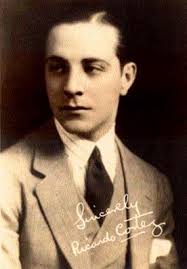
You would think with a name like Ricardo Cortez and the fact that he was born in New York City, he would be  Cuban, Puerto Rican or of some other Caribbean Latin ancestry.  In fact he was born Jacob Krantz to recently immigrated Austrian Jewish parents.  He mother was heavily pregnant with him when the couple made the move to NYC, so many sources incorrectly list his birthplace as Vienna.  The reason for his name change had nothing to do with him personally. With the popularity of the "Latin Lover" type, first made a character type by Rudolph Valentino, who was Italian and other actual Latin actors coming in to fill out roles; due to his genuinely Semitic dark skin color, Hollywood executives actually changed his name (possibly without his knowing it, or at least with some protest) to place him in roles of that sort.  Certainly he was a truly handsome man, and he did bear resemblance to Valentino.  But the incident reminds me a bit of the joke in the Coen Brothers Barton Fink, where Tony Shalhoub's character Ben Geisler mistakes Barton (John Tuturro) for an actor, notices his dark skin and makes a remark about "Indians" (meaning Native Americans), and Barton replies that he's there because he's a writer and Geisler replies "Think about it Fink! Writers come and go, we always need Indians!" (Interesting to me as a side note, because both characters are themselves Jewish).  Before going to Hollywood, and having that abrupt name change, he worked in New York on Wall Street by day and as a amateur boxer by night.  After the move to Hollywood, press kits on him were circulated stating that he had Spanish ancestry, but it wasn't long before rumors arose about his ancestry (now I wonder, did he start them???), so the studios then said he was actually French, finally they admitted his "Viennese" origin, which is why the confusion of his place birth has persisted.  He was married to tragic silent film starlet Alma Rubens until her untimely death in 1931 from pneumonia; but the couple had separated due to her on going drug abuse and instability, she was released from jail just shortly before she caught the cold that eventually led to her death at the age of 33 (she may have been one of the Hollywood Studios first victims of enticed drug addiction--that is a truly dark subject, that was thought to have developed after the silent era).   In all he appeared in 100 films, he was also the second actor to assay the role of Perry Mason, with Warren William being the first.  He went on, to star in films with the likes of Joan Crawford, Bette Davis, Al Jolson and one of the best horror actors of all time Boris Karloff.  Having worked on Wall Street before, when he retired from films he went back to New York and work as a stockbroker at the later infamous (as least for a while) Salomon Brothers.  As a moment of serendipity for me today, checking his credits, I found that archive footage of him was used in two Greta Garbo documentaries (both after his death)--her birthday was just a day before her, and I wrote about her just yesterday. He is interred at Woodlawn Cemetery in The Bronx.

Circa 1935

The Non-Latin Romantic's Early Films

The Fringe Of Society (1927) (scenes deleted, this had to be a real let down for him!  This was to be his first film afterall.  Also has to be one of the earlier cutting room floor incidents in feature films.)


The Next Corner (1924) (Lon Chaney Sr.)

A Society Scandal (1924) (a Gloria Swanson film--love her!!)


Feet Of Clay (1924) (hey the first Jaws film and directed by Cecil D. DeMille to boot.  Take that Spielberg!)

This Woman (1924) (thankfully now a formerly lost film!)  


In The Name Of Love (1925) (also starred Wallace Beery.  Lost film)


Torrent (1925) (this was Greta Garbo's first US film and the last time anyone was ever billed above her...that would by Ricardo Cortez)


The Sorrows Of Satan (1926) (not billed as a horror film, it was directed by D. W. Griffith--but it probably should have been.  Can be viewed as Christian propaganda these days.  At the time it was a over romanticized (surprised surprised) response to Theosophy.  It was adapted from a novel Check out the poster--it's awesome!)


Mockery (1927) (also with Lon Chaney Sr.)


Excess Baggage (1928) (lost film)

The Gun Runner (1928) (lost film)

The Younger Generation  (1929) (Frank Capra directed)

New Orleans (1929) (lost film)

Midstream (1929) (lost film)--was a partial silent with sound effect and musical soundtrack by RCA Photophone System)

The Phantom In The House (1929) (early talkie, sound by RCA Photophone System)

The Lost Zeppelin (1929) (this is a partially lost film that has further footage that has been found--some claim that it complete.  I haven't been able to confirm that.  Would love it if were true.  It is on DVD, but some footage may still be missing due to strange issues with subplots.  Or maybe, it's just a bad script)


Tuesday, September 15, 2015

Born Today September 15: Fay Wray


1907-2004

No introductions needed here!  Every horror fan knows her as the original "scream queen"--mostly for her turn in King Kong 1933, but she was plenty "screamy" in other films she made around this time as well.  My personal favorite of these is The Mystery Of The Wax Museum starring Lionel Atwill, directed by the great Michael Curtiz, also made in 1933, and up until the late 1960's was considered to be a lost film.  So much is made of her appearances and noise in early talking horror films, that not much attention is paid to her silent career.  Born Vina Fay Wray in Cardston, Alberta, Canada; the family soon relocated to Los Angeles here in the US.  She began as an extra when she was barely into her teens, and was one of the few child actors that seemed to weather the transition to adult actor better than most.  Far from being a silent horror star, she was in a number of short slapsticks early on.  If she can be said to have specialized in any genre in the 1920 it was westerns ironically.  She passed away at the age of 96 on the 8 of August 2004, in New York City.  She is another very famous celebrity interred in the famous Hollywood Forever Cemetery.


Her Early Film Work:


The Coast Patrol (1925) (the first feature length film she was in.)

Sure-Mike! (1925) (short slapstick)


Isn't Life Terrible? (1925) (short with Charley Chase & Oliver Hardy)

Thundering Landlords (1925) (short, first featured credit in title cards)


Madame Sans Jane (1925) (short written by Hal Roach)


Your Own Back Yard (1925) (an Our Gang short)

A Lover's Oath (1925) (partially lost film)

Moonlight And Noses (1925) (partial lost short)

Ben-Hur (1925) (her slave girl appearance in this is still unconfirmed)

WAMPAS Baby Stars Of 1926 (the fist time she is credited with "self")


The Snow Cowpuncher (1926) (short, part of the Mustang Western series)


Loco Luck (1927) (A Blue Streak Western)

A One Man Game (1927) (A Blue Streak Western)

Spurs And Saddles (1927) (A Blue Streak Western)


Street Of Sin (1928) (lost film)


The Wedding March (1928) (an Erich von Stroheim directed film)

The Honeymoon (1928) (another Stroheim film)

The Four Feathers (1929) (early talkie, William Powell and Noah Berry were in this, dialog by Western Electric, soundtrack and sound effects by MovieTone)

Thunderbolt (1929) (two versions circulated, one silent the other in mono, with sound by Western Electric)

Pointed Heels (1929) (early musical, sound by MovieTone, early two strip technicolor, with some parts in black and white)