Showing posts with label The Ten Commandments (1923). Show all posts

Saturday, June 3, 2017

Born Today June 3: Robert Edeson


1868-1931

Silent film and stage actor Robert Edeson was born on this date in New Orleans, Louisiana.  Given that he was born so long before the actual invention of the narrative film, it is hardly surprising that he was much more of a stage legend than a film star.  He was a major actor during his time on Broadway.  He got into film acting relatively late in life.  His first film dates from the year 1912 with the short western His Message, a Thomas Ince film.  The first film that he acted in that has historical merit comes in the Cecil B. DeMille co-directed The Call Of The North (1914).  He worked pretty steadily throughout the rest of the 1910's, all the while still managing stage appearances.  The first film of the 1920's that he acted in came with Extravagance (1921), a Phil Rosen film.  In 1922, he had a small role in Erich von Storheim's Foolish Wives; doubling for the star of the film Rudolph Christians after the star died of pneumonia during filming.  In 1923, he landed a medium sized role in Cecil B. DeMille's The Ten Commandments.  Throughout the 1920's his acting in film picked up notably--as he was by this time thoroughly a Hollywood performer and under contract to DeMille's company DeMille Pictures Corp. By 1928, his contract up, he appears to have become a type of free agent.  He had a part, for example, in Frank Capra's The Power Of The Press (1928), which was made for Columbia and starred Douglas Fairbanks Jr..  His next film was an all mono film with sound by Vitaphone; The Home Towners (1928) was made for Warner Bros (the early sound comedy is a lost film).  The first film that he made in the 1930's was produced by Fox, Cameo Kirby (1930) appears to have yet another victim of the Fox vault fire of 1937.  The last film that he appeared in was Aloha (1931).  Edeson died of a heart disease of some sort on the 24th of March 1931 in Hollywood, having worked right up to the day he passed.  His remains were cremated and scattered at an unknown location in Hollywood Forever Cemetery.  He was 62 years old. 

His star on east side of the 1600 block on Vine St.


For More:


Leave Virtual Flowers @ Find A Grave

Friday, May 19, 2017

Born Today May 20: Estelle Taylor


1894-1958

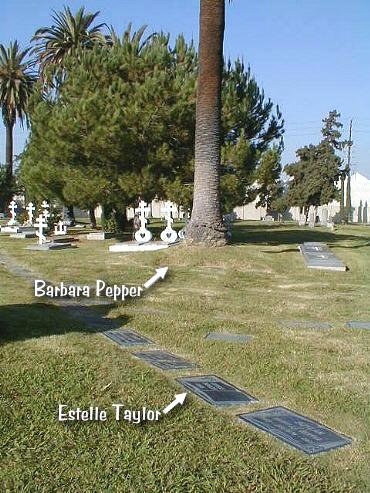
Born Ida Estelle Taylor on this date in 1894 in Wilmington, Delaware, into a Jewish family.  Her mother, for whom she was named, had worked as a freelance make up artist.  In 1903, her parents divorced, and her mother remarried Harry J. Boylan, a vaudevillian.  Little Estelle, as she was known because of her mother, was raised by her maternal grandparents.  Her childhood dream was to become and actress, and at the age of ten, she sang on stage for the first time in an amateur performance of H.M.S. Penifore in the part of "Buttercup" in Wilmington.  While in high school she got a job as a typist; at 17 she married a bank cashier (some sources cite her age as 14, was is wrong and ridiculous).  The marriage didn't last long; and she soon set out for New York with acting aspirations.  She made her official stage debut in the musical Come On, Charlie.  She then relocated to Hollywood, and was able to start film work playing extras.  The first film that she is credited in comes in 1919 with the comedy The Broadway Saint; at 50 minutes, this was considered a very early feature length film.  She found some early success in an early crime melodrama anthologies While New York Sleeps; playing the female leads in each of it's segments (one including a Vamp role).  What is remarkable about this film is that I am happy to write that it is a formerly lost film.  A nitrate copy was discovered and was restored enough to screen at an L.A. film festival (the original nitrate copy is in the vaults of the film school at UCLA).  Her fame only strengthened when she appeared in the critically acclaimed Monte Cristo, across John Gilbert in 1922.  Around this time, she started having trouble with an arthritic condition.  Despite this, she kept working and appeared in the role of Miriam in Cecile D. DeMille's first version of The Ten Commandments in 1923.  In ever increasing pain, she fought for and got the supporting role of Mary, Queen of Scots in Dorothy Vernon of Haddon Hall in 1924 starring Mary Pickford. She was the consummate silent actor and her fame and popularity with players only increased as time went by.  In 1926 she was cast in one of the earliest sound films that was a major production; Don Juan, as Lucrezia Borgia. This was a major breakthrough in sound effects in movies, and was touted as so by Warner Brothers, that unbeknownst to theater organists who played music live in film theaters to projected silents, their days were numbered.  This was so early in this phase, in fact, that the sound was provided by Vitaphone, a company that had been pioneering sound tracking--they were quickly rewarded for their efforts be being copied and improved on, because, in large part they had not been able to patent much of their earliest sound technology because of the Edison corporate giant.  It would be over two years later that she would appear in a film of the same sort; in Show People (1928).  In between this time, she had been cast to star opposite Rudolph Valentino, but he died before production ever started and the film was never made.  The first full sound film that she made was in 1929, Pusher-in-the-Face, a short drama penned by F. Scott Fitzgerald.  Ironically enough, she ended the 1920's going back to starring in a partial silent, with the soundtrack and sound effects being the only tracked recordings in the film and the dialog completely silent, quite unusual for the day for someone who had achieved such success in the height of the 1920's feature length cinematic spectacle.  The film was Where East Is East, a title not without merit; it was directed by Tod Browning and starred Lon Chaney Sr. During the twenties, she had appeared in several films featuring New York, a kind of type casting--one of the earliest that can be easily recognized--despite that she from Delaware (her nickname was "The Delaware Delilah").  Taylor did make a transition to sound film, but it was not to last.  In 1925 she had married famous boxer Jack Dempsey, this in part added to her celebrity; the marriage was over by 1931 and her star began to wane.  Though she is touted as having been a serious star of the silent era who made the transition the talking era, that was not completely the case.  After 1932, she only made more 4 more films in her life; and unfortunately she was 40 years of age in 1934 and the studios still give women of that age a hard time even today; back then one can only imagine the pressure!  Combine that with her health issues from the mid 1920's, one can hardly blame her for retiring from film.  Between Call Her Savage in 1932 and her last film The Southerner in 1945 she only appeared in roles that could barely be considered "bit parts" by actors starting out in the film business.  One notable, and sad, event happened to her in 1944, when she was reportedly the last person to see Lupe Valez before she committed suicide.  In her retirement, she became the founder and president of the California Pet Owner's Protective League and in 1953 served on the Los Angeles City Animal Regulation Commission.  Taylor died in her home on the 15th of April in 1958 at the age of 63 after battling cancer.  She is interred in Hollywood Forever Cemetery.  


For More:


Leave Virtual Remembrances @ Find A Grave