Showing posts with label Disraeli (1929). Show all posts

Saturday, February 27, 2021

Born Today February 27: Joan Bennett


1910-1990


Actress Joan Bennett is instantly recognizable as the matriarch of the cult gothic television series "Dark Shadows," but she got her start in films at a very young age and very much in the silent era. Bennett was born on this day in the Palisades area of film studio town Fort Lee, New Jersey. Her career was a long a varied one that started when she was just six years old. Bennett was one of three acting daughters of actor Richard Bennett and his second wife actress/writer Adrienne Morrison. The Bennett's were from a long line of actors, with Richard being the first to enter films. As far as silent films go, it is Joan's older sister Constance is much more associated with the era. Her other older sister Barbara, was also an actress, though much lesser known, with a very short career. All three of them made their motion picture debut in The Valley of Decision, starring both of their parents, in 1916. Joan is also listed as having a small part in the 1923 Bert Lytell/Barbara La Marr war drama The Eternal City at the age of 13. She was married and divorced, and had a child, all before making her actual professional acting debut at the age of 18.  And, her debut came on the stage in 1928; acting again with her father, she had a major part in a Broadway production that ran for more than 130 performances. She also started her film career in earnest that same year, starting out in the fully silent comedy Power with William Boyd (later Hopalong Cassidy) and Alan Hale Sr. (father of "The Skipper" on Gilligan's Island). Though she only had a supporting role (Jacqueline Logan had the female lead), her performance got her noticed, making her instantly an in-demand actor for film work.  She was almost instantly cast in the early talkie Bulldog Drummond (May 1929) starring Ronald Colman; following close on with Three Live Ghosts (September 1929) and the Oscar winning Disraeli (November 1929).  At just 19, Joan Bennett was a full fledged film star; and appeared in one additional talkie in 1929, taking the female lead in The Mississippi Gambler opposite Austrian born actor Joseph Schildkraut (there was a silent version of this film and that released simultaneously with the all talking version). She quickly followed this up with the leading lady role of Dolores Fenton in the romantic nightlife film Puttin' on the Ritz in March of 1930. Just a few of her leading roles in the 1930's include: Moby Dick (1930) with John Barrymore, Doctors' Wives (1931) with Warner Baxter, She Wanted a Millionaire (1932) with Spencer Tracy, Little Women (1933) with Katherine Hepburn, The Pursuit of Happiness (1934) with Francis Lederer, Two For Tonight (1935) with Bing Crosby, Wedding Present (1936) with Cary Grant, I Met My Love Again (1938) with Henry Fonda and The Man In The Iron Mask (1939) with Louis Hayward. In 1940, she appeared in James Whale's adventure film Green Hell with Douglas Fairbanks Jr., John Howard, Alan Hale Sr., and Vincent Price. She next appeared in the gangster film The House Across the Bay (1940) with George Raft, worked with director Fritz Lang in Man Hunt (1941) and Otto Preminger in Margin For Error (1943)She would work with Lang three more times during the decade. But, Bennett is best known today for her television work, and she made her television debut in 1951 in an episode of Nash Airflyte Theatre (which aired on the 8th of February).  The series was live. Though she did act in a handful of films during the 1950's, most of her work during that decade was for the small screen. In 1959 she was given her own series "Too Young to Go Steady," made for NBC, though it was cancelled after seven episode. In 1966, she was cast as Elizabeth Collins Stoddard in the supernatural soap "Dark Shadows" created by Dan Curtis for ABC. Bennett appeared in nearly 400 episodes during the six years of the show's run.  Her other famous role of Madame Blanc came in Dario Argento's 1977 witch horror Suspiria.  She had just three more acting jobs after appearing in Argento's film; all of them were made for television films. The last of these was Divorce Wars: A Love Story, made for ABC, it stars Tom Selleck and Jane Curtin (yes the SNL alum) and aired on the 1st of March in 1982.  She then retired and lived in New York state until her death from natural causes on the 7th of December in 1990 at her home in Scarsdale. She was 80.  She is interred at the Pleasant View Cemetery in Lyme, Connecticut. During her career, Bennett also acted through at least the 1960's on the stage as well.  


[Source: Jan Franco (Find A Grave)]

[Source: Jeanne Stewart (Find A Grave)]


with Jonathan Frid as Barnabas Collins in Dark Shalows


Suspiria (1977) lobby card


IMDb 

Wikipedia        

Find a Grave entry 

Sunday, March 12, 2017

Born Today March 12 (Not So Silent Edition): Thomas Augustine Arne


1710-1778

English composer Thomas Augustine Arne was born in Convent Garden, London, UK on this date to an Catholic mother and an Anglican father.  Despite that his grandfather and father, both ulpholsterers, had fallen on hard times (his grandfather actually died in a debtors prison), his father had saved enough monies back to have young Thomas educated at Eton.  The young Arne showed a very early interest in music and smuggled a spinet into his room to practice on during the night when the rest of the family slept.  He also would dress up as a liveryman to gain access to the opera, which eventually lead to his having an apprenticeship of sorts with musician and composer Michael Festing; who among other things, taught Arne to play the violin.  When he finished school, he was articled to a solicitor for a period of three years.  He had, though, continued to work with Festing; a situation that his father found out about.  Festing was mostly likely the person responsible for persuading Arne's father to allow him to leave the legal service and pursue a career in music instead.  What Arne is by far and away most famous for is his composition Rule Britannia; he also penned A-Hunting We Will Go and a version of God Save The King (which in movies, he is also credited for when it is listed as God Save The Queen).  Three partial-sound or full sound films made use of his Rule Britannia and one short featuring "Hunting" were made in the late 1920's.  The first of these is a very famous, one could say infamous, film:  the Paramount produced, William A. Wellman directed (at least most of...) Wings, starring Clara Bow and Charles Rogers.  The film was made in 1927, but not released formally until 1929.  The mono musical score and sound effects were furnished by Western Electric.  The Divine Lady (1929) was also a partial sound film.  The first full sound film featuring his music also came in 1929, with the Mickey Mouse short animation When The Cat's Away, featuring sound from the Powers Cinephone Sound System; this marks the first use in a film of A-Hunting We Will Go.  Finally, the first all sound feature film to use the work was Disraeli (1929). Rule Britannia was used next in King Of Jazz  in 1930.  Of course, over the decades, such well known music has been used in dozens of films from the likes of The King and I  to Minions.  The most recent use came last year in the series The Crown.  Arne died at the age of 67 close to the place of his birth in London on the 5th of March, just shy of his 68th.  He is buried in St. Paul's, Covent Garden, a church designed by the renowned Inigo Jones; it is known as "The Actors Church."

Scene from When The Cat's Away (1929)


For More:


Leave Virtual Flowers @ Find A Grave  

Thursday, May 19, 2016

Born Today May 19 Not So Silent Edition: Anthony Bushell


1904-1997

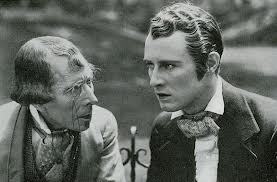
Anthony Arnatt Bushell was born in Kent, England, UK.  He was educated at Magdalen College, and later, Hertford College, Oxford.  After Oxford, he went on to study formal training in stage acting at the Royal Academy of Dramatic Art in London.  Bushell made his stage debut in 1924 in a production of Sardou's Diplomacy at the West End's Adelphi Theater.  By 1927 and 1928 he was touring with high profile theatrical productions in the United States; and by the end of 1928 he was the talk of Broadway.  That same year fellow British stage actor George Arliss saw him in a play; when Arliss was cast in a very early talkie Disraeli (1929) [sound by the Western Electric Apparatus], Arliss recommended Bushell for the role of Charles Deeford, which the studio accepted.  Also in 1929, Bushell was part of the huge production of The Show Of Shows.  He was featured in the "Henry VI" sequence.  Thus his movie career began in the earliest era of sound in motion pictures.  He would go on to be in films with likes of Douglas Fairbanks Jr., Myrna Loy, Edward G. Robinson and Erich von Stroheim.  He served his country during World War II; commissioned into the Welsh Guards, where he served as commander in the Guards Armoured Division--tank squadron.  After the war, he developed a close relationship with Sir Lawrence Olivier, and would go on to be an assistant director to him.  By the early 1960's, he had grown tired of the business.  The last full length film he made was the The Queen's Guards in 1961 and, he retired for good in 1964 after making his last acting appearance on the television series Drama 61-67.  He served for a time as the director of the Monte Carlo Golf Club.  Bushell passed away on 2 April 1997 at the age of 92 in Oxford, England, UK.  The details of his burial are unknown

Bushell right with Arliss in Disraeli (1929)


Leave Virtual Flowers at Find A Grave