Showing posts with label The Show of Shows (1929). Show all posts

Thursday, May 19, 2016

Born Today May 19 Not So Silent Edition: Anthony Bushell


1904-1997

Anthony Arnatt Bushell was born in Kent, England, UK.  He was educated at Magdalen College, and later, Hertford College, Oxford.  After Oxford, he went on to study formal training in stage acting at the Royal Academy of Dramatic Art in London.  Bushell made his stage debut in 1924 in a production of Sardou's Diplomacy at the West End's Adelphi Theater.  By 1927 and 1928 he was touring with high profile theatrical productions in the United States; and by the end of 1928 he was the talk of Broadway.  That same year fellow British stage actor George Arliss saw him in a play; when Arliss was cast in a very early talkie Disraeli (1929) [sound by the Western Electric Apparatus], Arliss recommended Bushell for the role of Charles Deeford, which the studio accepted.  Also in 1929, Bushell was part of the huge production of The Show Of Shows.  He was featured in the "Henry VI" sequence.  Thus his movie career began in the earliest era of sound in motion pictures.  He would go on to be in films with likes of Douglas Fairbanks Jr., Myrna Loy, Edward G. Robinson and Erich von Stroheim.  He served his country during World War II; commissioned into the Welsh Guards, where he served as commander in the Guards Armoured Division--tank squadron.  After the war, he developed a close relationship with Sir Lawrence Olivier, and would go on to be an assistant director to him.  By the early 1960's, he had grown tired of the business.  The last full length film he made was the The Queen's Guards in 1961 and, he retired for good in 1964 after making his last acting appearance on the television series Drama 61-67.  He served for a time as the director of the Monte Carlo Golf Club.  Bushell passed away on 2 April 1997 at the age of 92 in Oxford, England, UK.  The details of his burial are unknown
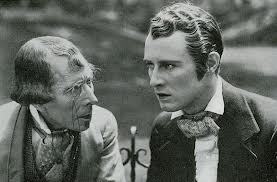
Bushell right with Arliss in Disraeli (1929)


Leave Virtual Flowers at Find A Grave

Tuesday, February 16, 2016

Born Today February 16: Chester Morris


1901-1970

Born John Chester Brooks Morris to acting parents:  his father a Broadway actor and his mother a successful comedian, in New York City.  As a child, he became very interested in magic tricks, and was a self-taught top amateur magician by adulthood.  He began his acting career at the age of 15. After dropping out of school; he went straight to Broadway; acting opposite of Lionel Barrymore in The Copperhead.  He made his film debut the following year in An Amateur Orphan, which starred Gladys Leslie (the film is now considered lost). Though he appeared in 3 more films between the years 1919 and 1925; his film acting career did not actually take off until the year 1929--having spent his time in the 1920's on the stage.  When he did return to films, his acting was immediately noticed.  His performance in the early all talking Alibi (1929) earned him a nomination for an Academy Award in the the Best Actor category.  His next film, Fast Life, also an all talking film, is also, unfortunately lost.  In all, the four films that he made in in 1929 was early talkies, though Woman Trap, had a silent version.  He had become so popular in film as such a fast pace, he even appeared in the Hollywood extravaganza The Show of Shows; representing both Broadway and Hollywood at the same time. Because of this, he appears in not one, but two skits in the musical.  By the mid 1930's, his Hollywood star began to fade and he found himself accepting lead roles in B-pictures.  He wound up in the serial part of "Boston Blackie" and made several films in that role; even playing the role on the radio in the 1940's.  During World War II, he performed numerous magical skits to entertain troops at USO shows.  The 1950's found him making television appearances on a steady and regular basis, with his first appearance coming as a magician in 1950 on a show called Cameo.  He even made it into one 1950's cult horror film, playing a mad doctor who had magical powers of transformative hypnosis.  He went on acting in television right up until the time of his death.  His last role was "Pop Weaver" in The Great White Hope in 1970, starring James Earl Jones (the film was released after his death).  Before filming began, he had been diagnosed with stomach cancer.  After filming wrapped, he joined a stage production of The Caine Mutiny Court Martial in New Hope, Penn.  On the 11th of September, when he didn't show up for a luncheon date with the producer of the play, Lee R. Yopp; Yopp went to his hotel room, only to find the actor dead on of the floor from a overdose of barbiturates.  His body was cremated and his ashes were scattered over a river in Germany.

As Dr. Carlo Lombardi in The She-Creature (1956)


Friday, January 22, 2016

Born Today January 22: Ann Sothern


1909-2001

Born Henriette Arlene Lake in Valley City, North Dakota; her mother was a professional singer who regularly toured with musicals.  Her maternal grandfather was famed Danish violinist Hans Nielsen.  The family resided in Minneapolis, where she attended McPhail School of Music.  Her mother also home schooled her in piano.  Her parents separated when she was four.  She then began to tour with her mother when time permitted.  By 11 she was both a well schooled pianist and soloist in singing and spent time singing in her church choir.  By 14 she resumed voice lessons.  In high school, she not only appeared in several school plays, she even directed a few of them!  Also while in high school, she entered state sponsored music composition competitions, and won three years in a row.  After she graduated from high school her mother moved to Los Angeles because she had gotten a job a Warner Bros. studios as vocal coach.  Sothern chose to move to Seattle where her estranged father had moved, there she enrolled in the University of Washington; but dropped out one year later.  At some point after she dropped out of University, she appeared in one silent film (her motion picture debut) as a Fan Dancer extra in 1927; Broadway Nights [this must be around the time that she chose to use a stage name].  The film was shot in New York City and produced by the short lived Robert Kane Productions.  She then visited her mother in Los Angeles; while there she auditioned for and got a role in a very early full sound musical revue produced by her mother's employer Warner Bros in 1929:  The Show of Shows.  The film featured full mono sound by Vitaphone with the Western Electric Apparatus, and had parts that were in very early technicolor.   This lead to her signing a 6 month contract with MGM.   These titles were the only two films she appeared in during the late silent era.  She quickly became disillusioned with Hollywood, and left for Broadway in the 1930's with the help of Florenz Ziegfeld.  She returned 3 years later; and had a very long and prolific career in film, radio and television.  During the 1950's, she decided to become a business woman and owned a slew of different type of business ventures, from production companies, a sewing store, to a cattle ranch in Idaho.  She even managed to record an album in 1958.  Some of the notable television appearances came on shows such as:  The Loretta Young Show, The Alfred Hitchcock Hour, and The Lucy Show.  From 1958-1961 she had her very own television series The Ann Sothern Show.  She is also the mother of actress Tisha Sterling (her father is was actor Robert Sterling).  The last film she made was in 1987, The Whales of August, with the likes of Lillian Gish, Bette Davis and Vincent Price.  This garnered her the only Oscar nomination of her career--that for a supporting role.  After this she retired to her ranch in Idaho.  She passed away there at the age 92 on the 15th of March 2001.  She buried there in the Ketchum Cemetery.