Showing posts with label Lon Chaney Sr.. Show all posts

Saturday, October 29, 2022

October 29: Mini Post on Some Makeup Men


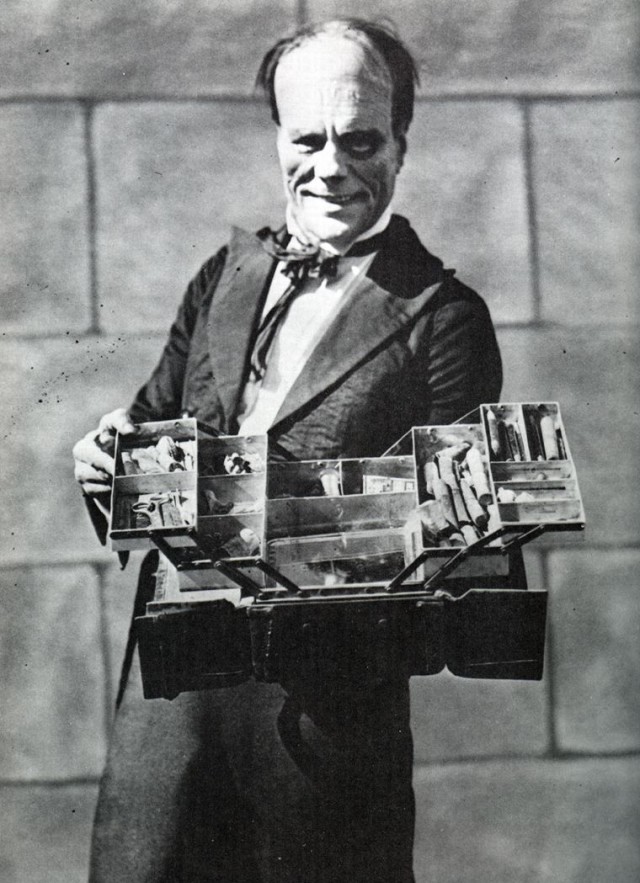
We all know Lon Chaney as "the man of a thousand faces" for his many roles that required either heavy makeup or prosthetics of some sort in the 1920's. Many people also know that Chaney was his own makeup artist, what is not as widely known is that Chaney was just one of a long line of actors that were also very accomplished makeup artists. Two actors to appear in horror before him that stand out are Charles Ogle and King Baggot. They both created their monstrous looks that have in many ways become iconic today.


Charles Ogle was the star of Edison's 1910 adaptation of Frankenstein, the film is only 16 minutes long, but it is memorable for it's creature. Ogle created the complete look himself and makes an unforgettable entrance in the film, emerging from a "creation chamber." His visage is as monstrous as the creature has ever been in film. With wild hair and deformed hands, he appears more a wholly supernatural monster, than a deformed human created wholly by science. Long thought lost until the mid-1970's; the film has been restored multiple times, most recently by our own Library of Congress. 


King Baggot was cast in the dual role of Dr. Jekyll and Mr. Hyde in the 1913  IMP/Universal adaptation of the Stevenson work.  Not the very first adaptation of the work, it was the first for Universal, making Baggot really the first "Universal Monsters." He was responsible for creating the visage of the wild and insane Hyde.  What is interesting about Baggot's Hyde is that it is a look that apparently influenced the 1941 MGM production starring Spencer Tracy.  Originally released in the two parts, the film in total runs close to half and hour. Both are available to stream online and are well worth a view. 

Saturday, October 22, 2022

October 22: The Unholy Three (1925 & 1930)


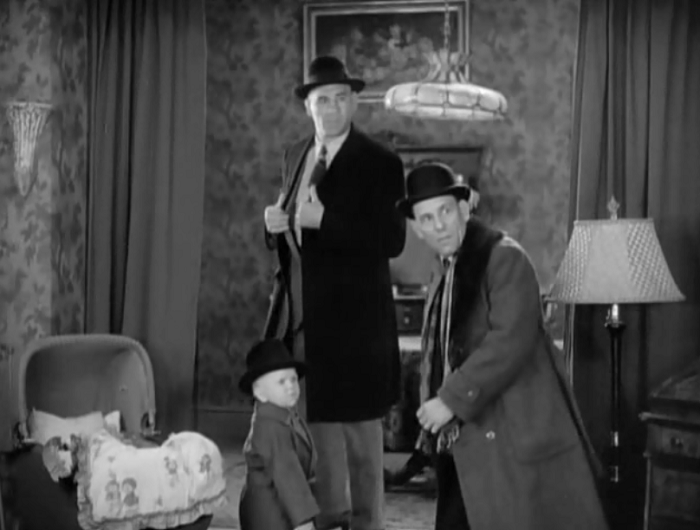
Lon Chaney may not have lived long enough to reprise role from Tod Browning's London After Midnight, but he did reprise another Browning role in a speaking remake of the original. Regarded as one of Browning best films, his 1925 The Unholy Three starred Chaney as a ventriloquist (a feat of very expressive silent acting); Chaney reprised the role in an all sound version in 1930 just prior to his untimely death that year (it would be his only speaking role in a film).  Browning, however, did not direct the film: Jack Conway did. Conway was regarded as a "Jack of all trades" (literally) in terms of genres that he directed. He was not known for an particular specialty; which meant that his pictures, while technically good, were rather bland; it also meant that he was beloved by studio management, particularly Irving Thalberg. The talking remake suffers for it though. It's a competent enough film to be sure, but it is (like so many remakes after it) a poor imitation of the original. The only other principle actor to return from the original cast was German born actor Harry Earles (Kurt Schneider).  Earles was Tweedledee in the original; Conway and crowd merely credited him as "midget" in the remake (Earles was only 3'3"). Below are some production comparisons of the two films. 


Saturday, October 15, 2022

October 15: Juxtaposing London After Midnight with The Mark Of The Vampire


Director Tod Browning remade his London After Midnight (1927) as The Mark of the Vampire in 1935. His original intent was to have Lon Chaney reprise his role of the professor, but Chaney died at the age of 47 in 1930. The next logical choice was Bela Lugosi whom Browning had directed in Dracula in 1931. Today a full print of the London is one of the most sought after films in the world.  Mark of the Vampire however, is very much intact and available for viewing. Just a few still comparisons follow. 


Saturday, October 8, 2022

October 8: Few Set Stills: The Hunchback of the Notre Dame (1923)


[These are all stills in wide public use, including several from Wikimedia Commons, the last image is an aerial shot of the Universal backlot at the time of the building of the Notre Dame sets]

Friday, October 7, 2022

October 7: A Blind Bargain (1922)


Tod Browning's London After Midnight is not the only lost Lon Chaney horror silent from the 1920's that would cause a stir if a copy where ever found. Goldwyn's 1922 A Blind Bargain was directed by Wallace Worsley, who had previously directed Chaney in The Penalty (1920) and would direct him the following year in The Hunchback of Notre Dame, one of the most famous surviving films of the 1920's. A Blind Bargain was based on a story that had similar premise as Mary Shelley's Frankenstein with a little H.G. Wells thrown in. It was based on a novel by British writer/humorist Barry Pain.  The film sported your standard mad scientist, complete with a hunchback assistant (who is one of Dr. Lamb's failed experiments); both of these parts were played by Chaney (applying, as was his custom, his own makeup). The main protagonist of the film is a down-on-his-luck writer and desperate for money; the part of Robert Sandell was played by Raymond McKee, whose performance was over-shadowed in the reviews by Chaney's dual monster performances. Sandell winds up under the sway of the mad surgeon Lamb after agreeing to an unspecified "bargain" that the doctor will operate on his sickly mother. Turns out that "blind bargain" is an agreement to be experimented on. The film also featured a full ape man--who was likely NOT Chaney. There are been persistent rumours that the man in ape suit was in fact Wallace Beery, but there is a high likelihood that this will never be proven one way or the other. The film had trouble overing the censors of the time delaying it's release for more than a year.  In the end, the film was cut from six reels to five over objections to the subject matter of creating life aka playing god. But nevertheless, it received a standing ovation on it's eventual opening night.  We know that the film was tinted throughout and one section was colored using a hand stenciling process. The last known print perished in the same fire in the mid-1960s that burned the last print of London After Midnight. Now all that remains of it (for now) are a few stills and some beautifully produced lobby cards.