Showing posts with label Vitagraph Studios. Show all posts

Thursday, September 3, 2020

Born Today September 3: Benjamin Webster


1797-1882

British stage actor, manager and playwright Benjamin Nottingham Webster was born on this day in Bath, England. He was born into a performance family and several of his children carried on the acting tradition after him.  He made his stage debut in 1829, and thereafter specialized in comedic roles.  He would later become a theatrical manager in his own right and retired in the year 1874. Throughout his career, he also penned stage plays. To date, only one film as been made from one of these plays.  In 1916, the Vitagraph company adapted his play "One Touch of Nature" into a dramatic short starring Leah Baird entitled The Bond of Blood.  The film was adapted from his play for the screen by A. Van Buren Powell and the film's director Van Dyke Brooke, who also took the male lead.  Webster died in London at the age of 84 on the 3rd of July (some sources cite the 8th). He is buried at London's historic Brompton Cemetery.  His grandson Ben Webster would go on to star in films and even worked and died in Hollywood; he was likewise married to actress May Whitty. Their daughter, Benjamin's great-granddaughter, was the celebrated theatrical actor/director/producer Margaret Webster.  

[Source: Wikipedia]


Wikipedia

Tuesday, February 5, 2019

Born Today February 5: Maxine Elliott


1868-1940

Maxine Elliott was indeed an actress, but first and foremost, she was a successful businesswoman and investor. She was born on this day in Rockland, Maine--her birth name was Jessie Dermott and her father was a pretty-well-to-do sea captain.  As far as her acting career was concerned, she of course started on the stage, and it seems a way to escape her home life or troubled teenage past. She made her stage debut in 1889; it is also the occasion that she adopted her stage name, which would become the name that she was personally known by for the remainder of her life.  In 1895 she was hired by theater man Augustin Daly in a supporting role--this proved to be her big break. She, continuing to work with and for Daly, became a star of sorts.  She also proved to be a very shrewd business person, negotiating a contract for one play's profit that wound up handsomely benefiting her.  By 1905, she was living and working in London (it is worth noting here, that her younger sister was the wife of noted British actor Johnston Forbes-Robertson). She returned to the United States in 1908 and set up her own theater. Her theater--The Maxine Elliot (built expressly for her, demolished in 1960)--was the only theater in the country that was owned and operated by a woman.  While she continued with success in her chosen field, she also got into investments elsewhere with the help of financier J. P. Morgan (there were rumours of a relationship beyond business and friendship--but nothing has ever come of these--she was also linked, earlier, to the King of England romantically).  She was by 1910 a very wealthy and successful woman.  She made her film debut in 1913 in the Vitagraph short drama Slim Driscoll, Samaritan, but film acting was not to her taste and she only appeared in four more films between 1913 & 1919. Three of those films were in 1913, and one of these--From Dusk To Dawn--was a full feature running 1 and 1/2 hours and consisting of 4 reels.   She didn't appear in another film until 1917, when she was given a starring role in Alan Dwan's Fighting Odds, based on a play co-penned by Irvin S. Cobb and Roi Cooper Megrue.  Her last film appearance came just one year before she retired from acting altogether. She starred as "The Eternal Magdalene" in The Eternal Magdalene.  She was filmed in 1918 visiting Charlie Chaplin in his studio, and as of this date, it is the only film footage of her that has survived (there have been persistent rumours about Fighting Odds and a possible print abroad for years--nothing has ever come of it...it is similar to London After Midnight in that respect).  Elliott's last stage performance came in 1920; she then retired to a life of wealth and social engagements. She had homes in the U.S., Britain, and France; but it was in France that she spent most of her time. She died there in Cannes on the 5th of March in 1940 at the age of 72. She was buried locally in the Protestant Cemetery. Though twice married and divorced, she never had any surviving children. Her wealth appears to have passed to the Forbes-Robertson side of the family.  


Saturday, January 5, 2019

Born Today January 5: J. Stuart Blackton


1875-1941

Founder of Vitagraph studios J. (James) Stuart Blacktin was born on this day in Sheffield, England. His entire family emigrated to the United States ten years later,  changing their last name to Blackton. As a young man, he worked as both a reporter and illustrator at a New York area newspaper (New York Evening World); he supplemented his income by appearing on stage with stage illusionist, later turned filmmaker, Albert E. Smith.  As part of his newspaper duties, he was sent to interview Thomas Edison when the inventor unveiled  his Vitascope projector 1896 (in this regard, Edison was late to the game of film innovation).  Struck with the machine, and owed to Edison wanting a long write-up, he was keen to demonstrate the contraption to Blackton, he took Blackton to the famous Black Maria and filmed him sketching an illustration of his likeness.  Edison actually made two films of Blackton that day, the second of which comes down to us as Blackton Sketches, No. 2 (1896).  Blackton being so impressed with the experience, and owed to Edison's real talent--the art of salesmanship--the illustrator agreed to an investment of sorts in Edison's technology. Blackton and the above mentioned Albert Smith partnered in purchasing a Vitascope from Edison (and a print of the film in which the illustrator appeared) for purposes of making money on their own from paid public exhibition in New York.  Taking a name from the contraption to produce films of their own, Vitagraph Studios was born in 1897, with official name of the company being the American Vitagraph Company. It is hardly surprising that given Blackton's background in newsprint illustration, that Vitagraph would become one of the first major producers of animated films (Blackton starred in films based on the popular comic strip character Happy Hooligan; but these were not what we would regard as animated films). They were also major producers of dramatic narrative film works as well, becoming one of only a handful of major motion picture studios in early film (and, basically, the only one to avoid the lawsuits that Edison flung around like confetti, by purchasing "special licenses" from Edison's company).  They were also one of ten companies to make up the infamous Motion Pictures Patent Company.  Almost all of their films were released to public viewing after the turn of the new century (as far as films listed in their catalog as dating from the late 1890's--most appear to be manufacturing, rather than release dates).  By 1905 the company was well on it's way to being one of the biggest studios in the business.  The company was eventually sold to Warner Brothers in 1925 [Smith's book Two Reels and a Crank gives a very detailed account of the studio and it's complete history as an independent company.] While the company that Blackton helped found was one of the biggest in the early film industry, his personal contribution to the world of film is somewhat over looked.  His genius undeniably lie in animation, and his earliest films made use of tricks first pioneered by the likes of Mélèis, but he would go to invent (or at least partially invent) other forms of animation that would become the mainstay of films for generations.  For example, he basically invented stop-motion animation--even it was by accident (having noticed the effects of industrial steam in a film he shot--he would go on to attempt to reproduce it artificially--which lead to all types of animated images ideas).  I personally do not think that it can be wrong-headed to laud his animation contributions--even if the surviving films of his work don't seem to yield much to praise.  It is no small thing to be a founder of one of the very first major film studios (one whose name continued in use in some form into the 1960's) and to make contributions of any sort to the mechanisms of animation that led to the popularization of that as an independent art form apart from live action. On paper, his credits don't look that distinguished, but note his first directorial efforts are credited in 1897 as Political Cartoon; and all of his earliest work comes in the form of pure animated "cartoon" ideas.  Almost no other director of note started out this way. His directorial contributions continued into the sound era--just barely, but still...what a spansive career (his last direction came on a history of film piece made in England entitled March Of The Movies in 1933). His interest in cartoon artists also lead him to bring some of them to film--the most notable was Winsor McCay who showed up in a Vitagraph short Winsor McCay, the Famous Cartoonist of the N.Y. Herald and His Moving Comics in 1911 (McCay's work had been previously featured as a subject of a now famous surviving Edison short Dream Of A Rarebit Fiend in 1906).  Blackton would also direct some feature silent films that featured famous stars--especially in the 1920's (see for example The Redeeming Sin (1925) starring Alla Nazimova--the film was penned almost entirely by his daughter Marian-- and, she was the writer for most of the melodramas that he directed in the mid 1920's).  He continued to direct for Warner Bros. even after it's acquisition of his company. The first of four films--all contained in the year 1926--that he directed for Warner's was Bride Of The Storm starring Dolores Costello. The last silent film that he directed was a western made for the independent Natural Vision Pictures starring Bessie Love entitled The American in 1927. His life, like many in the business, took a sharp turn for worse in 1929 with the stock market crash. By 1931 he had to declare personal bankruptcy. He died ten years later on the 13th of August, two days after being hit by a bus while crossing a street. He was cremated and interred at Forest Lawn in Glendale. He was 66 years old. At the time of his death, he was working on color processes with famed producer Hal Roach.  All four of his children had some footprint in the film world, but none of them would make as big a mark as his daughter Marian did--as she was a writer in the industry at a time when female writers were at the very least frowned upon.  In addition to his work in the film industry, he was the president of the well known Vitaphone Co.--manufacturer of records players (and vinyl).   He was also a avid boater.


IMDb

Wikipedia

Find A Grave Entry

For More On Vitagraph: Wikipedia

Tuesday, January 2, 2018

Born Today January 2: Florence Lawrence


1886-1938

The woman who would be called "The First Movie Star" Florence Lawrence was born Florence Annie Bridgewood in Hamilton, Ontario, Canada on January 2nd to a family that included her carriage builder father, two other siblings and her mother, a vaudeville actress.  Florence's mother, Charlotte Bridgewood, went by the professional stage name of Lotta Lawrence (name taken from the dramatic company she worked for); she brought young Florence, called "Baby Flo" onto the stage at the age of 3 (her mother was actually quite the ground breaker with the acting company that she worked for; she was not just a leading lady, but also a director). At the age of 12, her mother moved the family to Buffalo, New York, where her own mother resided (this was following the death of her husband--Florence's father, who had been separated from the family for many years--the death allowed Charlotte the chance to legally immigrate with her children).  After the move, she was taken off the stage and enrolled in school instead. After graduation, she returned to the stage with her mother; and upon the dissolving of the Lawrence Acting Company, the two of them moved to New York City sometime around 1905/1906.  This was expressly done because of the film industry's presence in the area--young Florence had film aspirations and also had her eyes set on Broadway.  It was not long before she did indeed appear in a film, though the Broadway auditions came to nothing. She made her film debut in the Vitagraph crime short The Automobile Thieves, which was released in the fall of 1906.  The film can be regarded, in a way, as a screen test--it was the project of Vitagraph director and executive J. Stuart Blackton (more on him on the 5th!). Her appearance in the Edison film Daniel Boone in the following year is much more widely known; it is the film that most often cited as her film debut.  Keep in mind that in these days actors were not only anonymous, they were expected to do their own stunts as well.  Her ability to ride a horse, and her willingness to shoot in very bad weather earned her the Edison part, but it was her debut appearance in the Vitagraph short that earned her a contract.  She worked for the studio until she was poached by Biograph in 1908 (D. W. Griffith reportedly did this himself on the sly, as he had to quietly figure out who she was due to lack of acting credit--an irony in her case!).  The first film that she made at Biograph was a little known Griffith short The Bandit's Waterloo 1908.  During that year, she would appear in more than 50 Griffith directed shorts for the company; she became a success and was a serious selling point for the company despite her anonymity.  Fans, lacking a actual name, simply called her "The Biograph Girl."  It was a moniker that the company would attempt to keep and cultivate even after Lawrence's departure, but due to Lawrence herself, such "cutesy" anonymous marketing titles would soon be obsolete.  By 1909, "the Biorgraph Girl" had her own franchise in what has been called "the Jone series," (the first of which was Mrs. Jones At The Ball) and was receiving handsome payment for her work.  But, when her and her 1st husband, Harry Solter, who also worked under contract for Biograph, were caught trying to sell their talent to rival Essanay, they both found themselves out of work.  This is how Lawrence came to work for the Independent Moving Pictures Company, or IMP for short; and how she came by her second nickname "The Imp Girl."  At that time, the studio was not a member of the consortium that was later busted as a monopoly (with some very bad "business" tactics) known as the MPPC (read more about it's history here).  The company was owned and run by Carl Laemmle, and he had a head for promotion.  Not long after Lawrence came to work for him, he decided that giving a credit, hell, even a marquee headliner, would be a great way to interest theaters in showing IMP films, since they could be cut from MPPC distribution circles for showing films not made by member companies.  The scheme worked--and it was not long before Lawrence was a household name.  Laemmle even went so far as to put out that Lawrence had be killed, only to reveal her to be alive and unscathed by any accident.  Not wanting to miss out on the back end of such a stunt, he then claimed that a wildly relieved crowd of fans had literally torn her clothes off when seeing her alive and well.  There is zero evidence that anything of the sort occurred, but it was great press.  Her headlining for the company is where she got the nickname--well earned actually--of "The First Movie Star" (Laemmle would later be "credited" with creating what came to be called the "star system," and his company would go into creating the powerhouse studio Universal, where he would basically become a household name himself as a powerful executive).  

Advert in Moving Picture World 1912 proving Lawrence's star power through her name.


The first film that she made at IMP appears to be The Forest Ranger's Daughter in late 1909.  Laemmle gave her husband the director's chair for films featuring his wife, something he could never have had at Biograph because of Griffith.  The couple, though, would not stay there long.   By the end of 1910 they left for Lubin, with His Bogus Uncle being the first film that they made at the house in early 1911 (Solter, again, directed).  Feeling the lose, despite Lawrence's urging of Mary Pickford to take her place at IMP, Laemmle promised Lawrence and Solter that he would bankroll their own studio, which he did in 1912, creating Victor Film Company in Fort Lee, NJ.  The couple (in what could only be an attempt to copy the founding of Solax studio by the uber talented Alice Guy and her rather ne're-do-well husband) was given complete artistic control.  They did manage to lure in some real talent in Owen Moore (one of the talented Moore Bros.), and he appeared in the their first film In Swift Waters opposite Lawrence in 1912.  The company would not remain independent for a long; in 1913 it was folded into the conglomerate that would become Universal.  In 1914 Lawrence was working on a Victor/Universal film The Pawns of Destiny when a staged fire set for a dangerous stunt went wrong and got out of control.  Another Moore brother, Matt (more about him on the 8th), was on the set that day.  Lawrence was seriously wounded and was laid up for months with what was essentially a broken back (and possibly a case of PTSD as well).  It was put out that she had miraculously saved Moore from the fire; we are talking about a woman who stood no taller than 5'3"--and Moore was a stocky man.  I don't know if Laemmle had a hand in that extreme exaggeration (um...er...lie), but it certainly has his M.O. all over it!  Lawrence returned to work that same year, but collapsed on set.  This was really the end for her career.  Things would only get worse from there, though she tried and tried again to make a comeback to the industry.

Another ad in Moving Picture World, this time placed directly by Laemmle in 1916 attempting to make a big deal out of comeback that wasn't really happening.

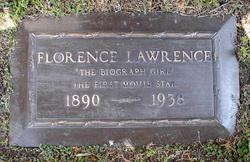
She appeared in just three films between 1916 ad 1918, one for each year.  In the meantime, Universal had pulled paying for her medical expenses and she and Solter divorced.  She wouldn't appear in another film until 1922.  By then, the film industry had dried up on the east coast almost completely; so in order to attempt a comeback, she had to relocate to Hollywood.  She was given a starring role in The Unfoldment the 1922 "independent" drama produced by minor company Producers Pictures; though after this, her roles became smaller and smaller, until, eventually she was consigned to uncredited roles.  Her last appearance in a silent film came in an uncredited part as "woman" in the World War I drama The Greater Glory in 1926.  She next showed up in a bit part in the late partial silent Sweeping Against the Winds in 1930.  The first full sound picture that she was filmed for came in an uncredited role Homicide Squad in 1931, a lesser crime drama produced by Universal (that must have stung, given her history with essentially fonding a portion of the studio in the teens!). She would have just one more credited role in her lifetime and that came in the 1931 romantic drama Pleasure.  She managed to get very, very small roles in nine more films, with the last being the 1937 MGM mystery thriller Night Must Fall (it is possible that she was in other films after this, as MGM hired her and other silent actors to work in bit parts for a salary).  Lawrence through her hard times was a survivor, but she just couldn't seem to catch a break.  She lost most of the money that she had made in films in the stock market crash in 1929 and the upscale cosmetic company that she started in Hollywood with her second husband fell victim to the depression.  She was obviously possessed engineering skills naturally and is credited with the invention of the precursor to the turn signal and braking lights on automobiles; but she failed to patent the invention and the inventions were stolen, leaving her no profit and no credit [she must have gotten her "inventors brain" from her mother who was also possessed of this talent and used it to start her own business in California].  She lost her mother, with whom she was very close, suddenly in 1929--an emotional blow that never fully recovered from.  And, she had recurring problems from the fire accident that she was in, that also included scaring (at some point she apparently had plastic surgery).  The end of the end came in 1937 when she was diagnosed with some type of bone disease that is thought to be a type of bone marrow cancer, or maybe a type of auto-immune "anemia." Lawrence took her own life on the 28th of December 1938 by ingesting cough syrup mixed with "ant paste"--or ant poison, leaving behind a very pragmatic suicide note that is just heartbreaking. In it she acknowledges that she had been told that her condition was incurable.  She was buried in an out of the way corner Hollywood Cemetery (now Hollywood Forever) where she had laid her mother to rest nearly ten years earlier.  For a decades, her grave laid unmarked; but in 1991 an "anonymous" British actor (re: Roddy McDowell who was a film preservationist and historian, in addition to being a great actor) paid to have a marker placed listing her both "The Biograph Girl;" and indeed, The First Movie Star.  


Lotta Bridgewood's urn at Hollywood Forever


Leave Virtual Remembrances @ Find A Grave (note the marker has her birth year off by 4 years)


Find A Grave for her mother's information

Monday, April 24, 2017

Born Today April 24: Charles Nuitter


1828-1899

French librettist Charles Nuitter (birth name Charles-Louis-Étienne Nuitter) was born on this day in Paris.  Not only did he write lyrics for original operas, he also translated other non-French operas into French.  For example, he helped translate Wagner operas from the original German.  There are more than 500 original works by him.  Additionally, he also worked as an archivist/librarian in the field of music for the Paris Opera.  A handful of films have been made from his work, two of them in the silent era.  The first was The Toymaker's Secret a Vitagraph short, which was released in 1910.  The second was Una tazza di the, an Italian production, it was released in 1923.  The most recent film to use his work as source material was a filmed ballet made for television affair by the BBC: Coppélia: A ballet in three acts, it aired in 2000.  In 2015 the horror film Victor Frankenstein used one of his songs in it's soundtrack.  He died in Paris on the 23rd of February 1899 after suffering a stroke days before, he was 70 years old.  There is no information about any memorial for him in Paris.


For More:


Thursday, February 2, 2017

Born Today February 2: William J. Gaynor


1848-1913

Judge and New York City Mayor William Jay Gaynor was born on this date in Oriskany, New York into a devoutly Catholic Irish family on a farmstead.  He grew up there with his brother and his parents.  From an early age, he developed a keen fascination with the natural world, reportedly spent hours roaming the countryside attempting to understand and figure how various things worked the way that they did.  This curiosity lead him to be an excellent student from the very start of his education.  His parents pushed him toward a vocation in church, but while studying toward this goal, he became intensely interested in Stoic philosophy.  This lead him to lose his faith in the Christian religion all-together and as a result he left religious studies to move back in with his family in Utica, where they had since relocated.  His father then managed to procure for him a position with a local law firm, with the goal of him actually taking the bar exam and becoming a full fledged practicing lawyer.  It, instead, lead to a interest and career in politics.  Gaynor was first a judge on the New York Supreme court, before becoming Mayor of New York.  Amongst a lot of other things Gaynor did as mayor, one big move was to remove any lasting opposition to the finishing of the New York subway system.  He also, to the chagrin of the city coffers, removed tolls on the Williamsburg Bridge.  To read more about his life and his politics, follow links below.  For the purposes of film, all the shorts he appeared in (many of them in Pathe's Weekly's) were in newsreels in the capacity of mayor, save one--the very first one.  He appeared in 1909 in Vitagraph's Judge Gaynor and Hon. John McCooey.  In all, he was in 12 known newsreels between 1909 and 1913, the year of his death.  Very early in his term as mayor, Gaynor survived an assassination attempt by a disgruntled ex-city employee.  He was struck in the neck and the bullet was never removed.  He died on board the RMS Baltic on his way to Europe on September 10, 1913.  Doctors determined that he most likely died of a massive heart attack while lounging in a deck chair.  It was also determined that his old wound likely played no role in his passing.  His remains were returned to the U.S., where he was buried in Brooklyn's famed Green-Wood Cemetery (family burial located in Section 7, Lot 7051).  As a matter of film and television related trivia, one of his granddaughters Jean "Foxy" Rennard was actor Fred Gwynne's (Herman of "Munsters" fame) first wife; together they had 5 children.  

The is the marker for the entire Gaynor family in Green-Wood Cemetery in Brooklyn New York.


Leave Virtual Flowers @ Find A Grave

Thursday, September 17, 2015

Born Today September 17: Dolores Costello AKA Goddess Of The Silent Screen


1903-1979

Born in 1903 Pittsburgh, Pennsylvania, by 1909, she and her sister Helene, who was 3 years younger than her made their first film appearance in an early adaptation of Shakespeare's "A Midsummer Night's Dream."  Interesting, a lot of sources on the film don't mention that their father Maurice was also in the film as Lysander.  It was probably because of their father that they became child actors at all, he was an actor and director in his own right (though the question marks come in as to whether he got where he was in Hollywood because of his daughters in the first place); Interesting, though,  Wikipedia page doesn't make any reference at all to her father's role in her's or her sister's acting careers.  Additionally curious to me because Dolores is the grandmother of Drew Barrymore.  So much is made of Drew's Barrymore family background in acting and movie making--almost nothing is ever made of her Costello ancestry on the same subject.  Even her Drew family ancestry, a well known theatrical family, is more a topic of conversation concerning her acting blood relations.  Dolores and her sister were contracted to the Vitagraph Film Company through the year 1915, possibly or probably arranged by their father.  Almost all of those films were shorts.  During that time, if my count is right she appeared in a staggering 33 films, many of them with her sister.  Their success together in film resulted in both appearing on Broadway.  After that contract ran out, she didn't appear in another film until 1923.  She went on to sign with Warner Brothers in the 1920's, which, is in part, how so was selected for a major starring role opposite John Barrymore, which how she met the man that would become Drew Barrymore's grandfather.  She became romantically involved with him probably  as a result of a later role that the pair starred opposite each other again in 1927, and they were married in 1928.  They went on to have two children together, Dolores Barrymore and John Drew Barrymore (father of Drew, and other children)--who went on to have a tumultuous career in Hollywood.  She quit acting in 1931 to devote time to her family, but resumed acting after her divorce from John Barrymore, but, all though she had ample speaking talent for the so-called "talkies" she quit acting permanently in the early 1940's, with her last role coming in Michael Curtiz's This Is The Army in 1943 (that film, as a matter of trivia also had Ronald Reagan in a role--it is currently on Amazon Prime, if anyone is interested).  Her need for having to quit acting were for reasons that don't often get talked or wrote about when it comes to early Hollywood.  Make up that was used on her during the silent years, especially when she was a child at Vitagraph ruined her complexion to the point that it was basically it could not be camouflaged.  So the rest of her life was spent in semi-seclusion due to Hollywood make-up ravaging.  She did, however, sucessfully manage an avocado farm in California.  One tragic thing that did occurr during the 1970's, her house was hit with a flash flood that destroyed most of her personal early Hollywood/John & Dolores Barrymore memoribilia, a true lose to the most talented family in acting and to history.  She passed away, suffering from emphysema on the first of March 1979.  She is interred at Calvary Cemetery in East Los Angeles.  She certainly earned her nickname "Goddess of the Silent Screen!"

Dolores and Helene

The Career of The Goddess Of The Silent Screen


The Telephone (1910) (this was released as a split reel along with a the title A Day On The French Battleship "Justice")


The Geranium (1911) (the sister's father was also in this, along with Ralph Ince)


Some Good In All (1911) (Dolores was in this with her father minus Helene)


The Meeting Of The Ways (1912) (Maurice Costello also in this)

For The Honor Of The Family (1912) (their dad was also in this one)


Lulu's Doctor (1912) (another all family affair)


The Money Kings (1912) (yet another family affair, a note about IMDb here:  the poster they have posted for this really WRONG, laughingly so!  Most of these types of shorts didn't have full posters.)


Wanted...A Grandmother (1912) (another father daughter collaboration)


Her Grandchild (1912) (Dolores in the with her father, no sister)


The Hindoo Charm (1913) (Maurice Costello actually directed himself and his daughters here)


Fellow Voyages (1913) (Maurice Costello co-directed this with Eugene Mullin, with the family starring)

Some Streamer Scooping (1914) (now this really is a family affair, Maurice directing, daughters starring and joined by their mother Mae Costello)

Etta Of The Flootlights (1914) (Maurice co-directed his daughters and himself with Robert Gaillard)

Too Much Burglar (1914) (the same direction and cast here, except that the Gaillard is credited as "Robert Gaillord.")

The Evil Men Do (1915) (same exact credits here, complete with misspelled name)

The Heart Of Jim Brice (1915) (same credits as the last two films)

The Glimpses Of The Moon (1923) (full starring role for Maurice with just a bit part for Dolores.  Lost Film)


The Little Irish Girl (1926) (presumed lost film, there are some legitimate rumors that a copy may in the private collection, or stored someplace misnamed)


When A Man Loves (1927) (another role starring opposite John Barrymore, partial silent, sound effects and musical score by Vitaphone)

A Million Bid (1927) (partially lost film,  Michael Curtiz directed)

Old San Francisco (1927) (two version, one silent and one full mono sound with dialog by Mono, with sound effects and score by Western Electric Apparatus)


Tenderloin (1928) (partial silent, mono talking sequences by Vitaphone, lost film)

Glorious Betsy (1928) (two version one silent, mono sound version by Vitaphone)

Noah's Ark (1928) (Mono-Western Electric)

The Redeeming Sin (1929) (partial silent, the mono talking sequences by Western Electric, also a lost film)

Glad Rag Doll (1929) (also mono--Vitaphone Michael Curtiz directed, lost film)

Madonna Of Avenue A (1929) (another Michael Curtiz directed early talkie, sound by Vitaphone)

Hearts In Exile (1929) (another early talkie lost Michael Curtiz directed film)

The Show Of Shows (1929) (early musical, here she has a singing credit as well)