Showing posts with label Alice Guy. Show all posts

Thursday, October 21, 2021

Spooktober 21: The Pit and The Pendulum (1913)


A surviving fragment from Alice Guy's 1913 The Pit and the Pendulum made at her Solax studio. This film was thought completely lost until a copy was found at the Library of Congress. It is an excellent example of why movie lovers should always have hope for the recovery of lost reels! Happy Spooktober 🎃🎃🎃


Sunday, July 9, 2017

Born Today July 9: Marian Swayne


1891-1973

Silent film ingenue Marian Marguerita Swayne (sometimes spelled "Marion") was born on this day in Philadelphia.  She got her start on the stage, where she quickly became a darling with audiences; so it wasn't very long before she garnered the attention of the film industry.  And, it wasn't just any studio that took notice of her.  In 1911, she signed a contract with Alice Guy Blanché's and her husband Herbert's newly formed Solax Film Company.  Her first film appearance was in An Interrupted Elopement, in which she acted across from Lee Beggs.  She very quickly became a darling of the silver screen as well.  She was young enough and popular enough after just a few film appearances to get a role in Alice Guy's studio spoof celebrating the coming of the 1912 new year as "The Chi-i-ld" A Solax Celebration.  With her contract up a Solax, she was free to take roles at various other production houses.  The first non-Solax film that she was in came in The Line-Up At Police Headquarters in 1914, made for the Nonpareil Feature Film Corp, which only made two films--one of which is the historically important 1915 version of Alice In Wonderland (1915).  She had very steady work all throughout the years during the 1910's that her career spanned, but started going back to the stage 1919.  She only made 5 films made 5  films in the 1920's, the last of which was Heart Of Alaska in 1924.  She then retired from silver screen, presumably to raise a family; she was married to fellow screen actor Joseph Levering.  Later in life she took acting on the radio.  Swayne died on the 21st of August 1973 in New York City at the age of 82.  She is buried in a family at West Laurel Cemetery in Bala Cynwynd, Pennsylvania.  


For More:


Leave Virtual Flowers @ Find A Grave

Saturday, July 1, 2017

Born Today July 1: Alice Guy


1873-1968

Ground breaking film director and writer Alice Guy-Blanche was born Alice Ida Antoinette Guy in Paris on this date. Her parents were based in Chile and this left little Alice in the care of elderly grandparent in a French speaking area of Switzerland.  Around the age 4 (possibly 3), she was sent to live briefly with her parents in Chile.  At the age of 6, she was sent to school in a convent in France on the boarder with Switzerland.  When her father's book business in Chile went bankrupt, the family could no longer afford her private Jesuit education, and so she was sent to a regular school.  By 1893, she was training as a typist and stenographer.  She soon went to work in that capacity at a vanish factory in order to help support her family.  One year later, she went to work as a secretary to Léon Gaumont at the still photography company that he would eventually run through a type of by-out.  When the company went bankrupt, Gaumont purchased the company's inventory and started a business for himself, taking Guy with him.  Although she was working as a secretary, she showed a keen interest in learning all aspects of the business and became acquainted with many of the company's clients.  Three of these were early film pioneers: The Lumière Brothers and Georges Demenÿ.  On the 22nd of March 1895, she and Gaumont attended an event by the Lumière Brothers that they were billing as a "surprise."  The event turned out to be the first ever demonstration of a film projector.  Though they were selling their equipment for "demonstration films"--actualities, newsreels and moving photographic subjects--a light immediately went off in Guy's head that the medium could be used for fictional narrative stories.  The exact date surrounding her being "green lit" to explore her ideas in film is not really known, however it is known that her first film came out in 1896: Les démolisseurs was made using Gaumont's funds, making his company a de facto production venture.  Though her one-woman power-house project La fée aux choux (1896) (The Cabbage Fairy) is often cited as being her first film--in fact, it is often tagged as the first film directed by a woman--she actually made some 4 shorts before this.  It is correct to say that it is probably the world's first narrative film; and one that gave her credits in writing, cinematography and acting.  This had her off to a start in one of the most influential careers in film history.  From 1896 to 1906 she was Gaumont's head of production--their very own in house director.  During this period of time she experimented heavily with various techniques, with hand tinting proving to be one of her talents.  Her films became so popular, that Gaumont licensed them to both Lumières and Edison, making her internationally known.  She became one of the very first film-makers to adapt works of literature to film (she directed the first film adaptation of Victor Hugo's The Hunchback of Notre Dame in 1905 with Esmeralda). She was also an early sound pioneer, utilizing Gaumont's in house Chronophone system. A good example of this is her 1905 Le boléro cosmopolite. She garnered her first actual producer credit in 1902 with Midwife To The Upper Classes (she wouldn't have another until 1911, when she became a producer at her own company). Guy also was probably the first film maker to feature interracial casting in a narrative film. 

Colored still from La Tango (1905)


One of her true groundbreaking moments came in 1906 with the huge production that was The Birth, the Life, and the Death of Christ.  The film boasted 300 extras and several of her on inventions for special effects; the film also features a very early sweeping pan shot.  In all, many of her innovations included things she either came up with on her own, or perfected from the techniques of others; they include:  double exposure, running film in reverse,  and various masking treatments.  In 1907 she married filmmaker Herbert Blanché, and thus hyphenating her last name (though the pair divorced in 1922, she used the name for the rest of her life).  It was truly a marriage of equals; they were put in charge of the Gaumon't newly created American house and thus left for the U.S. to run that.  They stayed the U.S. Gaumont until 1910, when they left to found their own production house--the hugely influential Solax; they promptly built a studio in Flushing, New York.  Gaining in influence and popularity (and poaching talent from production companies that people were unhappy with), the company built a brand new studio in Fort Lee, NJ in 1912 to the tune of $100,000.  

The Solax "Factory" under construction (photo from great little book Fort Lee: Birthplace Of The Motion Picture Industry).

Rumors began to swirl around the power couple that all was not well with their relationship, that Herbert Blanché spending wildly to try and out do his more talented wife--Solax was reputed to be bankrupt.  She, herself, blamed the money woes on her husband's bad stock investments.  With the delusion of her marriage and the rapid decline in east coast film production, she auctioned off what assets were left at Solax, while claiming bankruptcy.  She then quietly went back to France.  Before this, and while dealing with the money woes of her production studio, she directed her last film Vampire, during which she came down with Spanish flu and almost died--the year was 1920.  In 1927, she returned to the U.S. to try to resume her film making career, but to no avail, so she returned to her birth country.  In the 1940's she wrote a memoir, but it was not published during her lifetime.  She never remarried and in 1964 again returned to the U.S. to stay with one of her daughters and 4 years later, she died in a nursing home in Mahwah, New Jersey at the age of 94.  She is buried at the Maryrest Cemetery there.  During her lifetime she often did not get anywhere near the credit that was her due because of her sex, it is so important to give her the credit that she deserves, as many of her personal innovations were claimed to have been invented by later filmmakers--all of them male.

Her original grave marker

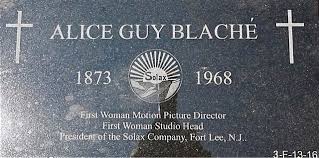
Newer marker giving her credit where credit is richly deserved!


For More:


Leave Virtual Flowers @ Find A Grave


Sunday, February 26, 2017

Born Today February 26: Victor Hugo


1802-1883

French Romantic writer Victor Marie Hugo was born on this day in Besançon, Doubs, France.  His parents held opposite belief patterns; his father was a "freethinking republican" whose hero was Napoleon and served in his army; his mother, on the other hand, was a devout Catholic who was a staunch royalist.  His godfather, who was a Napoleonic general with secret royalist allegiance (and possible lover of his mother), was executed by Napoleon in 1812 when Hugo was 10.  His early life saw him and his siblings living through some of the most politically turbulent times in Europe (actually the world), with Napoleon being declared emperor when Hugo was just two years of age; and with the Bourbon Monarchy being restored to power by the time he was 13.  Hugo displayed a fascination with poetry at a very early age. By 1822, he had published his first volume of poetry; this gained him a royal pension from King Louis XVIII.  This was followed by several more volumes in the years to come.  His first work of fiction came 1823 with a novel; by 1829 he had come out with The Last Day of a Condemned Man; a large work of fiction that would go on to be hugely influential on a whole host of writers.  By 1827 he had published successful plays; in the case of that year it was  Cromwell.  In 1830, he became abnormally famous for his time with his play Hernani staged to huge success across the European continent.  In 1831 one of the works that he is best known was published; the novel (translated) The Hunchback Of Notre Dame was an instant success and was immediately translated into several language; it also had the effect of shaming the city of Paris into restoring that great cathedral, as the book began to attract thousands of tourists every year.  1832 saw him venture into the world writing librettos for opera, in the this case, for no less a composer than Verdi!  In 1834, he published a short story based on true events--that of a condemned murderer who had been executed by the state; Hugo later made the observation, that the story had been the smallest seed from which his great Les Misérables would grow.  That great novel did not appear until 1862.  In 1843, Hugo suffered the worst lose of his life when his favored eldest daughter drowned after a boating accident at the age of 19 (she was also newly married, her husband perished trying to save her); those who knew him said that he never quite recovered from lose.  Laments of this lose were immortalized in poetry by him.  Also in the 1840's, he got involved with French politics.  He was a staunch Republican who wished to stand for a complete democratic form of government.  He fled the country for Belgium after Louis Napoleon sized power in France in 1851.  His exile would last until 1870. When back in France, he resumed his political activities; he would basically remain politically engaged for the remainder of his life. Given the enormity of his literary influence, it is hardly surprising that his works were used early on in the formation of narrative film. The first of these came in 1905 with the now famous Esmeralda, which was co-directed by Alice Guy, who is believed to be the very first female director. It would be 4 more years (as far as anyone knows) that the next film (one of many for the year !), based on his work would be released.  That film was Rigoletto, and was an Italian production.  The year 1909 would also see the first filming of Les Misérables, it would be broken into 3 separate releases and was probably the first trilogy in film (links for the films can be found herehere and here).  It is also no surprise that there was a proliferation of films made from his work during the silent era, given the well known nature of his work.  The two most well known, considered horror classics to this day, came in the 1920's.  The first of these was The Hunchback Of Notre Dame, which was directed by Wallace Worsely and starred Lon Chaney Sr., released in 1923.  The second was The Man Who Laughs, which came out in 1928, and was directed by the great Paul Leni and starred Conrad Veidt of The Cabinet Of Dr. Caligari (1920) fame.  The first sound film to be made using his work was a short from 1929, The Bishop's Candlesticks, a Paramount production.  The last silent films to be made using his work, were produced in Japan in 1929 and 1931.  The first full length sound film to be produced was a whopping 4 hours and 41 minute version of Les Misérables in 1934.  The most recent released film of his work dates from last year, with the comedy French Movie.  Two additional films have been announced:  a television adaptation of Les Misérables, with no release date information; and The Hunchback, slated for release later this year.  Hugo died in Paris on the 22nd of May of pneumonia.  He was given a lavish state funeral and it is estimated that close to 1 million people (some estimates put it at 2 million!) turned out on the streets the day of his funeral.  In addition to being one literature's greatest and most prolific writers, he was also an avid artist, producing more than 4,000 drawings during his lifetime.  He is interred in a tomb in The Pantheon in Paris.


For More:


Leave Virtual Flower @ Find A Grave