Showing posts with label Two-Strip Technicolor. Show all posts

Thursday, May 14, 2020

Born Today May 14: Billie Dove


1903-1997

Actress Billie Dove was born Bertha Bohny to Swiss immigrants on this day in New York City.  She was one of the earliest "blonde bombshells" in Hollywood; and her nickname was "The American Beauty." She first changed her first name to legally to "Lillian" in the 1920's when she moved to Hollywood, and later began using the stage name "Billie Dove" when entering film work. She got her start back in New York as a model and was then hired by Florenz Ziegfeld for his Ziegfeld Follies Revue; upon her arrival in Tinsel Town she promptly found work in film. Her first role came in 1921, when she appeared in Frank Borzage's comedy Get-Rich-Quick Wallingford (a remake of Fred Niblo's film of the same name from 1916).  From then on, Dove specialized in comedy and comedic roles. She also managed to make it into at least one very important technological "first"--she landed the role of Princess Isobel in the feature length techicolor The Black Pirate released in 1926 (this is early, so-called "2 Strip Technicolor"). We are truly fortunate that the film survives and has been restored; ill-regardless of whether one is a fan of silent swashbucklers or not, this film worth a look just for the color alone...and Dove playful performance (it's currently on Amazon Prime). Dove married thrice in her life, and her first marriage was to director Irvin Willet, whom she met on the set of All Brothers Were Valiant in 1923.  They divorced in 1929 and she was next connected to Howard Hughes, to whom she was briefly engaged. But it was her marriage to oil executive Robert Alan Kenaston in 1933 that stuck (she may have actually met him through Hughes, who was from Texas).  With Kenaston she had two children (one adopted) and it was her nuptials to the weathy oil man that ended her acting career.  Her last silent film was Careers in 1929, it was also released as a sound film to theaters in big cities that had the ability to screen films with sound effects and music (her last fully silent film was the melodrama Night Watch).  She then made a handful of early talkies, ending the decade with The Painted Angel.  Dove made only a handful of movies in the 1930's, despite the fact that she was a literally a movie star of extreme popularity. Her last film was Blondie of the Follies in 1932 (she reportedly shot a cameo appearance for Diamond Head (1962), but the footage was left out of the film). She retired to family life after this. She does not seem to have missed the life however; in addition to being a comedic acting talent, she was also an accomplished artist, (and an author and enjoyed flying, becoming a pilot at some point). Her marriage to Kenaston came to end in 1970 upon the occasion of his death; three years later she wed architect John Miller, only to divorce him a year later. She lived out her life, writing and painting, in her adopted home town of Hollywood; dying there of complications from pneumonia on New Year's Eve 1997 at the age of 94.  She is interred at the Freedom Mausoleum at Forest Lawn Memorial Park in Glendale under the name Lillian Bohny Kenaston with "Billie Dove" inscribed below. Reportedly her "name" Billie was taken by another extremely talented lady born only 11 years after Dove; Eleanora Fagan is better known to the world as Billie Holiday. 


[Source: Find A Grave]


Tuesday, April 25, 2017

Born Today April 25 (Not So Silent Edition): James Pierpont


1822-1893

American songwriter James Pierpont, born James Lord Pierpont, was born on this day in Boston, Mass (some sources wrongly list his birthplace to be in Maine).  His father was a well known pastor, poet and abolitionist.  He was also the nephew of the famous banker James Pierpont Morgan.  In 1832, young James was sent to boarding school in New Hampshire.  But in 1836, he ran away to sea on board a whaling ship.  Upon returning, he enlisted in the Navy, leaving at the age of 21.  Back in New England, he married and started a family, but later got caught up in the gold fever that was gripping San Francisco.  He left his young family to start a supply store there, but the business failed when he lost all of his inventory in a fire.  He also supplemented his income by becoming a photographer.  In 1856, his wife died, leaving him with 3 children.  James' father had taken a job in church located in Savannah, Georgia; so James followed him there.  He was then hired by the church as the organist and music director.  He also became an independent music teacher, teaching both the organ and voice.  (A point of trivia, the organ from that church is currently located at Florida State University in Tallahassee).  This is when he started composing his own songs.  Though he was a prolific song writer, there is just one song that he is known for (well known!) today.  In 1857 he composed Christmas song that he originally called "The One Horse Open Sleigh"--two years later, he added "Jingle Bells" to the title.  Today it is one of the most well known non-religious Christmas song in the world.  While in Savannah, he also remarried and had more children.  Then the civil war broke out and James and his father found themselves on opposite sides of the conflict, with his father serving as Army Chaplin in the the Union Army and James writing songs from the Confederacy.  After the war, he moved with his family to Valdosta, Georgia to teach music, then in 1869 he moved just down the road to Quitman, where he had accepted a job as church organist in a Presbyterian church there and to teach music at the Quitman Academy.  By the time he reached retirement age, he was the Music Director at the Academy.  After retirement, he moved to Winter Haven, Florida; where he died at the age of 71 on the 5th of August.  He is buried at Laurel Grove Cemetery in Savannah, Georgia.  In regards to films, the first time "Jingle Bells" was used in a movie came in an early sound short from 1927 also called Jingle Bells (the first hundreds to come!).  It was next featured in another early partial sound short The Toy Shop in 1928 (the film has a mono musical score, and is also an early color film showcasing the early 2-strip Technicolor process).  The first time the song was used in a full length film came in 1930 in The Unholy Three.  The first time in was used in a television series came in 1951 with a Christmas special for The Frank Sinatra Show.  It's most recent use came on The Tonight Show Starring Jimmy Fallon.  It's most recent use in a feature film dates from this year with the thriller Clinical.  Pierpont was inducted into the Songwriters Hall Of Fame in 1970.


For More:


Leave Virtual Flowers @ Find A Grave

Tuesday, February 14, 2017

Born Today February 14: Ernest Legouve


1807-1903

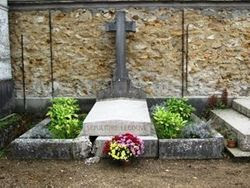
French dramatist Ernest Legouve was born Valentine's Day in Paris; his birth name was Gabriel Jean Baptiste Ernest Wilifrid Legouvé.  Though writing came as an inheritance--his father was a poet, and his grandfather was a well known writer and reader--his young life was rocked with tragedy.  His mother died when he was only 3, and his father was soon after placed in lunatic asylum.  The family was extremely well-of and he inherited that fortune at this young age and was carefully educated by a tutor.  By his early 20's he was already an award winning poet and would go on to find success and fame both inside and outside of academia.  Today he is by far most well known for the collaborative play Andrienne Lecouvreur, which he wrote with A. E. Scribe.  He is also known for being the grandfather of the French writer Maurice Desvailliéres.  Almost all the films that have used his work as source material have been based on that play.  In the silent era, 5 films were produced using his work for screenplays, the first coming in 1913 with a French short rendition of Adrienne Lecouvreur, which is unfortunately a lost film.  The last silent film made from his work was Dream Of Love, starring Joan Crawford. The first sound film to use his work for a film production came in 1929 with Devil-May-Care, a comedic musical, starring Dorothy Jordan and the tragic "other Latin Lover" Ramon Novarro.  The sound was by Western Electric System and the film sported one color sequence with the early Technicolor 2-strip technique. The most recent film to be produced from his work came in 2000 with a very lavish production of Adrienne Lecouvreur, under the title Adriana Lecouvreur, made in Italy.  Lagouve died in Paris at the age of 96 (!) on 14 March 1903, exactly one month after his birthday.  He was a lifelong proponent of physical exercise and made fencing his sport and workout of choice.  He is buried in Paris' Cimetiere de Montmartre.
 
[source: Tyler Li (Find a Grave)]

[Source: Tyler Li (Find a Grave)]


Leave Virtual Flowers @ Find A Grave


View of Montmartre facing a major road over pass [Rue Caulaincourt]--showing how urban the cemetery really is.

Monday, October 28, 2013

Legong Dance Of The Virgins (1935)


It is rare to find a feature length silent film in age of talkies (unless it was made in 1929, when the first talkies were introduced), and this was filmed in 1935, well into the talkie era.  In fact, this was the last Hollywood silent film to ever be released from the original silent era onward.  It is also the very last film ever shot in two-strip Technicolor.  There were actually 3 versions of it, with the original running 65 minutes, and two censored version (one for the US and the other for the UK), that ran roughly 45 minutes.  As a result, parts of the film have been lost.  The above movie is as restored as the film will be, unless someone finds more footage somewhere.  It was shot entirely on location in Bali.