Sunday, February 19, 2017

Born Today February 19 (Not So Silent Edition): Merle Oberon


1911-1979

Merle Oberon was a woman with secrets. She went to great lengths to obscure her origins, the history of which was so convoluted that she herself may not have known all of the details until later in her life.  She is listed in most sources as an "Anglo-Indian actress," but her background was more complicated than that description belays.  Her birth name was Estelle Merle O'Brien Thompson. She was born Mumbai, India (then Bombay).  She spent most of her life and career trying to flee even these basic facts, claiming that she was, in fact, born in Tasmania and spent her formative years there.  When reporters, sensing a story, dug they found the basic facts of her true origins; but when it came to who her parents were, things got considerably more complicated.  The woman that for years was thought to be her mother, Charlotte Shelby (who was mixed race: Sri Lankan/Maori/Anglo), was, in fact, her grandmother.  Her eldest "sister" Constance, was actually her birth mother, who gave birth to her at the shockingly young age of 12.  For this reason, her grandmother decided to raise her as her daughter.  Who her birth father was does not seem to be known. Oberon went to great lengths throughout her life to keep all of this secret; so much so that she tried and failed to keep away from being honored in Tasmania--she, in fact, seems to have only visited Australia twice in her life.  She also frequently told people that her "mother" who lived with her was actually her housekeeper, to keep people from realizing that she was not 100% Anglo.  She claimed that at the age of 17 she left India for Great Britain; the year was 1928.  She got work as a hostess at a club under the name Queenie O'Brien ("Queenie" being her childhood nickname); it here that she got into acting by accepting bit-parts in dinner theater there.  This was later proven to be part of a concocted story--at least in part.  She was reportedly given a bit part in an early talkie directed by Rex Ingram:  The Three Passions (1928).  Her career took off in the 1930's when she was noticed by director Alexander Korda, who gave her the name "Merle Oberon."  By the mid-1930's she was in Hollywood under partial contract to Samuel Goldwyn.  This made  her a huge star; by 1935 she was nominated for an Academy Award.  In 1937, she was in a very bad car accident, that could have ended her career as she was left with some facial scarring; but fortunately it only resulted in one film project being shelved. Oberon acted steadily right through the 1950's, even getting into television work.  But by the 1960's she was, for all intense and purposes, in retirement.  She accepted only two roles in the 1960's and only 1 in 1970's.  Oberon died on the 23rd of November 1979, following a massive stroke.  She is interred in Forest Lawn Memorial Park.  


For More:


Leave Virtual Flowers @ Find A Grave

Saturday, February 18, 2017

Born Today February 18: Mór Jókai


1825-1904

Hungarian writer Mór Jókai was born Móric Jókay de Ásva in Komárom, Hungary (the town is now located in Slovakia) on this date in 1825.  He had nobility on both sides of his family.  He was home schooled until the age of 10, after which he was sent to a Calvinist college to complete his education.  After his father died when he was only 12, he followed his father's profession and studied the law.  He did become a full advocate; argued and won cases; but he found the law profession dull and boring, so he began writing.  He finished his first play when he was barely past the age of twenty.  In 1848, he married famed stage actress Róza Laborfalvi.  When war broke out that same year, he went into the service, but backed the Hungarian side to depose the Habsburg dynasty and was captured.  He actually planned to commit suicide to avoid being sent to prison, however he wife was able to secure his release instead.  He was after wards active in politics, especially later in life.  Amongst other accomplishments in his life, he can be counted as one of the earliest science fiction pioneers; his book (translated) The Novel Of The Next Century was oddly prophetic and included elements, such as flying machines.  He was proud to write in his native Hungarian language and was very much tied up with his Hungarian identity.  The first film to be made from his writings came in 1915 with The Hungarian Nabob, an American film produced by Biograph (it would be one of the only English language films to be made of his work as of this writing).  Biograph also produced another film from his work a year later:  The Iron Will (1916).  The first film to be produced in his native Hungary came in 1917 with Mire megvénülünk (a partial restored edition is available today).  In all, 13 films using his work as source material were produced in the silent era.  The first full sound film to utilize his work came in 1935 with the German produced The Gypsy Baron:  a musical.  Even animated films have used his writing for scenarios, such as the 1985 Hungarian film The Treasure Of Swamp Castle.  The most recent film to use his work for a screenplay, came in 2006, with the Hungarian made for television Melyiket a kilenc közül?.  Jókai died on 5 May 1904 in Budapest at the age of 79.  He is buried with his wife in Kerepesi Cemetery there.  


For More:


Leave Virtual Flowers @ Find A Grave

Friday, February 17, 2017

Born Today February 17: Arthur Shirley (I)


1853-1925

British writer and actor Arthur Shirley was born on this date in London, England, UK.  He started out as writer.  This first film to make use of his written work as a source for a screenplay came in 1908 with Saved From The Sea, which is based on a play that he co-wrote with Ben Landeck.  The first film that he worked directly for in crafting a "Scenario"--in other words, a screenplay--came in 1913 with Sixty Years A Queen, which he worked on with two other writers, from source material from a book of the same name (this is again, another unfortunately lost film).  He made his filmed acting debut in 1915 in the serial short The Girl Detective, in the role of John Talcott, a role that he would reprise many times over during that year.  He did not act in any films beyond the year 1916.  Also in 1915, his My Old Dutch was given full film treatment (see poster above); the play had already been filmed once before in 1911.  That same play would be the only work used as source material in a full sound film, and that came in 1934.  Shirley died in London on 22 August 1925; he was 72 years of age. He had been married to one Florence Mary Allen; together they had 5 children.  

Scene from The Girl Detective (1915)

For More:

Thursday, February 16, 2017

Born Today February 16: Julia Grant


1826-1902

Julia Grant was the 18th First Lady of the United States, being married to Ulysses S. Grant.  She was born Julia Boggs Dent on this date in 1826 in the White Haven section of St. Louis, MO to a slave owning planter and merchant and his wife.  She was the fifth of eight children.  She married the future president in 1848, with Grant's father refusing to attend the wedding on the grounds that he objected to her family owning slaves.  After enduring life as a military wife--being away from her husband for long stretches; and then as the wife of a poor farmer, the Grants found themselves caught up in the Civil War.  Ulysses Grant eventually found himself appointed commander of the Union armies; Lincoln sent for Julia, understanding her positive effect upon her husband.  In 1868 U. S. Grant won the nomination for the Republican party, Julia was much more elated than he was.  He felt he had been compelled to enter the race for highest office in land by the political storm surrounding the impeachment of Andrew Johnson.  She was deeply involved in her husband's political career, and she proved astute in her assessments of situations.  In regards to silent film, she appeared in two news reels the date from the year 1899.  The first was First City Troop Of Philadelphia, appearing with President McKinley.  The second was Mrs. Grant and President McKinley, which also includes Ida McKinley.  Both films were produced by American Mutoscope & Biograph. Her views on slavery and racism have always been a matter of conjecture; what is known is that she thought that the "black race" was inferior to the "white race," though she never supported post-war white supremacists--which included member of her own family--even a brother.  On women's rights, she was much clearer.  She was a complete defender of women's rights and would permit no jokes being told at a woman's expense in her company (especially in Washington D.C.).  After her husband left the office of the presidency, she joined several other former first ladies to become "Queen Mother" figures in the country.  Her husband died of throat cancer in 1885, she continued to live on until she passed away from kidney failure in Washington D.C. in 1902 on 14 December.  She was interred in General Grant's National Monument, affectionately known as "Grant's Tomb," in New York City.   As a curious fact, she always appears in profile in photographs, because she was born with strabismus; a condition that she wanted to correct after becoming first lady.  President Grant was having none of that, proclaiming to her "Did I not see you and fall in love with you with these same eyes? I like them just as they are, and now, remember you are not to interfere with them. They are mine, and let me tell you, Mrs. Grant, you had better no make any experiments, as I might not like you half so well with any other eyes."
 
[source: Found a Grave]

 
[source: Wikipedia]


For More:


Leave Virtual Flowers @ Find A Grave

Wednesday, February 15, 2017

Born Today February 15: John Barrymore


1882-1942

John Sidney Blyth (some family spellings have the name spelled Blythe) either on this day or on Valentine's Day in Philadelphia.  It could easily be said that he was born into acting royalty; even then the Drew and Barrymore families were giants of the stage.  His parents were British actor Maurice Barrymore, whose birth name was Herbert Blyth, who had adopted the Barrymore last name after he took a liking to it from a poster is saw in Haymarket Theater in London.  His mother was Georgie Drew Barrymore; she was the descendent of the powerful and well known theater family the Drews.  Her parents were well off and occupied high positions in the theater, including her mother, who was a famous thespian and one the earliest female managers of a large theater, the Arch Street Theater; her father, who was also an actor, was considered a comedic genius.  Several other members of the Drew family were also successful actors of the stage. While a great deal of the details of John Barrymore's early life are not known, it is known that he was steeped on the theater and accompanied his parents on at least one major dramatic tour.  The family was not without it's stresses; Barrymore was often a naughty, uncontrollable child (owed to being the baby of fmaily?) and he was sent away to numerous schools.  One actress from Poland insisted that he and his two siblings be baptized into the Catholic faith (apparently as a show to his mother's secret conversion); his grandmother came to live with the family when her theater business began to flounder, and that caused considerable stress with the household.  But, it was his mother's death from tuberculosis when he was 11 that left him solely in the custody of his grandmother, who raised him.  He would go onto attend (and be kicked out of) one prep school.  For higher education, he decided that a stint in his father's home country would be the thing, and in 1898 he headed off to King's College in Wimbledon, eventually winding up in the Slade School of Fine Arts.  Though, none of this made much of an impression on him, and he was soon enjoying the London nightlife more than anything.  He returned to New York in 1900, where he found work as an illustrator for The New York Evening Journal.  That same year, he was persuaded by his father, despite that he had proclaimed a disliking for the professor of acting, to join performance of a short play.  But, it was a stage incident in the play that his older sister Ethel was acting in that would have a real effect on how he viewed acting.  She had persuaded the director to take him on when the production was short of players, one evening he forgot his lines, and admitted so on stage; rather than giving in, the actors then proceeded to improvise the whole scene instead.  He then got himself embroiled in a real scandal that included in the murder of the high profile New York architect Stanley White.  He almost had to testify at the trial of the man who shot White.  Already in the throws of a serious drinking problem, he was fired from his newspaper job for producing poor illustration while intoxicated.  It was then that he resigned himself to taking up the family business of acting.  Between the year's 1903 and 1913, Barrymore appeared in larger and larger roles on the stage,  many of which that would go on to be hits.  It was during that later part of this theatrical run, that he is thought to have entered the motion picture business.  It is known that in 1912 he traveled to Los Angeles.  Five films (it is sometimes listed as 4) then came out with the name of an actor as "Jack Barrymore" as a star; it is generally agreed that "Jack" was, in fact, John Barrymore.  The first of these was The Dream Of A Moving Picture.  All of them were produced by the Lubin Manufacturing Co., and all but one--the last one--were intended to be vehicles that studio's in house "star" at the time Jerold T. Hevener.  The last of these films, One On Romance, which was actually released in 1913, saw "Jack Barrymore" as the top billed star.  John Barrymore's film career was off.  The first film that carries Barrymore's actual name came in 1914 with An American Citizen.  The film was directed by none other that J. Searle Dawley, probably the first true director of films, for the Lasky Famous Players, that would later become Paramount.  Barrymore would go on to be one the most recognizable faces in silent film and super-star known all over the globe.  Before we had Lon Chaney Sr. in recognizable horror transformation roles, we had Barrymore in the roles of Dr. Jekyll and Mr. Hyde, in the Famous Players version of the Stevenson story in 1920 (not that Chaney wasn't in films before this, he was!).  That on-screen transformation is still in the horror vaults as one the finest ever filmed.  The number of seriously famous silent films that he appeared in during the 1920's are basically two numerous to list here (that what links below are for); but what is remarkable about his career, is that up until 1925, he had never left the stage.  This meant that when the inevitable happened, that talking pictures would take over, the studios had little to worry about in regards to his voice capabilities; what they did have to worry about (and they knew it), was his ever growing debilitation from alcohol consumption.  Given his star power, it's little surprise that Barrymore was one of the actors put in the earliest transitional or partial sound films.  The first of these was in 1926 with Don Juan.  Vitaphone provided the sound effects and some early musical scoring.  The first full sound (in other words, "full on talkie") that he appeared in, was General Crack in 1929.  By 1933, he had gone to work for MGM and his health began fail. The first effect of this to primarily affect was his ability to remember lines for live performances.  It's not that he didn't make films in the 1930's that showed terrible performances, it's just that they were few and far between and most studios wouldn't chance handing him a role due his extreme alcoholism, despite a spate of film appearances in 1933.  He wound up with a recurring role in the Bulldog Drummond series as Col. Neilson.  He collapsed on the set of a "reality" radio show of it's day--Rudy Vallé's show, sort a Howard Stern affair of it's time--on the 19th of May in 1942.  He was rushed to Hollywood Presbyterian Hospital, where he died 10 days later from cirrhosis that resulted in kidney failure and complicated by pneumonia.  He was 60 years old.  He was buried at first on the 2 of June 1942 in Calvary Cemetery in Los Angeles-- apparently against his wishes--his devoutly Catholic sister insisted on the burial there.  In 1980, his son disinterred his body for cremation and reburial next to his parents in the Mount Vernon Cemetery in Philadelphia, par his original request.  Today, for "Barrymore" fans not familiar with his work on it's own merits, he is most famous for being the grandfather of actress Drew Barrymore.

His current burial site in Philadelphia

Former burial site in California, now empty, but still maintained.


Find A Grave For Original Burial Information


Tuesday, February 14, 2017

Born Today February 14: Ernest Legouve


1807-1903

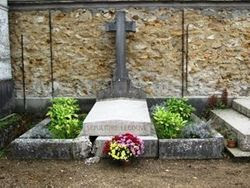
French dramatist Ernest Legouve was born Valentine's Day in Paris; his birth name was Gabriel Jean Baptiste Ernest Wilifrid Legouvé.  Though writing came as an inheritance--his father was a poet, and his grandfather was a well known writer and reader--his young life was rocked with tragedy.  His mother died when he was only 3, and his father was soon after placed in lunatic asylum.  The family was extremely well-of and he inherited that fortune at this young age and was carefully educated by a tutor.  By his early 20's he was already an award winning poet and would go on to find success and fame both inside and outside of academia.  Today he is by far most well known for the collaborative play Andrienne Lecouvreur, which he wrote with A. E. Scribe.  He is also known for being the grandfather of the French writer Maurice Desvailliéres.  Almost all the films that have used his work as source material have been based on that play.  In the silent era, 5 films were produced using his work for screenplays, the first coming in 1913 with a French short rendition of Adrienne Lecouvreur, which is unfortunately a lost film.  The last silent film made from his work was Dream Of Love, starring Joan Crawford. The first sound film to use his work for a film production came in 1929 with Devil-May-Care, a comedic musical, starring Dorothy Jordan and the tragic "other Latin Lover" Ramon Novarro.  The sound was by Western Electric System and the film sported one color sequence with the early Technicolor 2-strip technique. The most recent film to be produced from his work came in 2000 with a very lavish production of Adrienne Lecouvreur, under the title Adriana Lecouvreur, made in Italy.  Lagouve died in Paris at the age of 96 (!) on 14 March 1903, exactly one month after his birthday.  He was a lifelong proponent of physical exercise and made fencing his sport and workout of choice.  He is buried in Paris' Cimetiere de Montmartre.
 
[source: Tyler Li (Find a Grave)]

[Source: Tyler Li (Find a Grave)]


Leave Virtual Flowers @ Find A Grave


View of Montmartre facing a major road over pass [Rue Caulaincourt]--showing how urban the cemetery really is.

Monday, February 13, 2017

Born Today February 13: Charles Barnard


1838-1920


American author Charles Barnard was born on this day in Boston, Mass. to parents Charles Frances Barnard and Sarah Barnard (nee Holmes).  His writing had great expanse; he dabbled in everything from journalism, stories, plays to non-fiction subjects such as gardening and electricity.  His work has only been adapted to a screenplay for a film once; that film The County Fair, based on his dramatic play of the same name, was released the year of his death: 1920.  The film was a Maurice Tourneur, production (he is also credited as co-director).  Barnard died on 11 April in Pasadena, CA. at the age of 82.

Poster for the film
Barnard's Page on IMDb


Watch The Film at Internet Archive

Wikipedia Entry For The Film

Film's IMDb page

Sunday, February 12, 2017

Born Today February 12: Friedrich de La Motte


1777-1843

German romantic writer Friedrich de La Motte, Baron Fouque' was born on this day in Brandenburg, Prussia--then part of the Holy Roman Empire.  His family was of French Huguenot ancestry, and his grandfather had been a general to Frederick The Great.  Originally intended for university by his military father, he instead quit and joined the army. He was thrice married, with his second wife Caroline Philippine von Briest being a novelist herself.  Though he was an extremely prolific writer, it mostly by one tale that he is exclusively known by today: Undine, which appeared in 1811.  Every film that has been produced using his work is based on this tale.  The very first film made from his work came in 1912 called Neptune's Daughter was made by the famous Essanay Film Manufacturing here in the U.S.  In all, 4 films from this source would be made in the silent era; all of which were made by American production companies, the last of which dates from the year 1918.  It would not be until 1955 that the tale would again be used as source for a film; that was a West German production, and the first in the sound era.  The most recent film of this work used in a film, came in 1992 with a full theatrical release--that was a German production as well.  La Motte died on the 23rd of January in Berlin, just a few weeks shy of his 66th birthday.  He is buried in Berlin at the Alter Garnisonfriedhof.


Leave Virtual Flowers @ Find A Grave

Saturday, February 11, 2017

Born Today February 11: Melville Fuller


1833-1910

Melville Weston Fuller was born on this day in Augusta, Maine to a well off family.  His father was a lawyer and both of his grandfather's had been judges.  Fuller himself, would go to be the eighth Chief Justice of the U.S. supreme court.  He is notable here for appearing in two silent news-reels.  He actually became the very first Supreme Court justice to appear in a film.  The first of these dates from 1897; McKinley Taking The Oath, an Edison short, shows him swearing in President McKinley on inauguration day.  The second, President McKinley Taking The Oath, also an Edison short, shows him in the same capacity 4 years later (1901).  Fuller died of heart disease in 1910, ironically on the 4th of July, in Sorrento, Maine at the age of 77.  He is buried in Graceland Cemetery in Chicago, IL, where he had spent some of his formative years as a lawyer.  To read more about his life, follow links below.


Leave Virtual Flowers @ Find A Grave

Friday, February 10, 2017

Born Today February 10: Alan Hale Sr.


1892-1950

Character actor Alan Hale Sr. was born Rufus Edward Mackahan in Washington D.C. on this day in 1892.  Along with being famous in his own right, he is equally as famous for being the father of "Skipper" Alan Hale Jr. of "Gilligan's Island" fame.  Initially he studied to be an opera singer, but when that didn't work out, he decided to go into acting.  The first film he appeared in came in 1912 with a little known comedy short The Drummer.  As films got longer in time, he became a go-to man for supporting roles, which he occupied for very many famous silent and early sound actors, including, but not limited to:  Douglas Fairbanks, Wallace Beery, Errol Flynn & Clark Gable.  He also acted along side Lon Chaney Sr., whose son, Lon Jr., shared a birthday with him.  The first sound film that he appeared in came in 1928 with Sal Of Singapore, a partial silent with sound (talking sequences) by RCA Phonophone System.  His first full sound film came the next year with Sailor's Holiday.  Hale was married to silent film actress Gretchen Hartman; together they had 3 children (including Alan Jr. mentioned above).  Hale was also a keen inventor.  He invented several interesting, but unrelated, gadgets.  Probably the most helpful of his inventions, (and also relating to his work as a film actor) was a sliding theater seats, that would allow patrons to lean back and let people pass without having to stand up.  Hale worked as an actor right up until the time of his death, setting a record that has yet to be broken for the number of times that he played "Little John" in Robin Hood films.  The first of which came in 1922 with Robin Hood, starring Wallace Berry and Douglas Fairbanks (who provided the script under an alias).  The last came with Rogues Of Sherwood Forest, which was released in 1950 after his death.  Hale died in Hollywood, CA. on January 22, 1950 following a shift liver ailment and a massive infection.  He was survived by his wife and three children.  He was buried at the fame Forest Lawn Memorial Park, in Glendale.


Leave Virtual Flowers @ Find A Grave